World War III
Hypothetical future global conflict
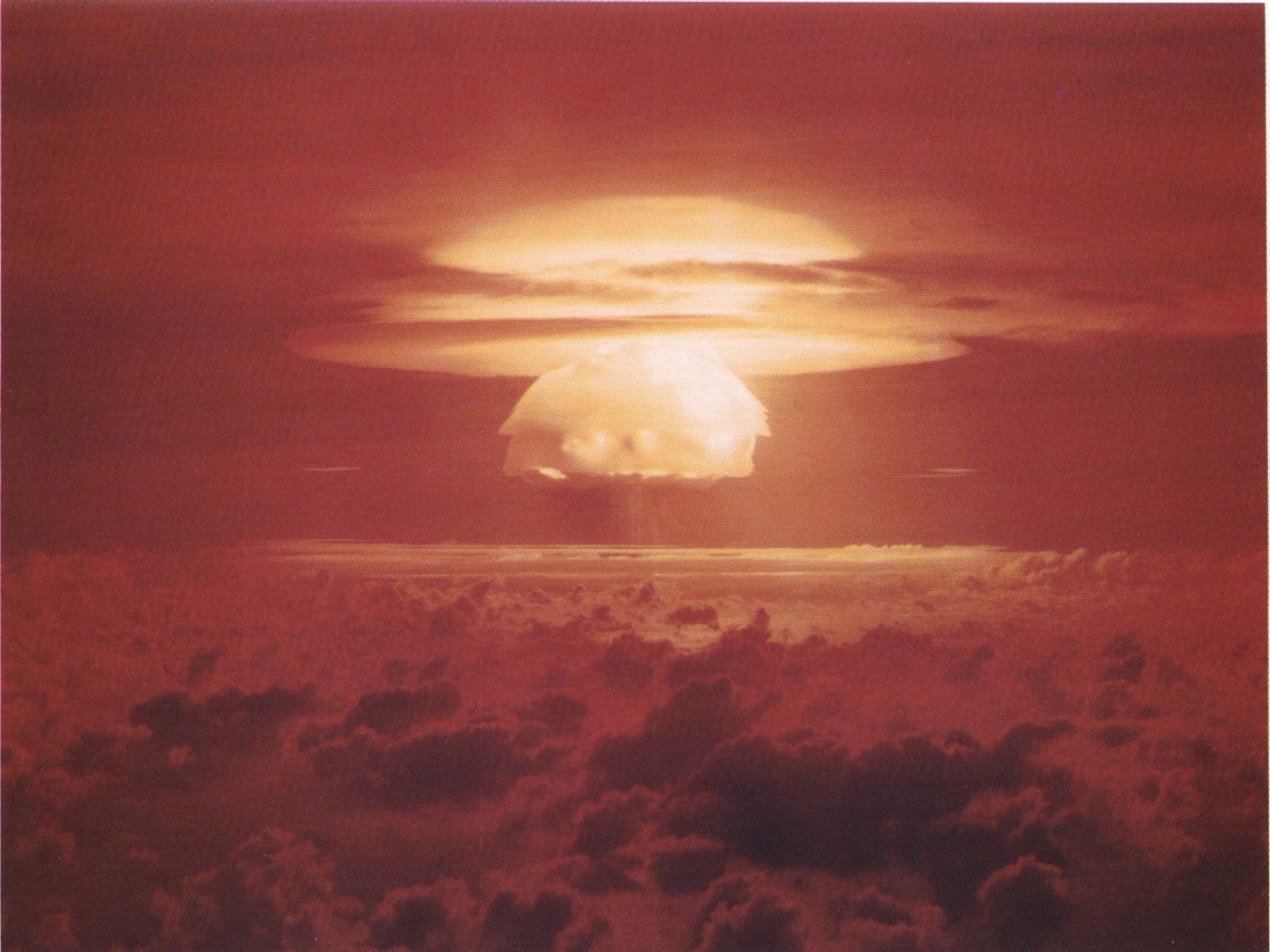
World War III, also known as the Third World War, is a hypothetical future global conflict subsequent to World War I (1914–1918) and World War II (1939–1945). It is widely predicted that such a war would involve all of the great powers, like its two predecessors, and the use of nuclear weapons or other weapons of mass destruction, thereby surpassing all prior conflicts in scale, devastation, and loss of life.
World War III was initially synonymous with the escalation of the Cold War (1947–1991) into conflict between the US-led Western Bloc and Soviet-led Eastern Bloc, though the United States and the Soviet Union never directly engaged. Since the US's development and use of nuclear weapons in the atomic bombings of Hiroshima and Nagasaki at the end of World War II, the risk of a nuclear apocalypse causing widespread destruction and the potential collapse of modern civilization or human extinction has been central in speculation and fiction about World War III. The Soviet Union's development of nuclear weapons in 1949 spurred the nuclear arms race and was followed by several other countries.
Regional proxy wars including the Korean War (1950–1953), Vietnam War (1955–1975), and Soviet–Afghan War (1979–1989), while significant, did not lead to a full-scale global conflict. Such a conflict was planned for by military and civil personnel around the world, with scenarios ranging from conventional warfare to limited or total nuclear warfare. The certainty of escalation from one stage to the next was extensively debated. For example, the Eisenhower administration promulgated a policy of massive retaliation with nuclear forces, to a minor conventional attack. After the Cuban Missile Crisis in 1962, which brought the US and Soviet Union to the brink of war, the strategic doctrine of mutually assured destruction, which held that a full-scale nuclear war would annihilate all parties, became widely accepted. At the 1985 Geneva summit, US and Soviet leaders first jointly stated "a nuclear war cannot be won and must never be fought". Advocates of deterrence theory hold that nuclear weapons prevent World War III–like great power conflict, while advocates of nuclear disarmament hold that their risks far outweigh this.
Since the end of the Cold War in 1991, speculation about World War III have shifted toward emerging threats, including terrorism and cyberwarfare. Great power competition has been renewed between the United States, China, and Russia, sometimes termed a Second Cold War. Various conflicts, most significantly the current phase of the Russo-Ukrainian war (2022–present), the Middle Eastern crisis (2023–present), and rising tensions over the status of Taiwan, have been perceived as flashpoints for World War III.
Etymology
Time magazine
Time magazine was an early adopter, if not originator, of the term "World War III". The first usage appears in its 3 November 1941 issue (preceding the Japanese attack on Pearl Harbor on 7 December 1941) under its "National Affairs" section and entitled "World War III?" about Nazi refugee Hermann Rauschning, who had just arrived in the United States. In its 22 March 1943, issue under its "Foreign News" section, Time reused the same title "World War III?" about statements by then–US Vice President Henry A. Wallace: "We shall decide sometime in 1943 or 1944 ... whether to plant the seeds of World War III." Time continued to entitle with or mention in stories the term "World War III" for the rest of the decade and onwards: 1944, 1945, 1946 ("bacterial warfare"), 1947, and 1948. Time persists in using this term, for example, in a 2015 book review entitled "This Is What World War III Will Look Like".
Military plans
Military strategists have used war games to prepare for various war scenarios and to determine the most appropriate strategies. War games were utilized for World War I and World War II.
Operation Unthinkable
British prime minister Winston Churchill was concerned that, with the enormous size of Soviet Red Army forces deployed in Central and Eastern Europe at the end of World War II and the perceived unreliability of the Soviet leader Joseph Stalin, there was a serious threat to Western Europe. In April–May 1945, the British Armed Forces developed Operation Unthinkable, thought to be the first scenario of the Third World War. Its primary goal was "to impose upon Russia the will of the United States and the British Empire". The plan was rejected by the British Chiefs of Staff Committee as militarily unfeasible.
Operation Dropshot
Operation Dropshot was the 1950s United States contingency plan for a possible nuclear and conventional war with the Soviet Union in the Western European and Asian theaters. Although the scenario made use of nuclear weapons, they were not expected to play a decisive role.
At the time, the US nuclear arsenal was limited in size, based mostly in the United States, and depended on bombers for delivery. Dropshot included mission profiles that would have used 300 nuclear bombs and 29,000 high-explosive bombs on 200 targets in 100 cities and towns to wipe out 85% of the Soviet Union's industrial potential in a single stroke. Between 75 and 100 of the 300 nuclear weapons were targeted to destroy Soviet combat aircraft on the ground.
The scenario was devised before the development of intercontinental ballistic missiles. It was also devised before US president John F. Kennedy and his Secretary of Defense Robert McNamara changed the US Nuclear War plan from the 'city killing' countervalue strike plan to a "counterforce" plan (targeted more at military forces). Nuclear weapons at this time were not accurate enough to hit a naval base without destroying the city adjacent to it, so the aim of using them was to destroy the enemy's industrial capacity to cripple their war economy.
British-Irish cooperation
Ireland started planning for a possible nuclear war in the late 1940s. Co-operation between the United Kingdom and Ireland would be formed in the event of WWIII, where they would share weather data, control aids to navigation, and coordinate the Wartime Broadcasting Service that would occur after a nuclear attack. Operation Sandstone in Ireland was a top-secret British-Irish military operation. The armed forces from both states began a coastal survey of Britain and Ireland cooperating from 1948 to 1955. This was a request from the United States to identify suitable landing grounds for the US in the event of a successful Soviet invasion. By 1953, the co-operation agreed upon sharing information on wartime weather and the evacuation of civilian refugees from Britain to Ireland. Ireland's Operation Sandstone ended in 1966.
Exercises Grand Slam, Longstep, and Mainbrace
In January 1950, the North Atlantic Council approved NATO's military strategy of containment. NATO military planning took on a renewed urgency following the outbreak of the Korean War in the early 1950s, prompting NATO to establish a "force under a centralized command, adequate to deter aggression and to ensure the defense of Western Europe". Allied Command Europe was established under General of the Army Dwight D. Eisenhower, U.S. Army, on 2 April 1951. The Western Union Defence Organization had previously carried out Exercise Verity, a 1949 multilateral exercise involving naval air strikes and submarine attacks.
Exercise Mainbrace brought together 200 ships and over 50,000 personnel to practice the defense of Denmark and Norway from the Soviet attack in 1952. It was the first major NATO exercise. The exercise was jointly commanded by Supreme Allied Commander Atlantic Admiral Lynde D. McCormick, the U.S. Navy, and Supreme Allied Commander Europe General Matthew B. Ridgeway, U.S. Army, during the autumn of 1952. The United States, the United Kingdom, Canada, France, Denmark, Norway, Portugal, Netherlands, and Belgium participated.
Exercises Grand Slam and Longstep were naval exercises held in the Mediterranean Sea during 1952 to practice dislodging an enemy occupying force and amphibious assault. It involved over 170 warships and 700 aircraft under the overall command of Admiral Robert B. Carney. The overall exercise commander, Carney summarized the accomplishments of Exercise Grand Slam by stating: "We have demonstrated that the senior commanders of all four powers can successfully take charge of a mixed task force and handle it effectively as a working unit."
The Soviet Union called the exercises "war-like acts" by NATO, with particular reference to the participation of Norway and Denmark and prepared for its military maneuvers in the Soviet Zone.
Exercise Strikeback
Exercise Strikeback was a major NATO naval exercise held in 1957, simulating a response to an all-out Soviet attack on NATO. The exercise involved over 200 warships, 650 aircraft, and 75,000 personnel from the United States Navy, the United Kingdom's Royal Navy, the Royal Canadian Navy, the French Navy, the Royal Netherlands Navy, and the Royal Norwegian Navy. As the largest peacetime naval operation up to that time, Exercise Strikeback was characterized by military analyst Hanson W. Baldwin of The New York Times as "constituting the strongest striking fleet assembled since World War II".
Content sourced from Wikipedia under CC BY-SA 4.0


