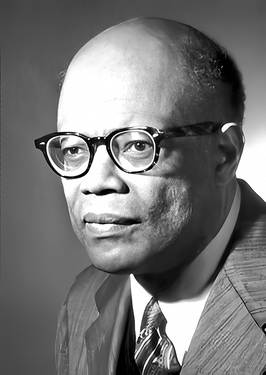
W. Arthur Lewis
Saint Lucian economist and Nobel laureate (1915–1991)
Sir William Arthur Lewis (23 January 1915 – 15 June 1991) was a Saint Lucian economist and the James Madison Professor of Political Economy at Princeton University. Lewis remains the only black person to have won the Nobel Memorial Prize in Economic Sciences.
W. Arthur Lewis was a pioneering development economist, especially famous for his “dual-sector model” of economic development. In his 1954 paper “Economic Development with Unlimited Supplies of Labour,” he described a poor country as having two sectors: a traditional (largely agricultural) sector with surplus labor, and a modern capitalist sector. Lewis showed how surplus labor could be transferred from the traditional sector into the capitalist sector, fueling industrial growth.
Biography
Arthur Lewis was born in Castries, Saint Lucia, then still part of the British Windward Islands federal colony, the fourth of the five sons of George Ferdinand and Ida Lewis (the others being Stanley, Earl, Allen and Victor). His parents had migrated from Antigua shortly after the turn of the century. George Lewis died when Arthur was seven years old and his brothers aged from five to 17, leaving Ida to raise her five children alone. Arthur was a gifted student and was promoted two classes ahead of his age. After finishing school when he was 14 years old, Lewis worked as a clerk, while waiting to be old enough to sit the examination for a government scholarship to a British university, which would be in 1932. During this time he began a lifelong friendship with Eric Williams, the future first prime minister of Trinidad and Tobago.
Lewis's initial career choice was to become an engineer, "but this seemed pointless since neither the government nor the white firms would employ a black engineer," as he later said: "Eventually I decided to study business administration, planning to return to St. Lucia for a job in the municipal service or in private trade. I would simultaneously study law to fall back on if nothing administrative turned up." At the age of 18, he earned the government scholarship to attend the London School of Economics (LSE), becoming the first black individual to gain acceptance there. While enrolled to study for a Bachelor of Commerce degree ("which offered accounting, business management, commercial law and a little economics and statistics") in 1933, he would achieve similar success as he did at grade school. While at LSE, he studied under John Hicks, Arnold Plant, Lionel Robbins, and Friedrich Hayek.
After Lewis graduated in 1937 with first-class honours, LSE gave him a scholarship to read for a PhD in industrial economics, under the supervision of Arnold Plant. Lewis would become the first black faculty member at LSE: in 1938 he was given a teaching appointment, and in 1939 was made an Assistant Lecturer, continuing to work as a member of the LSE staff until 1948.
In 1947, Lewis married Gladys Jacobs, and that year he was selected as a lecturer at the Victoria University of Manchester, and moved there with his family, becoming Britain's first black lecturer. In 1948, at the age of 33, he was made a full professor. He was elected to membership of the Manchester Literary and Philosophical Society in 1948 and he taught at Manchester until 1957. During this period, he developed some of his most important concepts about the patterns of capital and wages in developing countries. He particularly became known for his contributions to development economics, of great interest as former colonies began to gain independence from their European colonizers.
Lewis served as an economic advisor to numerous African and Caribbean governments, including Nigeria, Ghana, Trinidad and Tobago, Jamaica, and Barbados. When Ghana (where in 1929 his eldest brother Stanley had settled) gained independence in 1957, Lewis was appointed as the country's first economic advisor. He helped draw up its first Five-Year Development Plan (1959–1963).
In 1959, Lewis returned to the Caribbean region when appointed Vice Chancellor of the University of the West Indies. He was elected to the American Academy of Arts and Sciences in 1962. In 1963, he was knighted by the British government for his achievements and for his contributions to economics. That year, he was also appointed Professor of Public and International Affairs at Princeton University – the first black instructor to be given a full professorship – and subsequently held the position of James Madison Professor of Political Economics. In 1966, he was elected to the American Philosophical Society. He also served from 1966 to 1973 he served as Chancellor of the University of Guyana. Lewis worked at Princeton for the next two decades, teaching generations of students until his retirement in 1983. Lewis helped to establish the Caribbean Development Bank and in 1970 he was selected as its first president, serving in that capacity until 1973.
Lewis received the Nobel Prize in Economics in 1979, sharing it with Theodore Schultz, "for their pioneering research into economic development research with particular consideration of the problems of developing countries".
Personal life
In 1947, Lewis married Grenada-born Gladys Jacobs, with whom he had two daughters, Elizabeth and Barbara.Following his Nobel award, Lewis remained actively engaged in international economic policy until his final years. He continued to serve as an advisor to governments in Africa and the Caribbean and held a position as a professor at Princeton University until 1983, after which he became a professor emeritus. Lewis passed away on June 15, 1991, in Bridgetown, Barbados, and was buried on the grounds of the St. Lucian community college that bears his name. His personal papers are archived at the Seeley G. Mudd Manuscript Library at Princeton University, providing a valuable resource for scholars studying the history of economic thought and development policy.
Key works
Labour in the West Indies: The Birth of a Workers' Movement (1939)
Labour in the West Indies: The Birth of a Worker's Movement, first published by the Fabian Society in 1939, was an account of the 1930s labour movement in the Caribbean. It remained the only work published on the Caribbean-wide movement and the Labour Rebellions in the English-speaking Caribbean for decades. The book was republished by John La Rose and Sarah White at New Beacon Books in February 1978. Lewis is now characterised as "among the earliest proponents of Reparations for the former West Indies for Britain's colonial wrongs" because of the ideas he put forward in this work.
The "Lewis model"
Lewis published in 1954 what was to be his most influential development economics article, "Economic Development with Unlimited Supplies of Labour" (Manchester School). In this publication, he introduced what came to be called the dual sector model, or the "Lewis model".
Lewis combined an analysis of the historical experience of developed countries with the central ideas of the classical economists to produce a broad picture of the development process. In his theory, a "capitalist" sector develops by taking labour from a non-capitalist backward "subsistence" sector. The subsistence sector is governed by informal institutions and social norms so that producers do not maximize profits and workers can be paid above their marginal product. At an early stage of development, the "unlimited" supply of labour from the subsistence economy means that the capitalist sector can expand for some time without the need to raise wages. This results in higher returns to capital, which are reinvested in capital accumulation. In turn, the increase in the capital stock leads the "capitalists" to expand employment by drawing further labour from the subsistence sector. Given the assumptions of the model (for example, that the profits are reinvested and that capital accumulation does not substitute for skilled labour in production), the process becomes self-sustaining and leads to modernization and economic development.
The point at which the excess labour in the subsistence sector is fully absorbed into the modern sector, and where further capital accumulation begins to push the balance of power towards labour (thus increasing wages) in both capitalist and subsistence sectors, is sometimes called the Lewisian turning point. It has recently been widely discussed in the context of economic development in China. Work building on Lewis's analysis has shown that productivity gains in the areas formerly occupied by the subsistence sector (e.g. agriculture) can offset some of the labour demand.
The Theory of Economic Growth (1955)
In his 1955 book, The Theory of Economic Growth, Lewis sought to "provide an appropriate framework for studying economic development", driven by a combination of "curiosity and of practical need."
Content sourced from Wikipedia under CC BY-SA 4.0


