Virtual reality
Computer-simulated experience
Why this is trending
Interest in “Virtual reality” spiked on Wikipedia on 2026-02-25.
Categorised under Science & Nature, this article fits a familiar pattern. Interest in science articles on Wikipedia often follows major discoveries, published studies, or tech industry news.
By monitoring millions of daily Wikipedia page views, GlyphSignal helps you spot cultural moments as they happen and understand the stories behind the numbers.
Key Takeaways
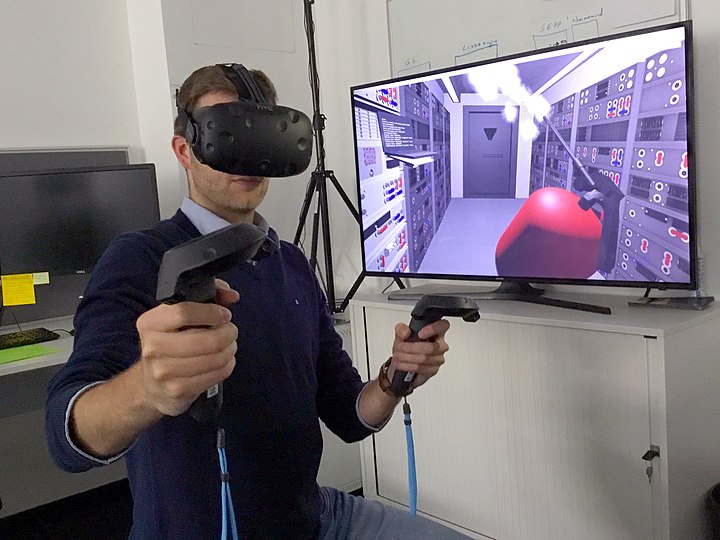
- Virtual reality ( VR ) is a simulated experience that employs 3D head-mounted displays and pose tracking to give the user an immersive feel of a virtual world.
- Currently, standard virtual reality systems use either virtual reality headsets or multi-projected environments to generate some realistic images, sounds, and other sensations that simulate a user's physical presence in a virtual environment.
- The effect is commonly created by VR headsets consisting of a head-mounted display with a small screen in front of the eyes but can also be created through specially designed rooms with multiple large screens.
- VR is one of the key technologies in the reality-virtuality continuum.
- Etymology "Virtual" has had the meaning of "being something in essence or effect, though not actually or in fact" since the mid-1400s.
Virtual reality (VR) is a simulated experience that employs 3D head-mounted displays and pose tracking to give the user an immersive feel of a virtual world. Applications of virtual reality include entertainment (particularly video games), education (such as medical, safety, or military training), research and business (such as virtual meetings).
Currently, standard virtual reality systems use either virtual reality headsets or multi-projected environments to generate some realistic images, sounds, and other sensations that simulate a user's physical presence in a virtual environment. A person using virtual reality equipment is able to look around the artificial world, move around in it, and interact with virtual features or items. The effect is commonly created by VR headsets consisting of a head-mounted display with a small screen in front of the eyes but can also be created through specially designed rooms with multiple large screens. Virtual reality typically incorporates auditory and video feedback but may also allow other types of sensory and force feedback through haptic technology.
VR is one of the key technologies in the reality-virtuality continuum. As such, it is different from other digital visualization solutions, such as augmented virtuality and augmented reality.
Etymology
"Virtual" has had the meaning of "being something in essence or effect, though not actually or in fact" since the mid-1400s. The term "virtual" has been used in the computer sense of "not physically existing but made to appear by software" since 1959.
Content sourced from Wikipedia under CC BY-SA 4.0


