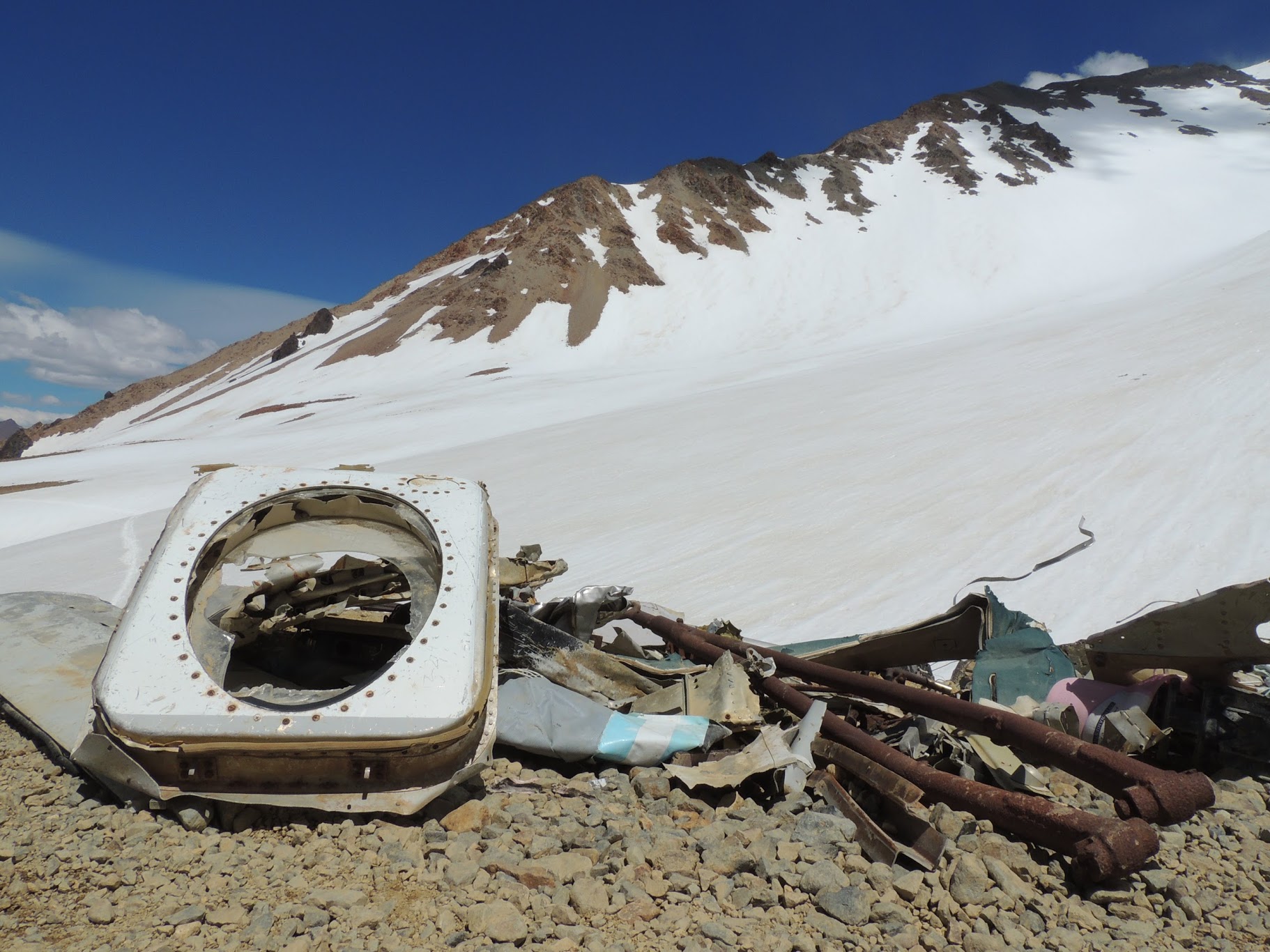
Uruguayan Air Force Flight 571
1972 aviation accident in the Andes mountains of Argentina
Uruguayan Air Force Flight 571 was the chartered flight of a Fairchild FH-227D from Montevideo, Uruguay, to Santiago, Chile, that crashed in the Andes mountains in Argentina on 13 October 1972. The accident and subsequent survival became known as both the Andes flight disaster (Tragedia de los Andes, literally Tragedy of the Andes) and the Miracle of the Andes (Milagro de los Andes).
The inexperienced co-pilot, Lieutenant-Colonel Dante Héctor Lagurara, was piloting the aircraft at the time of the accident. He mistakenly believed the aircraft had overflown Curicó, the turning point to fly north, and began descending towards what he thought was the Pudahuel Airport in Santiago de Chile. He failed to notice that the instrument readings indicated that he was still 60–69 km (37–43 mi) east of Curicó. Lagurara, upon regaining visual flight conditions, saw the mountain and unsuccessfully tried to gain altitude. The aircraft struck a mountain ridge, shearing off both wings and the tail cone. The remaining portion of the fuselage slid down a glacier at an estimated 350 km/h (220 mph), descending 725 metres (2,379 ft) before ramming into an ice and snow mound.
The flight was carrying 45 passengers and crew, including 19 members of the Old Christians Club rugby union team, along with their families, supporters and friends. Three crew members and nine passengers died immediately and several more died soon after due to the frigid temperatures and the severity of their injuries. The crash site is located at an elevation of 3,660 metres (12,020 ft) in the remote Andes mountains of western Argentina, just east of the border with Chile. Search and rescue aircraft overflew the crash site several times during the following days, but failed to see the white fuselage against the snow. Search efforts were called off after eight days of searching.
During the 72 days following the crash, the survivors suffered from extreme hardships, including sub-zero temperatures, exposure, starvation, and an avalanche, which led to the deaths of 13 more passengers. The remaining passengers resorted to eating the flesh of those who died in order to survive. Of the 19 team members on the flight, seven of the rugby players survived the ordeal; 11 players and the team physician perished.
Convinced that they would die if they did not seek help, Nando Parrado, Antonio "Tintin" Vizintín, and Roberto Canessa, set out across the mountains on 12 December. After three days, Tintin was sent back to the fuselage so that Parrado and Canessa could make the food last. After nine days, they spotted Sergio Catalán on horseback, thus ending their trek. On 22 and 23 December 1972, two-and-a-half months after the crash, the remaining 14 survivors were rescued. Their survival made worldwide news.
The story of the "Andes flight disaster" is depicted in the 1993 English-language film Alive and the 2023 Spanish-language film Society of the Snow.
Flight and accident
Flight origin
Members of the amateur Old Christians Club rugby union team from Montevideo, Uruguay, were scheduled to play a match in Santiago, Chile, against the Old Boys Club, an English rugby team. Club president Daniel Juan chartered a Uruguayan Air Force twin turboprop Fairchild FH-227 airplane to fly the team over the Andes mountains to Santiago. The aircraft carried 40 passengers and 5 crew members. The pilot in command, Colonel Julio César Ferradas, was an experienced Air Force pilot with 5,117 hours of flight time. He was accompanied by co-pilot Lieutenant-Colonel Dante Héctor Lagurara. There were ten extra seats, so the team invited friends and family members to accompany them. When someone cancelled at the last minute, Graziela Mariani purchased a ticket so she could attend her oldest daughter's wedding.
The aircraft departed Carrasco International Airport on 12 October 1972, but a storm front over the Andes forced them to spend the night in Mendoza, Argentina, to wait for meteorological conditions to improve. Although there is a direct westerly route from Mendoza to Santiago, the high mountains including Mount Aconcagua at 6,959 metres (22,831 ft) were near the FH-227D's service ceiling of 8,500 metres (28,000 ft). With the aircraft loaded to capacity, this direct route would have required the pilot to fly very carefully to avoid the mountains. Instead, it was customary for turboprops to fly the longer 600-kilometre (370 mi), 90-minute U-shaped route to Malargüe south of Mendoza using the A7 airway (now UW44), then west along the G-17 airway (now UB684), crossing Planchón pass and on to the Curicó radiobeacon in Chile, and from there due north to descend and land in Santiago.
The weather on 13 October affected the flight adversely. On the morning of the flight meteorological conditions over the Andes had yet to improve, but the weather was expected to improve by the early afternoon. The pilot delayed the flight and took off from Mendoza at 2:18 p.m. on Friday 13 October. He flew south towards the Malargüe radiobeacon at flight level 180 (18,000 feet or 5,500 metres). Lagurara radioed their position to Malargüe Airport to inform them that they expected to cross the 2,515 metres (8,251 ft) high Planchón pass at 3:21 p.m. Planchón pass is the air traffic control hand-off point between Chile and Argentina. After crossing the Andes into Chile the aircraft was supposed to turn north and initiate their descent into Pudahuel Airport in Santiago.
The crash
Pilot Ferradas had previously flown across the Andes 29 times. On this flight he was training co-pilot Lagurara, who was at the controls. As they flew above the Andes, clouds obscured the mountains below. The aircraft was four years old with 792 hours on the airframe.
The plane was nicknamed the "lead sled" by pilots because they considered it underpowered. The fuselage of this aircraft and others had been stretched to add a 1.83 metres (6.0 feet) section, increasing passenger capacity from 52 to 56, and making room for more cargo between the cockpit and the passenger cabin. A total of 78 FH-227 aircraft were built, 23 of which eventually crashed. The 1972 Andes flight disaster was the tenth FH-227 crash since the model was introduced in 1966.
At 3:21 p.m., shortly after crossing Planchón pass, Lagurara notified air traffic controllers that he expected to reach Curicó a minute later. While some reports state the co-pilot incorrectly estimated his position using dead reckoning, he was relying on radio navigation.
The flight time from Planchón pass to Curicó is normally 11 minutes, but only three minutes later the co-pilot radioed Santiago that they were overflying Curicó and turning due north. He requested permission from air traffic control to descend. The controller authorized the aircraft to descend to 3,500 metres (11,500 ft), unaware due to lack of radar coverage that the airplane was still flying over the Andes.
The aircraft encountered severe turbulence as it descended. Nando Parrado recalled that the plane rapidly descended several hundred feet out of the clouds. At first the rugby players joked about the turbulence until they saw the aircraft was flying abnormally close to the mountains. "That was probably the moment when the pilots saw the black ridge rising dead ahead."
Roberto Canessa later said he thought the pilot had turned due north too soon and began the descent to Santiago while the aircraft was still flying over the Andes. Then "he began to climb, until the plane was nearly vertical and it began to stall and shake." The aircraft's ground collision alarm sounded and scared all the passengers.
The pilots applied maximum power to gain altitude and climb over the 4,200 metres (13,800 ft) high southern ridge of the glacier's cirque. Witness accounts and evidence at the scene indicated the plane struck the mountain two or three times.
The co-pilot was able to bring the aircraft nose over the ridge, but at 3:34 p.m., the lower part of the tail-cone may have clipped the ridge at 4,200 metres (13,800 ft). The next collision severed the right wing. Some evidence indicates it was thrown back with such force that it may have been the event that tore off the tail-cone. When the tail-cone was sheared off, it took with it the rear part of the aircraft, including two rows of seats, the galley, baggage hold, vertical stabilizer and horizontal stabilizer, leaving a gaping hole in the rear. Three passengers, the navigator and the flight attendant were lost with the tail section.
The aircraft's momentum and its remaining engine carried it forward and upward until a rock outcropping at 4,400 metres (14,400 ft) tore off the left wing. Its propeller sliced through the fuselage. Two more passengers fell out of the gaping hole in the rear. The fuselage crashed onto the snow and careened 725 metres (2,379 ft) down the steep slope of the glacier at 350 km/h (220 mph), rammed into a snow bank and came to a sudden stop. The seats broke loose from the floor and were thrown against the forward bulkhead of the fuselage. The impact crushed the cockpit, pinning both pilots against the instrument panel, killing Ferradas immediately.
The official investigation concluded that the crash was caused by controlled flight into terrain due to pilot error.
Content sourced from Wikipedia under CC BY-SA 4.0


