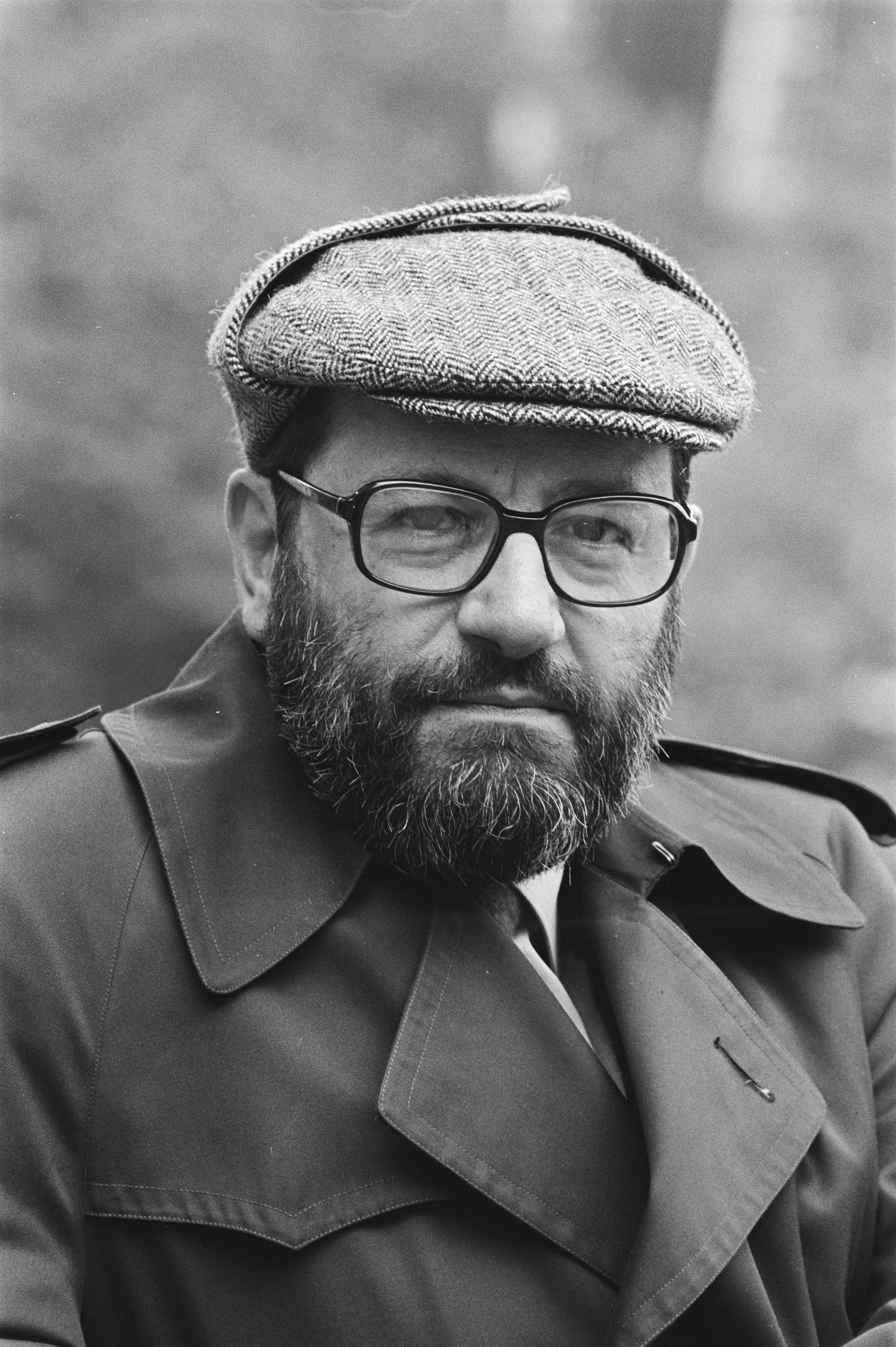
Umberto Eco
Italian semiotician, philosopher and writer (1932–2016)
Umberto Eco (5 January 1932 – 19 February 2016) was an Italian medievalist, philosopher, semiotician, novelist, cultural critic, and political and social commentator. In English, he is best known for his popular 1980 novel The Name of the Rose, a historical mystery combining semiotics in fiction with biblical analysis, medieval studies and literary theory, as well as Foucault's Pendulum, his 1988 novel which touches on similar themes.
Eco wrote prolifically throughout his life, with his output including children's books, translations from French and English, in addition to a twice-monthly newspaper column "La Bustina di Minerva" (Minerva's Matchbook) in the magazine L'Espresso beginning in 1985, with his last column (a critical appraisal of the Romantic paintings of Francesco Hayez) appearing 27 January 2016. At the time of his death, he was an Emeritus professor at the University of Bologna, where he taught for much of his life. In the 21st century, he has continued to gain recognition for his 1995 essay "Ur-Fascism", where Eco lists fourteen general properties he believes comprise fascist ideologies.
Early life and education
Eco was born on 5 January 1932 in the city of Alessandria, in Piedmont in northern Italy. The spread of Italian fascism throughout the region influenced his childhood. At the age of ten, he received the First Provincial Award of Ludi Juveniles after responding positively to the young Italian fascist writing prompt of "Should we die for the glory of Mussolini and the immortal destiny of Italy?" His father, Giulio, one of thirteen children, was an accountant before the government called him to serve in three wars. During World War II, Umberto and his mother, Giovanna (Bisio), moved to a small village in the Piedmontese mountainside. His village was liberated in 1945, and he was exposed to American comic books, the European Resistance, and the Holocaust. Eco received a Salesian education and made references to the order and its founder in his works and interviews.
Towards the end of his life, Eco came to believe that his family name was an acronym of ex caelis oblatus (from Latin: a gift from the heavens). As was the custom at the time, the name had been given to his grandfather (a foundling) by an official in city hall. In a 2011 interview, Eco explained that a friend happened to come across the acronym on a list of Jesuit acronyms in the Vatican Library, informing him of the likely origin of the name.
Umberto's father urged him to become a lawyer, but he entered the University of Turin (UNITO), writing his thesis on the aesthetics of medieval philosopher and theologian Thomas Aquinas under the supervision of Luigi Pareyson, for which he earned his Laurea degree in philosophy in 1954.
Career
Medieval aesthetics and philosophy (1954–1968)
After graduating, Eco worked for the state broadcasting station Radiotelevisione Italiana (RAI) in Milan, producing a variety of cultural programming. Following the publication of his first book in 1956, he became an assistant lecturer at his alma mater. In 1958, Eco left RAI and the University of Turin to complete 18 months of compulsory military service in the Italian Army.
In 1959, following his return to university teaching, Eco was approached by Valentino Bompiani to edit a series on "Idee nuove" (New Ideas) for his eponymous publishing house in Milan. According to the publisher, he became aware of Eco through his short pamphlet of cartoons and verse Filosofi in libertà (Philosophers in Freedom, or Liberated Philosophers), which had originally been published in a limited print run of 550 under the James Joyce-inspired pseudonym Daedalus.
That same year, Eco published his second book, Sviluppo dell'estetica medievale (The Development of Medieval Aesthetics), a scholarly monograph building on his work on Aquinas. Earning his libera docenza in aesthetics in 1961, Eco was promoted to the position of lecturer in the same subject in 1963, before leaving the University of Turin to take a position as lecturer in Architecture at the University of Milan in 1964.
Early writings on semiotics and popular culture (1961–1964)
Among his work for a general audience, in 1961 Eco's short essay "Phenomenology of Mike Bongiorno", a critical analysis of a popular but unrefined quiz show host, appeared as part of a series of articles by Eco on mass media published in the magazine of the tyre manufacturer Pirelli. In it, Eco observed that "[Bongiorno] does not provoke inferiority complexes, despite presenting himself as an idol, and the public acknowledge him, by being grateful to him and loving him. He represents an ideal that nobody need strive to reach because everyone is already at his level." Receiving notoriety among the general public thanks to widespread media coverage, the essay was later included in the collection Diario minimo (1963).
Over this period, Eco began seriously developing his ideas on the "open" text and on semiotics, writing many essays on these subjects. In 1962 he published Opera aperta (translated into English as "The Open Work"). In it, Eco argued that literary texts are fields of meaning, rather than strings of meaning; and that they are understood as open, internally dynamic and psychologically engaged fields. Literature which limits one's potential understanding to a single, unequivocal line, the closed text, remains the least rewarding, while texts which are the most active between mind, society and life (open texts) are the liveliest and best—although valuation terminology was not his primary focus. Eco came to these positions through the study of language and from semiotics, rather than from psychology or historical analysis (as did theorists such as Wolfgang Iser, on the one hand, and Hans Robert Jauss, on the other).
In his 1964 book Apocalittici e integrati, lit. 'The Apocalyptic and the Integrated', Eco continued his exploration of popular culture, analyzing the phenomenon of mass communication from a sociological perspective.
Visual communication and semiological guerrilla warfare (1965–1975)
From 1965 to 1969, he was Professor of Visual Communications at the University of Florence, where he gave the influential lecture "Towards a Semiological Guerrilla Warfare", which coined the influential term "semiological guerrilla", and influenced the theorization of guerrilla tactics against mainstream mass media culture, such as guerrilla television and culture jamming. Among the expressions used in the essay are "communications guerrilla warfare" and "cultural guerrilla". The essay was later included in Eco's book Faith in Fakes.
Eco's approach to semiotics is often referred to as "interpretative semiotics". In his first book-length elaboration, his theory appears in La struttura assente (1968; literally: The Absent Structure).
In 1969 he left to become Professor of Semiotics at Milan Polytechnic, spending his first year as a visiting professor at New York University. In 1971 he took up a position as associate professor at the University of Bologna and spent 1972 as a Fulbright scholar at Northwestern University . Following the publication of A Theory of Semiotics in 1975, he was promoted to Professor of Semiotics at the University of Bologna. That same year, Eco stepped down from his position as senior non-fiction editor at Bompiani.
The Name of the Rose and Foucault's Pendulum (1975–1988)
From 1977 to 1978 Eco was a visiting professor at Yale University and then at Columbia University. He returned to Yale from 1980 to 1981, and Columbia in 1984. During this time he completed The Role of the Reader (1979) and Semiotics and the Philosophy of Language (1984).
Content sourced from Wikipedia under CC BY-SA 4.0


