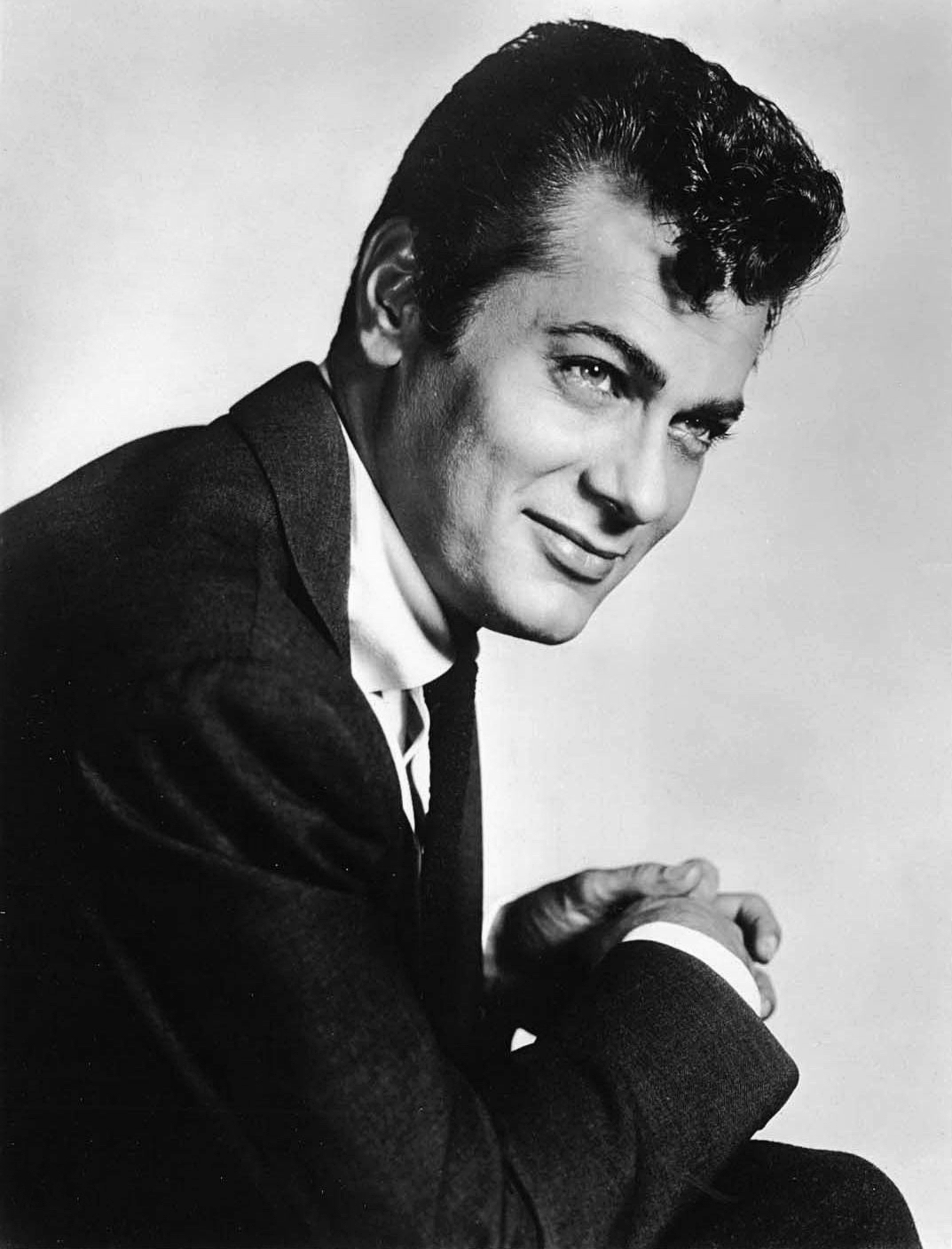
Tony Curtis
American actor (1925–2010)
Tony Curtis (born Bernard Schwartz; June 3, 1925 – September 29, 2010) was an American actor with a career that spanned six decades, achieving the height of his popularity in the 1950s and early 1960s. He acted in more than 100 films, in roles covering a wide range of genres. In his later years, Curtis made numerous television appearances.
He achieved his first major recognition as a dramatic actor in Sweet Smell of Success (1957) with co-star Burt Lancaster. The following year he was nominated for the Academy Award for Best Actor for The Defiant Ones (1958) alongside Sidney Poitier (who was also nominated in the same category). This was followed by the comedies Some Like It Hot and Operation Petticoat in 1959. In 1960, Curtis played a supporting role in the epic historical drama Spartacus.
Curtis's stardom and film career declined considerably after 1960. Subsequently, his most significant dramatic part came in 1968 when he starred in the true-life drama The Boston Strangler. Curtis also took on the role of the Ukrainian Cossack Andrei in the historical action romance epic Taras Bulba in 1962 and starred in the ITC TV series The Persuaders!, playing Danny Wilde, an American millionaire. The series ran for twenty-four episodes.
Curtis married six times and fathered six children. He is the father of the actresses Kelly Curtis and Jamie Lee Curtis with his first wife, actress Janet Leigh, and actresses Allegra Curtis and Alexandra Curtis with his second wife, actress Christine Kaufmann. He had two sons with his third wife, Leslie Allen, one of whom predeceased him. From 1998 until his death, he was married to Jill Vandenberg, a horse trainer.
Early life
Tony Curtis was born Bernard Schwartz on June 3, 1925, at the Fifth Avenue Hospital corner of East 105th Street in East Harlem, Manhattan, the first of three boys born to Helen (née Klein) and Emanuel Schwartz.
His parents were Jewish immigrants from Hungary: his father was born in Ópályi, near Mátészalka, and his mother was a native of Michalovce, now in Slovakia; she later said she arrived in the U.S. from Vaľkovo, Slovakia. He spoke only Hungarian until the age of six, delaying his schooling. His father was a tailor and the family lived in the back of the shop. His mother was later diagnosed with schizophrenia. His youngest brother Robert was institutionalized with the same mental illness.
When Curtis was eight, he and his brother Julius were placed in an orphanage for a month because their parents could not afford to feed them. Four years later, Julius was struck and killed by a truck. Curtis joined a neighborhood gang whose main crimes were truancy and minor pilfering. When Curtis was 11, a friendly neighbor saved him from what he felt would have led to a life of delinquency by sending him to a Boy Scout camp, where he was able to work off his energy and settle down. He attended Seward Park High School, but did not graduate from it until after he returned from the United States Navy, since he previously "had barely learned to read or write in high school and knew no arithmetic." At 16, he had his first small acting part in a school stage play.
Military service
Curtis enlisted in the United States Navy. Inspired by Cary Grant's role in Destination Tokyo and Tyrone Power's in Crash Dive (1943), he joined the Pacific submarine force. Curtis served aboard a submarine tender, the USS Proteus, until the end of the Second World War. On September 2, 1945, Curtis witnessed the Japanese surrender in Tokyo Bay from his ship's signal bridge about a mile away.
Following his discharge from the Navy, Curtis attended City College of New York on the G.I. Bill. He then studied acting at The New School in Greenwich Village under the influential German stage director Erwin Piscator. His contemporaries included Elaine Stritch, Harry Belafonte, Walter Matthau, Beatrice Arthur, and Rod Steiger. While still at college, Curtis was discovered by Joyce Selznick, the notable talent agent, casting director, and niece of film producer David O. Selznick.
Career
In 1948, Curtis arrived in Hollywood at age 23. In his autobiography, Curtis described how by chance he met Jack Warner on the plane to California.
Universal as "Anthony Curtis"
Under contract at Universal Pictures, he changed his name from Bernard Schwartz to Anthony Curtis and met unknown actors Rock Hudson, James Best, Julie Adams and Piper Laurie. The first name was from the novel Anthony Adverse and "Curtis" was from Kurtz, a surname in his mother's family. Although Universal Pictures taught him fencing and riding, Curtis admitted he was initially only interested in girls and money—adding that he was pessimistic regarding his chances of becoming a major star. Curtis's biggest fear was having to return home to the Bronx as a failure:
I was a million-to-one shot, the least likely to succeed. I wasn't low man on the totem pole, I was under the totem pole, in a sewer, tied to a sack.
Curtis's uncredited screen debut came in the crime drama Criss Cross (1949) playing a rumba dancer, dancing with Yvonne de Carlo. The male star was Burt Lancaster who would make a number of films with Curtis.
In his second film, City Across the River (also in 1949), he was credited as "Anthony Curtis" He had four lines in The Lady Gambles (1949) and a bigger part in Johnny Stool Pigeon (1949). He was also in Francis (1950), Woman in Hiding (1950), and I Was a Shoplifter (1950).
He was additionally in three Westerns, Sierra (1950), Winchester '73 (1950), and Kansas Raiders (1951), in which he was billed as "Tony Curtis".
Stardom
Curtis was receiving numerous fan letters, so Universal gave him the starring role in The Prince Who Was a Thief (1951), a swashbuckler set in the Middle East with Piper Laurie. It was a hit at the box office and Curtis was now established.
He followed it up with Flesh and Fury (1952), a boxing movie; No Room for the Groom (1952), a comedy with Laurie directed by Douglas Sirk; and Son of Ali Baba (1952), another film set in the Middle East with Laurie.
Curtis then starred with then-wife Janet Leigh in Houdini (1953), in which Curtis played the title role. His next movies were more "B" fare: All American (1953), as a football player; Forbidden (1953), as a criminal; Beachhead (1954), a war film; Johnny Dark (1954), as a racing car driver; and The Black Shield of Falworth (1954), a medieval swashbuckler with Leigh. They were moderately successful financially, and Curtis was growing in popularity.
Curtis then starred in the musical So This Is Paris in (1955), before appearing in Six Bridges to Cross (1955), as a bank robber; The Purple Mask (1955), as a swashbuckler; and the boxing film The Square Jungle (1955).
Major star
Curtis graduated to larger projects when he was cast as a co-star of Burt Lancaster and Gina Lollobrigida in Hecht-Lancaster Productions' Trapeze (1956). It was one of the biggest hits of the year. Curtis and Leigh formed their own independent film production company, Curtleigh Productions, in early 1955.
Curtis made a Western, The Rawhide Years (1957), was a gambler in Mister Cory (1957) and a cop in The Midnight Story (1957). Lancaster asked for him again, to play scheming press agent Sidney Falco in Sweet Smell of Success (1957), starring and co-produced by Lancaster. The film was a box office disappointment, but Curtis, for the first time in his career, received sensational reviews.
Curtis starred alongside Kirk Douglas and Janet Leigh in The Vikings (1958, produced by Douglas' Bryna Productions), which was a major box office hit. Curtis then co-starred with Frank Sinatra and Natalie Wood in the war movie Kings Go Forth (1958), before starring in The Defiant Ones the following year as a bigoted white escaped convict chained to a black man (played by Sidney Poitier). At the 31st Academy Awards, Curtis was nominated for the Academy Award for Best Actor in a Leading Role for his performance—losing to David Niven in Separate Tables.
Curtis and Janet Leigh then starred in Blake Edwards' The Perfect Furlough (1958). He subsequently co-starred with Jack Lemmon and Marilyn Monroe in Some Like It Hot as well as Cary Grant in Operation Petticoat (1959).
Curtis and Leigh made one more film together Who Was That Lady? (1960), a comedy with Dean Martin. He and Debbie Reynolds then starred in The Rat Race (1960). He then started in a supporting role in Spartacus (1960), before making two biopics: The Great Impostor (1961), directed by Robert Mulligan, playing Ferdinand Waldo Demara; and The Outsider (1961), in which he played war hero Ira Hayes. He returned to epics with Taras Bulba (1962), co starring Yul Brynner and Christine Kaufmann, who became Curtis's second wife.
Content sourced from Wikipedia under CC BY-SA 4.0


