Tidal locking
Situation in which an astronomical object's orbital period matches its rotational period
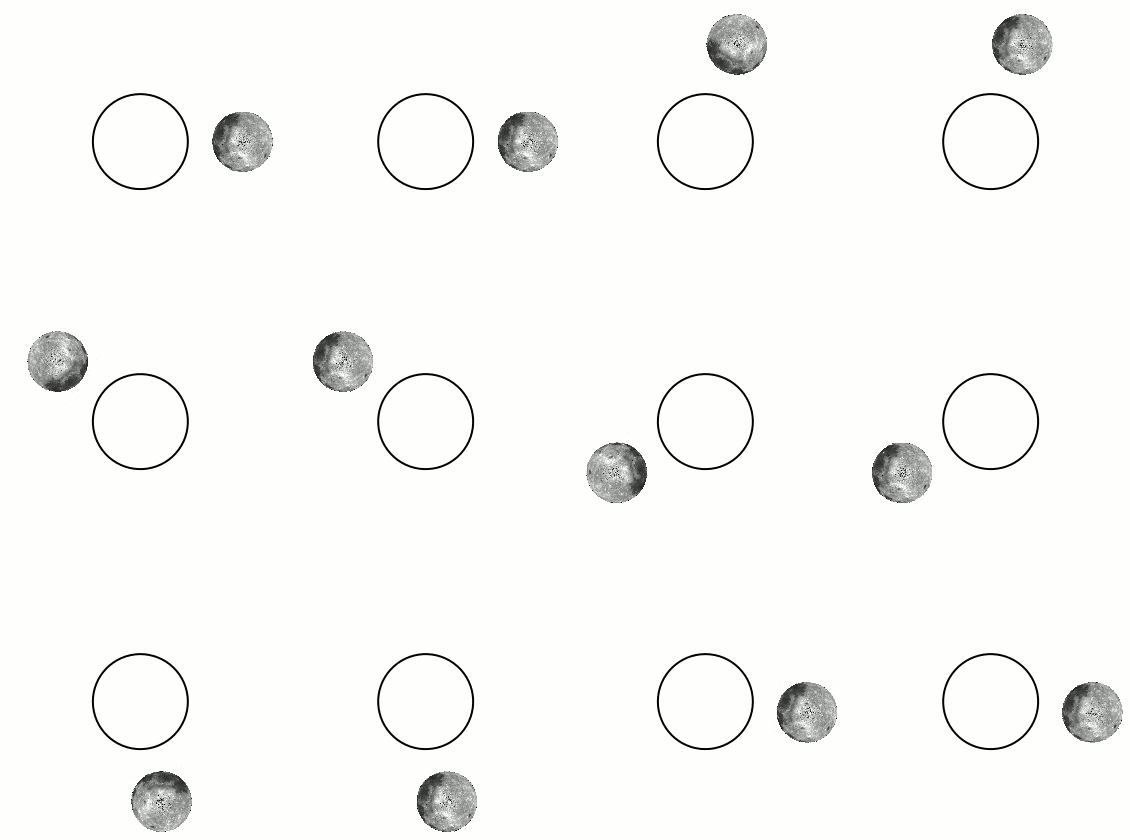
Tidal locking between a pair of co-orbiting astronomical bodies occurs when one of the objects reaches a state where there is no longer any net change in its rotation rate over the course of a complete orbit. In the case where a tidally locked body possesses synchronous rotation, the object takes just as long to rotate around its own axis as it does to revolve around its partner. For example, the same side of the Moon always faces Earth, although there is some variability because the Moon's orbit is not perfectly circular. Usually, only the satellite is tidally locked to the larger body. However, if both the difference in mass between the two bodies and the distance between them are relatively small, each may be tidally locked to the other; this is the case for Pluto and Charon, and for Eris and Dysnomia. Alternative names for the tidal locking process are gravitational locking, captured rotation, and spin–orbit locking.
The effect arises between two bodies when their gravitational interaction slows a body's rotation until it becomes tidally locked. Over many millions of years, the interaction forces changes to their orbits and rotation rates as a result of energy exchange and heat dissipation. When one of the bodies reaches a state where there is no longer any net change in its rotation rate over the course of a complete orbit, it is said to be tidally locked. The object tends to stay in this state because leaving it would require adding energy back into the system. The object's orbit may migrate over time so as to undo the tidal lock, for example, if a giant planet perturbs the object.
There is ambiguity in the use of the terms 'tidally locked' and 'tidal locking', in that some scientific sources use it to refer exclusively to 1:1 synchronous rotation (e.g. the Moon), while others include non-synchronous orbital resonances in which there is no further transfer of angular momentum over the course of one orbit. In Mercury's case, the planet completes three rotations for every two revolutions around the Sun, a 3:2 spin–orbit resonance. In the special case where an orbit is nearly circular and the body's rotation axis is not significantly tilted, such as the Moon, tidal locking results in the same hemisphere of the revolving object constantly facing its partner. Regardless of which definition of tidal locking is used, the hemisphere that is visible changes slightly due to variations in the locked body's orbital velocity and the inclination of its rotation axis over time.
Mechanism
Consider a pair of co-orbiting objects, A and B. The change in rotation rate necessary to tidally lock body B to the larger body A is caused by the torque applied by A's gravity on bulges it has induced on B by tidal forces.
The gravitational force from object A upon B will vary with distance, being greatest at the nearest surface to A and least at the most distant. This creates a gravitational gradient across object B that will distort its equilibrium shape slightly. The body of object B will become elongated along the axis oriented toward A, and conversely, slightly reduced in dimension in directions orthogonal to this axis. The elongated distortions are known as tidal bulges. (For the solid Earth, these bulges can reach displacements of up to around 0.4 m or 1 ft 4 in.) When B is not yet tidally locked, the bulges travel over its surface due to orbital motions, with one of the two "high" tidal bulges traveling close to the point where body A is overhead. For large astronomical bodies that are nearly spherical due to self-gravitation, the tidal distortion produces a slightly prolate spheroid, i.e. an axially symmetric ellipsoid that is elongated along its major axis. Smaller bodies also experience distortion, but this distortion is less regular.
The material of B exerts resistance to this periodic reshaping caused by the tidal force. In effect, some time is required to reshape B to the gravitational equilibrium shape, by which time the forming bulges have already been carried some distance away from the A–B axis by B's rotation. Seen from a vantage point in space, the points of maximum bulge extension are displaced from the axis oriented toward A. If B's rotation period is shorter than its orbital period, the bulges are carried forward of the axis oriented toward A in the direction of rotation, whereas if B's rotation period is longer, the bulges instead lag behind.
Because the bulges are now displaced from the A–B axis, A's gravitational pull on the mass in them exerts a torque on B. The torque on the A-facing bulge acts to bring B's rotation in line with its orbital period, whereas the "back" bulge, which faces away from A, acts in the opposite sense. However, the bulge on the A-facing side is closer to A than the back bulge by a distance of approximately B's diameter, and so experiences a slightly stronger gravitational force and torque. The net resulting torque from both bulges, then, is always in the direction that acts to synchronize B's rotation with its orbital period, leading eventually to tidal locking.
Orbital changes
The angular momentum of the whole A–B system is conserved in this process, so that when B slows down and loses rotational angular momentum, its orbital angular momentum is boosted by a similar amount (there are also some smaller effects on A's rotation). This results in a raising of B's orbit about A in tandem with its rotational slowdown. For the other case where B starts off rotating too slowly, tidal locking both speeds up its rotation, and lowers its orbit.
Locking of the larger body
The tidal locking effect is also experienced by the larger body A, but at a slower rate because B's gravitational effect is weaker due to B's smaller mass. For example, Earth's rotation is gradually being slowed by the Moon, by an amount that becomes noticeable over geological time as revealed in the fossil record. Current estimations are that this (together with the tidal influence of the Sun) has helped lengthen the Earth day from about 6 hours to the current 24 hours (over about 4.5 billion years). Currently, atomic clocks show that Earth's day lengthens, on average, by about 2.3 milliseconds per century. Given enough time, this would create a mutual tidal locking between Earth and the Moon. The length of Earth's day would increase and the length of a lunar month would also increase. Earth's sidereal day would eventually have the same length as the Moon's orbital period, about 47 times the length of the Earth day at present. However, Earth is not expected to become tidally locked to the Moon before the Sun becomes a red giant and engulfs both.
For bodies of similar size the effect may be of comparable size for both, and both may become tidally locked to each other on a much shorter timescale. An example is the dwarf planet Pluto and its satellite Charon. They have already reached a state where Charon is visible from only one hemisphere of Pluto and vice versa.
Eccentric orbits
A widely spread misapprehension is that a tidally locked body permanently turns one side to its host.
For orbits that do not have an eccentricity close to zero, the rotation rate tends to become locked with the orbital speed when the body is at periapsis, which is the point of strongest tidal interaction between the two objects. If the orbiting object has a companion, this third body can cause the rotation rate of the parent object to vary in an oscillatory manner. This interaction can also drive an increase in orbital eccentricity of the orbiting object around the primary – an effect known as eccentricity pumping.
In some cases where the orbit is eccentric and the tidal effect is relatively weak, the smaller body may end up in a so-called spin–orbit resonance, rather than being tidally locked. Here, the ratio of the rotation period of a body to its own orbital period is some simple fraction different from 1:1. A well known case is the rotation of Mercury, which is locked to its own orbit around the Sun in a 3:2 resonance. This results in the rotation speed roughly matching the orbital speed around perihelion.
Many exoplanets (especially the close-in ones) are expected to be in spin–orbit resonances higher than 1:1. A Mercury-like terrestrial planet can, for example, become captured in a 3:2, 2:1, or 5:2 spin–orbit resonance, with the probability of each being dependent on the orbital eccentricity.
Occurrence
Moons
All twenty known moons in the Solar System that are large enough to be round are tidally locked with their primaries, because they orbit very closely and tidal force increases rapidly (as a cubic function) with decreasing distance. On the other hand, most of the irregular outer satellites of the giant planets (e.g. Phoebe), which orbit much farther away than the large well-known moons, are not tidally locked.
Pluto and Charon are an extreme example of a tidal lock. Charon is a relatively large moon in comparison to its primary and also has a very close orbit. This results in Pluto and Charon being mutually tidally locked. Pluto's other moons are not tidally locked; Styx, Nix, Kerberos, and Hydra all rotate chaotically due to the influence of Charon. Similarly, Eris and Dysnomia are mutually tidally locked. Orcus and Vanth might also be mutually tidally locked, but the data is not conclusive.
The tidal locking situation for asteroid moons is largely unknown, but closely orbiting binaries are expected to be tidally locked, as well as contact binaries.
Content sourced from Wikipedia under CC BY-SA 4.0


