The Three Musketeers
1844 novel by Alexandre Dumas
The Three Musketeers (French: Les Trois Mousquetaires) is a French historical adventure novel written and published in 1844 by French author Alexandre Dumas. It is the first of the author's three d'Artagnan Romances. As with some of his other works, he wrote it in collaboration with ghostwriter Auguste Maquet. It is in the swashbuckler genre, which has heroic, chivalrous swordsmen who fight for justice.
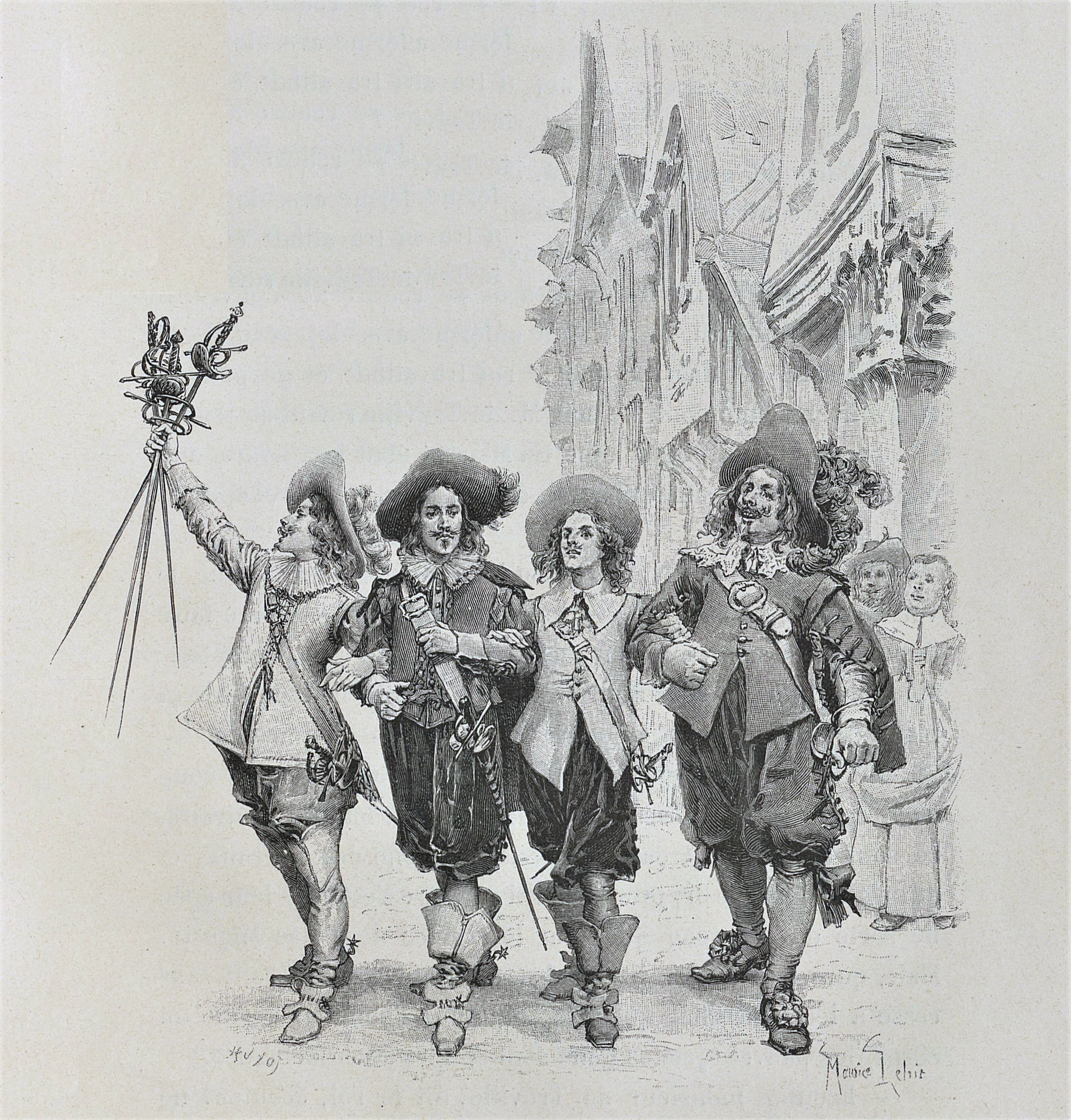
Set between 1625 and 1628, it recounts the adventures of a young man named d'Artagnan (a character based on Charles de Batz-Castelmore d'Artagnan) after he leaves home to travel to Paris, hoping to join the Musketeers of the Guard. Although d'Artagnan is not able to join this elite corps immediately, he is befriended by three of the most formidable musketeers of the age – Athos, Porthos and Aramis, "the three musketeers" or "the three inseparables" – and becomes involved in affairs of state and at court.
The Three Musketeers is primarily a historical and adventure novel. However, Dumas frequently portrays various injustices, abuses and absurdities of the Ancien Régime, giving the novel an additional political significance at the time of its publication, a time when the debate in France between republicans and monarchists was still fierce. The story was first serialised from March to July 1844, during the July Monarchy, four years before the French Revolution of 1848 established the Second Republic.
The story of d'Artagnan is continued in Twenty Years After and The Vicomte of Bragelonne: Ten Years Later.
Origin
Dumas presents his novel as one of a series of recovered manuscripts, turning the origins of his romance into a little drama of its own. In the preface, he tells of being inspired by a scene in Mémoires de Monsieur d'Artagnan (1700), a historical novel by Gatien de Courtilz de Sandras, printed by Pierre Rouge in Amsterdam, which Dumas discovered during his research for his history of Louis XIV. According to Dumas, the incident where d'Artagnan tells of his first visit to M. de Tréville, captain of the Musketeers, and how, in the antechamber, he encountered three young Béarnese with the names Athos, Porthos and Aramis, made such an impression on him that he continued to investigate.
Dumas's account is true up to this point, but is fictionalised from then on, relating how he finally found the names of the three musketeers in a manuscript titled Mémoire de M. le comte de la Fère, etc. Dumas "requested permission" to reprint the manuscript; which was granted:
Now, this is the first part of this precious manuscript which we offer to our readers, restoring it to the title which belongs to it, and entering into an engagement that if (of which we have no doubt) this first part should obtain the success it merits, we will publish the second immediately.
In the meanwhile, since godfathers are second fathers, as it were, we beg the reader to lay to our account and not to that of the Comte de la Fère, the pleasure or the ennui he may experience.
This being understood, let us proceed with our story.
The Three Musketeers was written in collaboration with Auguste Maquet, who also worked with Dumas on its sequels (Twenty Years After and The Vicomte of Bragelonne: Ten Years Later), as well as The Count of Monte Cristo. Maquet would suggest plot outlines after doing historical research; Dumas then expanded the plot, removing some characters, including new ones and imbuing the story with his unmistakable style.
The Three Musketeers was first published in serial form in the newspaper Le Siècle between March and July 1844.
Plot
In 1625 France, D'Artagnan leaves his family in Gascony and travels to Paris to join the Musketeers of the Guard. At a house in Meung-sur-Loire, an older man derides D'Artagnan's horse. Insulted, D'Artagnan demands a duel. The older man's companions instead beat D'Artagnan unconscious with a cooking pot and a tong that breaks his sword. His letter of introduction to Monsieur de Tréville, the commander of the Musketeers, a King's elite regiment, is stolen. D'Artagnan resolves to avenge himself upon the older man, who is actually the Comte de Rochefort, an agent of Cardinal Richelieu, who is passing the latter's orders to his spy, Milady de Winter.
In Paris, D'Artagnan visits Tréville at the Musketeers' headquarters. Without the letter, he faces a lukewarm reception from Tréville. Before their conversation concludes, D'Artagnan sees Rochefort passing in the street through Tréville's window and rushes out of the building to confront him. Pursuing Rochefort, he separately offends three musketeers, Athos, Porthos and Aramis, who each demand satisfaction; D'Artagnan must fight a duel with each of them that afternoon.
As D'Artagnan prepares himself for the first duel, he realizes that Athos's seconds are Porthos and Aramis, who are astonished that the Gascon intends to duel them all. As D'Artagnan and Athos begin, Richelieu's guards appear and attempt to arrest the musketeers for illegal dueling. Offered to leave by the Cardinal's guards, D'Artagnan decides to help the musketeers. Despite being outnumbered four to five, the four men win the battle. D'Artagnan seriously wounds Jussac, one of Richelieu's officers and a renowned fighter. King Louis XIII appoints D'Artagnan to Des Essart's company of the King's Guards, a less prestigious regiment, and gives him forty pistoles.
D'Artagnan hires a servant named Planchet and finds lodgings with Bonacieux, a merchant. His landlord later mentions the kidnapping of his wife, Constance Bonacieux, who works for Queen Anne of France. When she is released, D'Artagnan falls in love at first sight with her. Queen Anne secretly meets the Duke of Buckingham, England's first minister. At the meeting, she gives him a diamond necklace, the King's gift to her, as a keepsake.
Richelieu, who wants to diminish the influence of Queen Anne and her Spanish entourage on French internal affairs, plots to persuade the King that his wife is having an affair with Buckingham. On his advice, the King demands that the Queen wears the diamonds to an upcoming soirée. Constance tries to send her husband to London to fetch the diamonds, but he is instead manipulated by Richelieu and thus does not go, so D'Artagnan and his friends intercede. En route to England, Richelieu's henchmen attack them—Porthos is compelled to fight a duel and is badly wounded, Aramis is shot in an ambush, and Athos is falsely accused of forging money and detained at an inn. Only D'Artagnan and Planchet reach London. Before arriving, D'Artagnan is compelled to assault and nearly to kill Comte de Wardes, a friend of Richelieu, cousin of Rochefort and Milady's love interest. Although Milady stole two of the diamond studs, Buckingham provides replacements while delaying the thief's return to Paris. D'Artagnan thus returns a complete set of jewels to Queen Anne in time to save her honor.
D'Artagnan hopes to begin an affair with the grateful Constance. She writes him a letter asking her to meet him in private, but when he arrives, he sees signs of a struggle and discovers that Rochefort and Bonacieux, acting under the orders of Richelieu, have kidnapped Constance again. D'Artagnan traces his steps back to find his friends whom he abandoned on his way to London. At their meeting, Athos, drunk, tells D'Artagnan a story about a count who fell in love with and married a young woman. Months later, the count discovered that his wife was branded with a fleur-de-lis on her shoulder, a punishment for felony. The count left her to die in a forest with her hands tied, abandoned his family castle and joined the King's guard under another name. D'Artagnan understands that Athos is telling his own story.
In Paris, D'Artagnan meets Milady and recognizes her as one of Richelieu's agents. Nevertheless, he becomes infatuated with her, forgetting Constance, though her maid, Kitty, reveals that Milady is indifferent towards him. Entering her quarters in the dark, he pretends to be Comte de Wardes, whom she invited in a letter that D'Artagnan intercepted and makes love to her. However, D'Artagnan is not satisfied—he wants Milady to love him for who he is. He fakes a rude letter from de Wardes, offending Milady. She asks D'Artagnan to duel and kill the Comte. They make love again, but D'Artagnan's conscience kicks in, and he confesses his trickery. Milady is enraged and in the subsequent scuffle, D'Artagnan discovers a fleur-de-lis branded on her shoulder. Milady attempts to kill D'Artagnan, who eludes her. He later tells Athos that his former wife is alive.
Cardinal Richelieu offers D'Artagnan a career in his guards' ranks. Dreading the prospect of losing his friends, D'Artagnan refuses despite understanding that his career prospects diminish as a result. With their regiments, D'Artagnan and the three musketeers are ordered to the Siege of La Rochelle. There, the four friends survive two assassination attempts by Milady's agents. The would-be assassins die in the process.
Content sourced from Wikipedia under CC BY-SA 4.0


