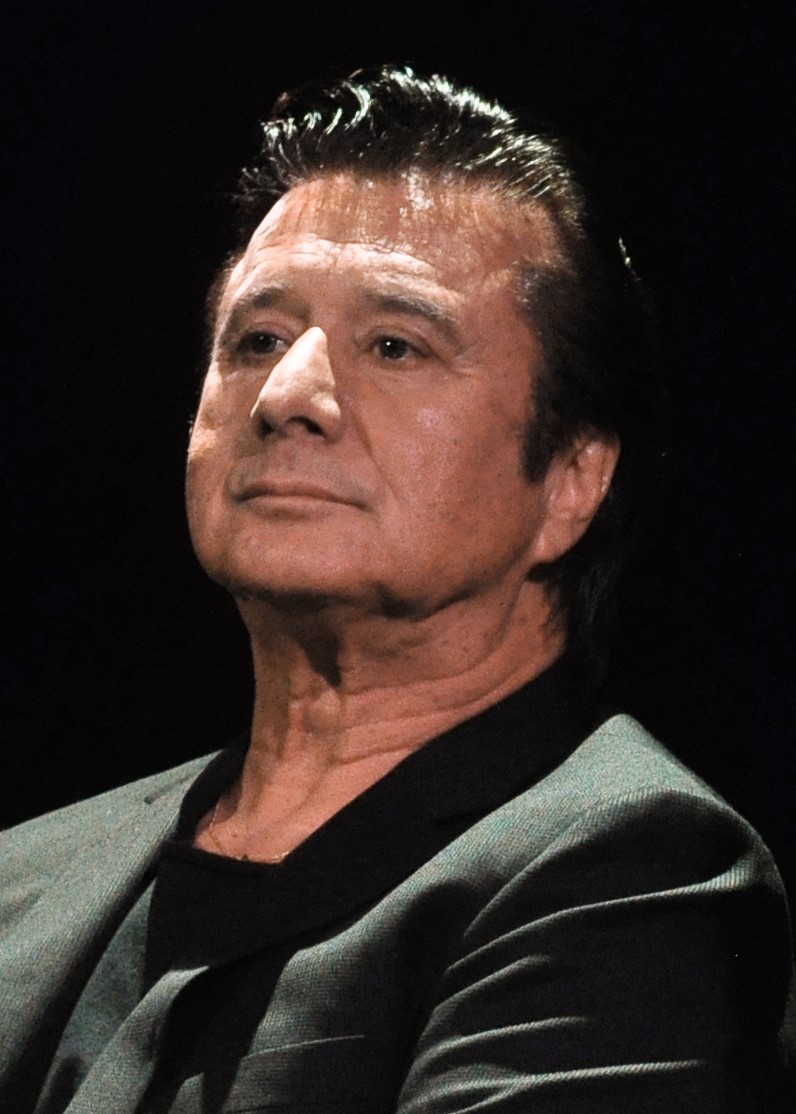
Steve Perry
American singer and songwriter (born 1949)
Stephen Ray Perry (born January 22, 1949) is an American singer and songwriter. He was the lead singer and frontman of the rock band Journey during their most successful years from 1977 to 1987, and again from 1995 to 1998. He wrote/co-wrote several Journey hit songs, including "Any Way You Want It", "Don't Stop Believin'", "Open Arms", "Who's Crying Now" and "Separate Ways (Worlds Apart)". Perry had a successful solo career between the mid-1980s and mid-1990s, made sporadic appearances in the 2000s, and returned to music full-time in 2018.
Perry's singing voice has garnered acclaim from prominent musical peers and publications; he has been dubbed The Voice, a moniker originally coined by Jon Bon Jovi. Ranked No. 76 on Rolling Stone's "100 Greatest Singers of All Time", Perry was inducted into the Rock and Roll Hall of Fame as a member of Journey on April 7, 2017.
In August 2023, Perry made the Billboard list of the 50 greatest rock lead singers of all time, coming in at number 30. At the same time, Billboard readers chose Perry as their favorite rock singer of all time, with 67 percent of the overall votes.
Early life
Stephen Ray Perry was born in Hanford, California to Portuguese parents from the Azores. He is an only child. Perry grew up interested in music, as his father, Raymond Perry (Pereira), was a vocalist and co-owner of radio station KNGS. Perry's parents ended their relationship when he was eight. He and his mother then moved to his grandparents' dairy farm. They lived in Lemoore, where he attended high school.
On Perry's 12th birthday, his mother, Mary Quaresma, presented him with a gold eighth note pendant; Perry wears the pendant for good luck. At age 12, Perry heard Sam Cooke's song "Cupid" on his mother's car radio, and it inspired him to become a singer.
Career
Early career
In his early 20s, Perry moved to Sacramento to start a band, later named Ice, with 16-year-old future music producer Scott Mathews, who co-wrote, played drums and guitar and sang. In 1972, they recorded at the Record Plant studios in Los Angeles by day while Stevie Wonder recorded his Talking Book album by night. Upon returning to Sacramento, Ice disbanded as they had no management, Mathews was still in high school, and the recordings went virtually unheard. In 1975, Perry moved to Thousand Oaks, California, where he formed a progressive rock band called Pieces with Tim Bogert (who had previously worked with Jeff Beck), Denver Cross, and Eddie Tuduri. After a year and a half, the group was unable to secure a record deal and disbanded. Perry also unsuccessfully auditioned to replace Rod Evans in Captain Beyond.
Perry then moved to Banta, a small community near Tracy, California, where he fronted the band Alien Project in his mid-20s. He nearly gave up music when the bassist of that band, Richard Michaels, was killed in an automobile accident.
Journey era
Upon returning to Lemoore, Perry decided not to continue his singing career, but at the urging of his mother, he answered a call from Herbie Herbert, manager of struggling San Francisco-based band Journey. Herbert had been given a demo of an Alien Project song, "If You Need Me, Call Me", and was told by producer Scott Mathews that the young singer would be a great replacement for then-current frontman Robert Fleischman. Fleischman had never signed with Herbert's company (preferring his previous manager) and had not fully coalesced with the band's then progressive rock style. Perry was brought on tour and to avoid alarming Fleischman was referred to as a roadie's Portuguese cousin. During a soundcheck in Long Beach, Perry surreptitiously performed a song with Journey while Fleischman was away from the stage; soon thereafter, Herbert informed the band members that Perry was the new lead singer.
Perry brought a radically new, more pop-influenced style sense to the band's music despite some grumblings from the band's existing members and fans of Journey's progressive rock sound. He made his public debut on October 28, 1977, in San Francisco to a mixed reception. Perry eventually won over new fans on his first album with the group, Infinity, which included "Lights", a single he co-wrote with lead guitarist Neal Schon. The band's style changed dramatically, but as Journey began to garner airplay and media buzz over Infinity, Perry's arrival was fully accepted.
Perry provided lead vocals on nine of Journey's albums: Infinity (1978), Evolution (1979), Departure (1980), Dream, After Dream (1980, a Japanese movie soundtrack), Captured (1980, a live album), Escape (1981, which reached No. 1 on the Billboard Top LPs & Tape chart), Frontiers (1983), Raised on Radio (1986), and Trial By Fire (1996). The single "Open Arms" from Escape was their biggest hit single, charting at No. 2 for six weeks on the Billboard Hot 100.
During his Journey tenure, Perry also sang backing vocals on several Sammy Hagar songs, including the 1980 tracks "The Iceman" (a nickname Hagar had for Scott Mathews) and "Run For Your Life", and duetting with Kenny Loggins on the 1982 No. 17 hit single "Don't Fight It".
In 1984, following the release of Frontiers and the tour supporting this effort, Perry released his first solo album, Street Talk. The album's title was derived from the original name of Perry's earlier band Alien Project. The record sold more than 2 million units, scoring the hit singles "Oh Sherrie", written for his then-girlfriend Sherrie Swafford and which went to No. 3 on the Billboard Hot 100, and "Foolish Heart", which went to No. 18. The music video for "Oh Sherrie" was on heavy rotation on MTV. The songs "She's Mine" and "Strung Out" were also released as singles. The album featured former Alien Project drummer Craig Krampf on a few tracks, guitarist Michael Landau, and future American Idol judge Randy Jackson on bass, among others.
In 1985, Perry was one of 21 singers on the USA for Africa all-star benefit song "We Are the World". He also recorded a song, "If Only for the Moment, Girl" for the We Are the World album. This song was added to the reissue of his album Street Talk. Also during this period, Perry worked with the Irish folk-rock group Clannad on their 1987 album Sirius.
While Perry was reuniting with Journey, his mother became ill. The recording of Raised on Radio, which Perry was producing, was stop-and-go as he frequently returned to the San Joaquin Valley to visit his mother, who died during the production of the album. It took a major toll on Journey to have intermittent recording sessions and a vocalist who was not with the band much of the time. Eventually, Perry became exhausted from the ordeal. Journey then went into hiatus in 1987 after the Raised on Radio tour.
In 1988, Perry began to work on another solo album, Against the Wall, which he ultimately left unfinished, although several of the songs that were recorded for the album would appear on Perry's 1998 solo compilation, Greatest Hits + Five Unreleased). A year later, on April 30, 1989, at the Shoreline Amphitheatre in Mountain View, California, Perry joined Bon Jovi to perform Sam Cooke's "Bring It On Home to Me" and the Four Tops' "Reach Out". He would also reunite with Journey at the Bill Graham tribute concert, "Laughter, Love and Music" on November 3, 1991, at Golden Gate Park in San Francisco, performing "Faithfully" and "Lights". Other than those three events, however, Perry mostly disappeared from the public eye for seven years, taking a break from the music industry.
In 1994, Perry released For the Love of Strange Medicine, his second solo effort. The album was successful, partly due to the Strange Medicine world tour.
Journey's classic 1981–85 lineup reunited in 1996 to record Trial by Fire. The album was a huge success, entering the Billboard charts at No. 3 and going platinum before year's end, but its triumph was short-lived. Before the Trial By Fire tour could begin, Perry suffered a hip injury while hiking in Hawaii and was unable to perform. Perry was diagnosed with a degenerative bone condition and a hip replacement was required, and as he was reluctant to rush into the surgery, Perry wanted to postpone the tour. The remaining members waited until 1998, nearly 17 months after Perry's injury, before making a decision on Journey's future. Growing impatient and realizing the window of opportunity was closing to follow up the success of the Trial By Fire LP with a world tour, Journey members Jonathan Cain and Neal Schon met with Perry. They presented him with an ultimatum: If he did not undergo hip replacement surgery so the tour could proceed upon his recovery, the band would hire a replacement singer. Still hesitant to undergo surgery, and now upset at his bandmates, Perry announced that he was permanently leaving Journey. His lead vocal duties were later taken over by Steve Augeri of Tall Stories. Nearly two years after the initial release of Trial by Fire, Journey began to tour.
Content sourced from Wikipedia under CC BY-SA 4.0


