Spanish flu
1918–1920 global influenza pandemic
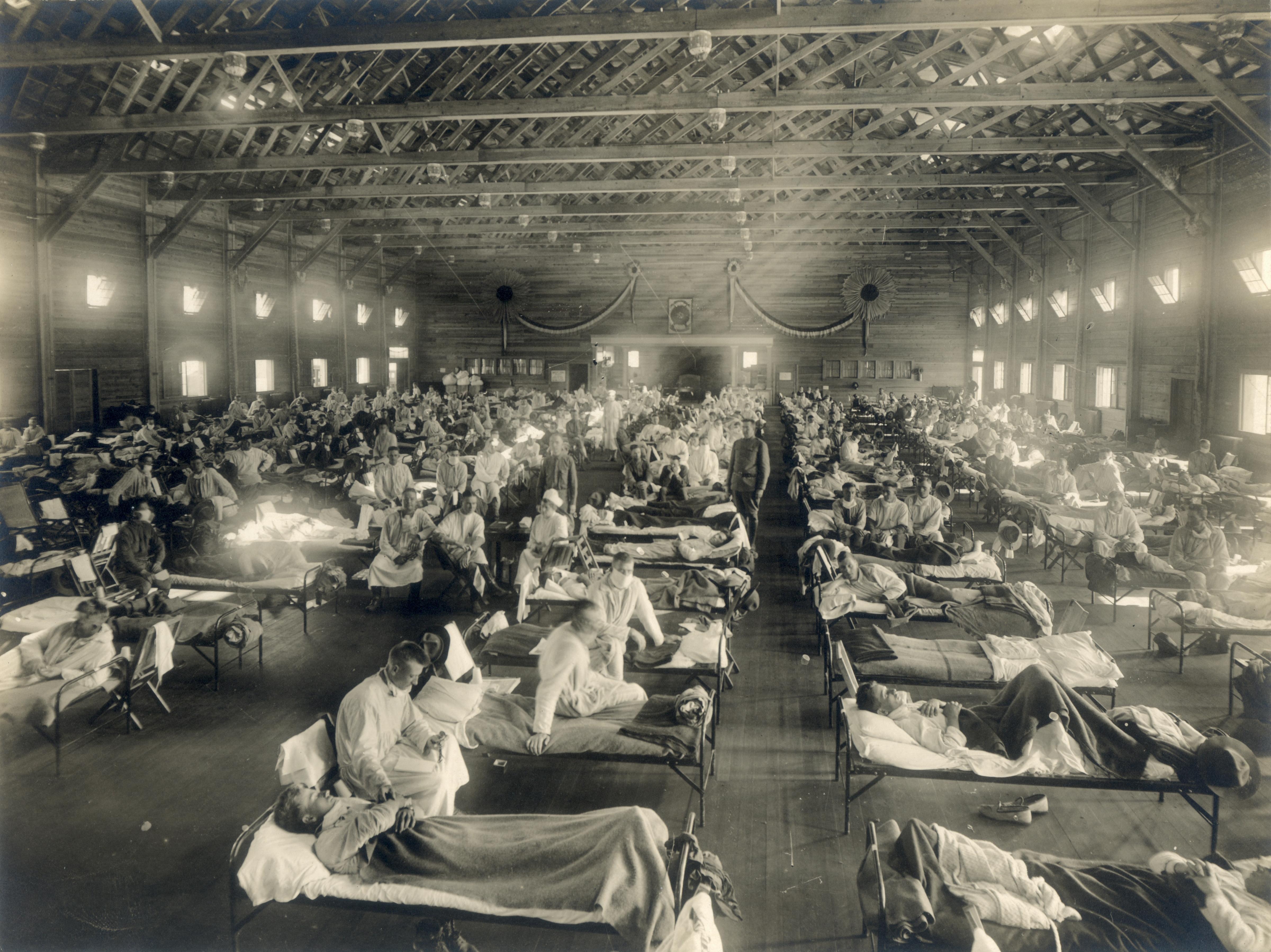
The 1918–1920 flu pandemic, also known as the Great Influenza epidemic or by the common misnomer Spanish flu, was an exceptionally deadly global influenza pandemic caused by the H1N1 subtype of the influenza A virus. The earliest documented case was March 1918 in Haskell County, Kansas, United States, with further cases recorded in France, Germany and the United Kingdom in April. Two years later, nearly a third of the global population, or an estimated 500 million people, had been infected. Estimates of deaths range from 17 million to 50 million, and possibly as high as 100 million, making it one of the deadliest pandemics in history.
The pandemic broke out near the end of World War I, when wartime censors in the belligerent countries suppressed bad news to maintain morale, but newspapers freely reported the outbreak in neutral Spain, creating a false impression of Spain as the epicenter and leading to the "Spanish flu" misnomer. Limited historical epidemiological data make the pandemic's geographic origin indeterminate, with competing hypotheses on the initial spread.
Most influenza outbreaks disproportionately kill the young and old, but this pandemic had unusually high mortality for young adults. Scientists offer several explanations for the high mortality, including a six-year climate anomaly affecting migration of disease vectors with increased likelihood of spread through bodies of water. However, the claim that young adults had a high mortality during the pandemic has been contested. Malnourishment, overcrowded medical camps and hospitals, and poor hygiene, exacerbated by the war, promoted bacterial superinfection, killing most of the victims after a typically prolonged death bed.
Etymologies
This pandemic was known by many different names depending on place, time, and context. The etymology of alternative names historicises the scourge and its effects on people who would only learn years later that viruses caused influenza. The lack of scientific answers led the Sierra Leone Weekly News (Freetown) to suggest a biblical framing in July 1918, using an interrogative from Exodus 16 in ancient Hebrew: "One thing is for certain—the doctors are at present flabbergasted; and we suggest that rather than calling the disease influenza they should for the present until they have it in hand, say Man hu—'What is it?'"
Descriptive names
Outbreaks of influenza-like illness were documented in 1916–17 at British military hospitals in Étaples, France, and just across the English Channel at Aldershot, England. Clinical indications in common with the 1918 pandemic included rapid symptom progression to a "dusky" heliotrope face. This characteristic blue-violet cyanosis in expiring patients led to the name 'purple death'.
The Aldershot physicians later wrote in The Lancet, "the influenza pneumococcal purulent bronchitis we and others described in 1916 and 1917 is fundamentally the same condition as the influenza of this present pandemic." This "purulent bronchitis" is not yet linked to the same A/H1N1 virus, but it may be a precursor.
In 1918, 'epidemic influenza', also known at the time as 'the grip' (French: la grippe, grasp), appeared in Kansas, U.S., during late spring, and early reports from Spain began appearing on 21 May. Reports from both places called it 'three-day fever'.
Associative names
Many alternative names are exonyms in the practice of making new infectious diseases seem foreign. This pattern was observed even before the 1889–1890 pandemic, also known as the 'Russian flu', when the Russians already called epidemic influenza the 'Chinese catarrh', the Germans called it the 'Russian pest', and the Italians called it the 'German disease'. These epithets were re-used in the 1918 pandemic, along with new ones.
'Spanish' influenza
Outside Spain, the disease was soon misnamed 'Spanish influenza'. In a 2 June 1918 The Times of London dispatch titled, "The Spanish Epidemic," a correspondent in Madrid reported over 100,000 victims of, "The unknown disease...clearly of a gripal character," without referring to "Spanish influenza" directly. Three weeks later The Times reported that, "Everybody thinks of it as the 'Spanish' influenza to-day." Three days after that an advertisement appeared in The Times for Formamint tablets to prevent "Spanish influenza". When it reached Moscow, Pravda announced, "Ispánka (the Spanish lady) is in town," making 'the Spanish lady' another common name.
The outbreak did not originate in Spain, but reporting did, due to wartime censorship in belligerent nations. Spain was a neutral country unconcerned with appearances of combat readiness, and without a wartime propaganda machine to prop up morale, so its newspapers freely reported epidemic effects, making Spain the apparent locus of the epidemic. The censorship was so effective that Spain's health officials were unaware its neighboring countries were similarly affected. In an October 1918 "Madrid Letter" to the Journal of the American Medical Association, a Spanish official protested, "we were surprised to learn that the disease was making ravages in other countries, and that people there were calling it the 'Spanish grip'. And wherefore Spanish? ...this epidemic was not born in Spain, and this should be recorded as a historic vindication."
Other exonyms
French press initially used 'American flu', but adopted 'Spanish flu' in lieu of antagonizing an ally. In the spring of 1918, British soldiers called it 'Flanders flu', while German soldiers used 'Flandern-Fieber' (Flemish fever), both after a battlefield in Belgium where many soldiers on both sides fell ill. In Senegal it was named 'Brazilian flu', and in Brazil, 'German flu'. In Spain it was also known as the 'French flu' (gripe francesa), or the 'Naples Soldier' (Soldado de Nápoles), after a popular song from a zarzuela. Spanish flu (gripe española) is now a common name in Spain, but remains controversial there.
Othering derived from geopolitical borders and social boundaries. In Poland it was the 'Bolshevik disease', while in Russia it was referred to it as the 'Kirghiz disease'. Some Africans called it a 'white man's sickness', but in South Africa, white men also used the ethnophaulism 'kaffersiekte' (lit. 'negro disease'). Japan blamed sumo wrestlers for bringing the disease home from Taiwan, calling it 'sumo flu' (Sumo Kaze).
World Health Organization 'best practices' first published in 2015 now aim to prevent social stigma by not associating culturally significant names with new diseases, listing "Spanish flu" under "examples to be avoided". Many authors now eschew calling this the Spanish flu, instead using variations of '1918–19/20 flu/influenza pandemic'.
Local names
Some language endonyms did not name specific regions or groups of people. Examples specific to this pandemic include: Northern Ndebele: 'Malibuzwe' (let enquiries be made concerning it), Swahili: 'Ugonjo huo kichwa na kukohoa na kiuno' (the disease of head and coughing and spine), Yao: 'chipindupindu' (disease from seeking to make a profit in wartime), Otjiherero: 'kaapitohanga' (disease which passes through like a bullet), and Persian: nakhushi-yi bad (disease of the wind).
Other names
This outbreak was also commonly known as the 'great influenza epidemic', after the 'great war', a common name for World War I before World War II. French military doctors originally called it 'disease 11' (maladie onze). German doctors downplayed the severity by calling it 'pseudo influenza' (Greek: pseudo, false), while in Africa, doctors tried to get patients to take it more seriously by calling it 'influenza vera' (Latin: vera, true).
A children's song from the 1889–90 flu pandemic was shortened and adapted into a skipping-rope rhyme popular in 1918. It is a metaphor for the transmissibility of 'Influenza', where that name was clipped to 'Enza':
History
Potential origins
Despite its name, historical and epidemiological data cannot identify the geographic origin of the Spanish flu. However, several theories have been proposed.
United States
The first confirmed cases originated in the United States. Historian Alfred W. Crosby stated in 2003 that the flu originated in Kansas, and author John M. Barry described a January 1918 outbreak in Haskell County, Kansas, as the origin in his 2004 article.
Content sourced from Wikipedia under CC BY-SA 4.0


