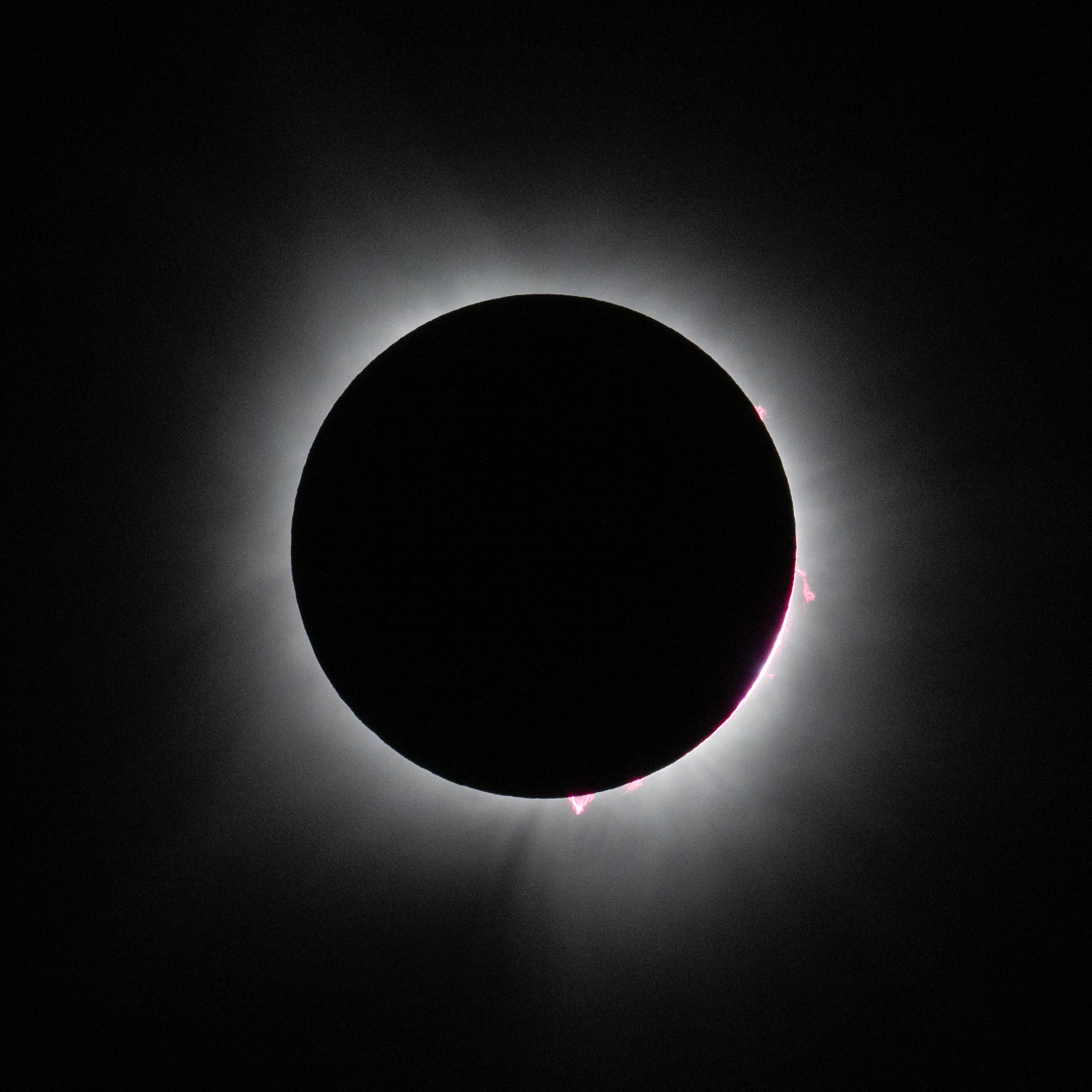
Solar eclipse of April 8, 2024
Total eclipse over North America
The solar eclipse of April 8, 2024, also known as the Great North American Eclipse, was a total solar eclipse visible across a band covering parts of North America, from Mexico to Canada and crossing the contiguous United States. A solar eclipse occurs when the Moon passes between Earth and the Sun, thereby obscuring the Sun. A total solar eclipse occurs when the Moon's apparent diameter is larger than the Sun's, which blocks all direct sunlight and allows some of the Sun's corona and solar prominences to be seen. Totality occurs only in a limited path across Earth's surface, with the partial solar eclipse visible over a larger surrounding region.
During this eclipse, the Moon's apparent diameter was 5.5 percent larger than average as a result of occurring about a day after perigee. With a magnitude of 1.0566, the eclipse's longest duration of totality was 4 minutes and 28 seconds near the Mexican town of Nazas, Durango.
This particular eclipse occurred at the Moon's ascending node of orbit. Totality was visible from 6 Mexican states, 15 U.S. states, and 6 Canadian provinces. Approximately 44 million people lived in the path of totality, including 32 million in the United States, 6 million in Canada, and 6 million in Mexico. The 10 largest cities in the path of totality accounted for a third of this population (5 of the 10 largest cities being in the United States, 3 in Mexico, and 2 in Canada). Adding people who travelled to the path of totality, an estimated 50 million people experienced the total solar eclipse, with at least 20 million people travelling to areas within the path of totality in the US alone. Meanwhile, about 652 million people experienced a partial solar eclipse.
This eclipse was the first total solar eclipse visible from Canada since August 1, 2008, and from the provinces since February 26, 1979. It was the first over Mexico since July 11, 1991. It was also the first over the United States since August 21, 2017. This is the only solar eclipse in the 21st century with totality visible from all three countries. The next total solar eclipse in the US will be on March 30, 2033, which will pass over Alaska. The next total eclipse in the contiguous United States of the US will be on August 23, 2044. The next total eclipse of similar width will take place on August 12, 2045, which will traverse coast-to-coast in a trajectory similar to the 2017 eclipse.
General path of shadow
The totality of the solar eclipse was visible in a strip beginning in the Pacific Ocean, the edge of which passed approximately 60 kilometers north of Penrhyn atoll, 115 kilometers south of Starbuck Island, 275 kilometers north of Vostok Island, and 370 kilometers north of the Marquesas Islands. Later, the total solar eclipse was visible from North America, starting from the west coast of Mexico then ascending in a northeasterly direction through Mexico, the United States, and Canada, before ending in the Atlantic Ocean about 700 kilometers southwest of Ireland.
Visibility in the Americas
Mexico
Totality first passed over the Revillagigedo Islands (a federal possession of Mexico and associated with Colima state) and Islas Marías of Nayarit. Upon reaching the continental mainland, totality passed through the states of Sinaloa (including Mazatlán), northern Nayarit, Durango (including the city of Durango and Gómez Palacio), extreme southeast Chihuahua, and Coahuila (including Torreón, Matamoros, Monclova, Sabinas, Ciudad Acuña, and Piedras Negras). A partial eclipse was visible across the remainder of the country, including 79% coverage of the solar disc in Mexico City. Torreón was the most populous Mexican city in the path of totality.
United States
In the United States, totality was visible through the states of Texas (including parts of San Antonio, Austin, Fort Worth, and all of Arlington, Dallas, Killeen, Temple, Texarkana, Tyler, Sulphur Springs, and Waco); Oklahoma (including Idabel and Broken Bow); Arkansas (including Morrilton/Petit Jean, Hot Springs, Searcy, Jonesboro, and Little Rock); Missouri (including Cape Girardeau and Poplar Bluff); Tennessee (extreme northwestern corner of Lake County); Illinois (including Carbondale, where it intersected the path of the 2017 eclipse); Kentucky; Indiana (including Bloomington, Evansville, Indianapolis, Anderson, Muncie, Terre Haute, and Vincennes); Ohio (including Akron, Cleveland, Dayton, Lima, Lorain,Toledo, and Warren); Michigan (extreme southeastern corner of Monroe County); Pennsylvania (including Erie); Upstate New York (including Buffalo, Niagara Falls, Rochester, Syracuse, Watertown, the Adirondacks, Potsdam, and Plattsburgh); northern Vermont (including Burlington); New Hampshire; and Maine; with the line of totality going almost directly over the state's highest point Mount Katahdin. The largest city that was entirely in the path was Dallas, Texas. It was the second total eclipse visible from the central United States in just seven years, after the eclipse of August 21, 2017. It was the last total solar eclipse visible in the contiguous United States until August 23, 2044.
A partial solar eclipse was visible in all of the other parts of the contiguous United States, Hawaii, and southeast Alaska (Alaska Panhandle).
Delta Air Lines scheduled two special eclipse-following flights: one from Austin to Detroit on a large-window A220-300, and one from Dallas to Detroit. Various other flights in the path of totality also avoided cloud cover entirely.
Canada
In Canada, totality was visible through parts of Southern Ontario (including Leamington, Fort Erie, Hamilton, Niagara Falls, Kingston, Prince Edward County, and Cornwall), parts of southern Quebec (including Montreal, Sherbrooke, Saint-Georges, and Lac-Mégantic), central New Brunswick (including Fredericton, Woodstock and Miramichi), western Prince Edward Island (including Tignish and Summerside), the northern tip of Cape Breton Island, Nova Scotia, and central Newfoundland (including Gander and Grand Falls-Windsor). Then, it ended on the eastern Atlantic coast of Newfoundland. The most populous Canadian city that the path of totality intersected was Montreal. Windsor, London, Toronto, and Ottawa lay just north of the path of totality, and Moncton just south of it.
A partial solar eclipse was visible in all of the other parts of Canada, except the western part of Yukon and the western tip of the Northwest Territories.
Boat cruises to observe the eclipse were conducted on Lake Erie, Niagara River, Lake Ontario, and Saint Lawrence River.
Central America and South America
The partial eclipse was seen in all Central American countries, from Belize to Panama, all the Greater Antilles (Cuba, Dominican Republic, Haiti, Puerto Rico, and Jamaica), and northern South America (Colombia).
Largest cities and recommended viewing sites
Space.com identified the ten largest cities where totality was visible. In population order, they were:
Astronomy magazine provided a list of 20 recommended viewing sites, based on factors such as proximity to the center line, population size, ease of access, and so on. They were ordered from west to east:
Visibility in other continents
Europe
A partial eclipse passed over Svalbard (Norway), Iceland, Ireland, western parts of the United Kingdom, north-western parts of Spain and Portugal, the Azores, and the Canary Islands. Cloud cover prevented views of it from most of the British Isles, although it was seen in Western Scotland. Unusually, this eclipse extended below the horizon, where the greatest phase was observed at mid-nautical twilight in Galicia (Spain) and the beginning of astronomical twilight in Nouvelle-Aquitaine (France). The extension of the eclipse path within the twilight zone created what was likely the best observation window for the 12P/Pons–Brooks comet located closely to Jupiter.
Oceania
The partial eclipse was seen in Hawaii, eastern Kiribati (the eastern Phoenix Islands and the whole Line Islands), Tokelau, American Samoa except for its extreme western part, the Cook Islands, French Polynesia, and the Pitcairn Islands. Although all located east of the 180th meridian, the local time of the eclipse in Kiribati and Tokelau was Tuesday, April 9, 2024, because either UTC+13 or UTC+14 is observed in these areas.
Total eclipse timing
Characteristics
Magnitude
The magnitude of an eclipse, or the ratio of the angular diameter of the Moon to the angular diameter of the Sun, must be one or greater for a total eclipse to occur. The Moon was near perigee (the closest point in its orbit to Earth) during this eclipse. Occurring only about 24 hours after perigee (on April 7, 2024, at 18:50 UTC), the Moon's apparent diameter was larger. The Sun had an angular diameter of 31'56" at the moment of greatest eclipse. As the magnitude of this eclipse at that time was 1.0566, the angular diameter of the Moon was 1.0566 times that of the Sun, or 33'44". This gave the eclipse a wider path of totality and more maximum time in totality (4 min 28 s) compared to the total eclipse in 2017 (2 min 40 s), which had a magnitude of 1.0306.
Content sourced from Wikipedia under CC BY-SA 4.0


