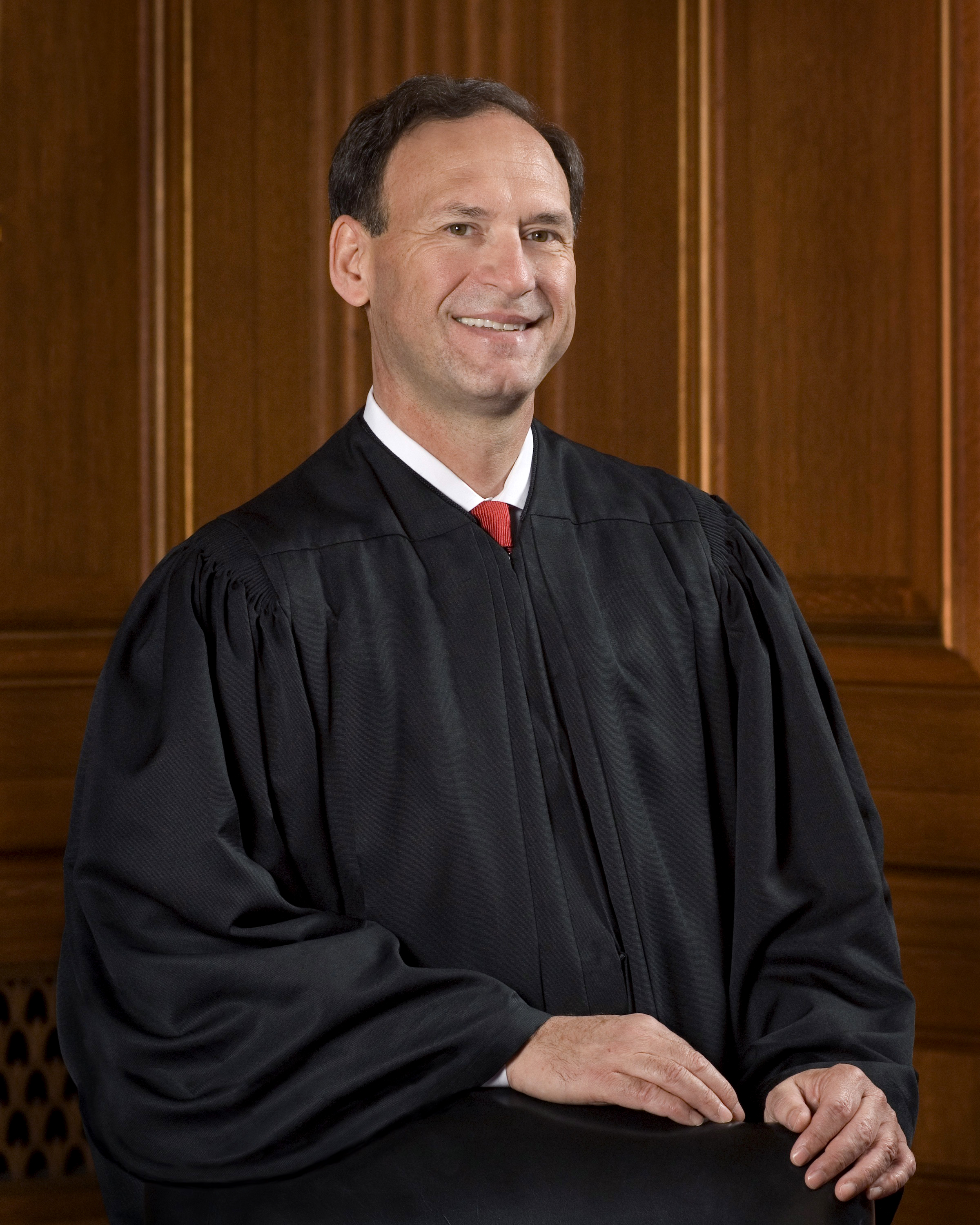
Samuel Alito
US Supreme Court justice since 2006
Samuel Anthony Alito Jr. ( ə-LEE-toh; born April 1, 1950) is an American jurist who serves as an associate justice of the Supreme Court of the United States. He was nominated to the high court by President George W. Bush on October 31, 2005, and has served on it since January 31, 2006. After Antonin Scalia, Alito is the second Italian American justice to serve on the U.S. Supreme Court.
Alito was raised in Hamilton Township, New Jersey, and graduated from Princeton University and Yale Law School. After law school, he worked as an assistant attorney general for the Office of Legal Counsel and served as the U.S. attorney for the District of New Jersey. In 1990, Alito was appointed as a judge on the U.S. Court of Appeals for the Third Circuit, where he served until joining the Supreme Court. He has called himself a "practical originalist" and is a member of the Supreme Court's conservative bloc.
Alito has written majority opinions in the landmark cases McDonald v. Chicago (2010) on firearm rights, Burwell v. Hobby Lobby (2014) on insurance coverage, Janus v. AFSCME (2018) on public-sector union security agreements, and Dobbs v. Jackson Women's Health Organization (2022) on abortion.
Early life and education
Alito was born in Trenton, New Jersey. He was the son of Samuel A. Alito Sr., a Calabrian immigrant from Roccella Ionica, Calabria, and Rose Fradusco, an Italian-American whose parents came from Palazzo San Gervasio in Basilicata. Alito's father earned a master's degree at Rutgers University and was a high school teacher and later the first director of the New Jersey Office of Legislative Services, a state government position he held from 1952 to 1984. Alito's mother was a schoolteacher.
Alito grew up in Hamilton Township, New Jersey, a suburb of Trenton. He attended Steinert High School, where he graduated in 1968 as the class valedictorian, subsequently matriculating at Princeton University. In 1972, he graduated with a Bachelor of Arts, summa cum laude, from the Woodrow Wilson School of Public and International Affairs. His senior thesis, supervised by political scientist Walter F. Murphy, was entitled "An Introduction to the Italian Constitutional Court".
At Princeton, Alito chaired a student conference in 1971 called "The Boundaries of Privacy in American Society", which supported curbs on domestic intelligence gathering and anticipated the need for a statute and a court to oversee national security surveillance. The conference report itself also called for the decriminalization of sodomy, and urged an end to discrimination against gay people in hiring. Alito also led the American Whig-Cliosophic Society's Debate Panel during his time at Princeton. He avoided Princeton's eating clubs, joining Stevenson Hall instead.
In December 1969, while a sophomore at Princeton, Alito received a low lottery number of 32 in the Selective Service drawing. He became a member of the school's Army ROTC program. Alito was commissioned a second lieutenant in the United States Army Reserve in 1972. He began his military duty after graduating from law school in 1975 and served on active duty from September to December while attending the Signal Officer Basic Course at Fort Gordon, Georgia. Alito was promoted to first lieutenant and captain, and completed his service obligation as a member of the inactive reserve before being honorably discharged in 1980.
Among the members of the American Whig–Cliosophic Society, Alito was "almost alone" in his familiarity with the writings of John Marshall Harlan II and was much influenced by the course on constitutional interpretation taught by Walter F. Murphy, also his faculty adviser. During his senior year at Princeton, Alito moved out of New Jersey for the first time to study in Italy, where he wrote his thesis on the Italian legal system. Graduating in 1972, Alito left a sign of his aspirations in his yearbook, which said that he hoped to "eventually warm a seat on the Supreme Court".
Alito then attended Yale Law School, where he served as an editor of the Yale Law Journal and earned a Juris Doctor in 1975.
Early legal career
After graduating from law school, Alito clerked for Third Circuit appeals judge Leonard I. Garth in Newark, New Jersey, in 1976 and 1977. He interviewed with Supreme Court Justice Byron White for a clerkship but was not hired. Between 1977 and 1981, Alito was Assistant United States Attorney, District of New Jersey. There, he served under the then-chief of the appeals division Assistant U.S. Attorney, Maryanne Trump Barry (Barry, the eldest sister of Donald Trump, later became a federal judge). While an Assistant U.S. Attorney for New Jersey, he prosecuted many cases involving drug trafficking and organized crime.
From 1981 to 1985, Alito was Assistant to U.S. Solicitor General Rex E. Lee. In that capacity he argued 12 cases before the Supreme Court for the federal government. In Thornburgh v. American College of Obstetricians & Gynecologists (1986), the Supreme Court ruled against Charles Fried after he rejected a memo by Alito urging the Solicitor General to avoid directly attacking the constitutional right to an abortion. Alito lost only two of the cases he argued before the Supreme Court.
From 1985 to 1987, Alito was Deputy Assistant Attorney General under Charles J. Cooper in the Office of Legal Counsel during the tenure of Attorney General Edwin Meese. John F. Manning worked under Alito there. Between 1986 and 1987, Alito authored nearly 470 pages of memoranda, in which he argued for expanding his client's law enforcement and personnel authorities. In his 1985 application for Deputy Assistant Attorney General, Alito espoused conservative views, naming William F. Buckley, Jr., the National Review, Alexander Bickel, and Barry Goldwater's 1964 presidential campaign as major influences. He also expressed concern about Warren Court decisions in the areas of criminal procedure, the Establishment Clause, and reapportionment.
From 1987 to 1990, Alito was the United States Attorney for the District of New Jersey. When he arrived, the office had begun the prosecution of 20 defendants accused of being mob affiliates of Anthony Accetturo. In August 1988, the two-year trial, then the longest federal criminal trial in history, ended in the acquittal of all 20 after less than two days of jury deliberations. Alito soon hired Michael Chertoff as his chief deputy.
After an FBI agent was shot in the line of duty in 1988, Alito personally handled the trial, assigning himself the then-novice Stuart Rabner as an assistant, and securing the shooter's conviction. In March 1988, Alito sought a rehearing of extradition proceedings against two Indian men, represented by Ron Kuby, who were accused of being terrorist assassins, after Alito discovered that the death threats his prosecutor, Judy G. Russell, had received had been sent to her by herself. The prosecutor was later found not guilty of obstruction of justice by reason of insanity, after psychiatrists found she may have suffered from schizophrenia, with up to four distinct personalities. In 1989, Alito prosecuted a member of the Japanese Red Army for planning a terrorist bombing in Manhattan.
Alito is a member of the Federalist Society, a group of conservative and libertarian lawyers and legal students interested in conservative legal theory.
Court of Appeals judge
Nomination and confirmation
Third Circuit Judges Leonard I. Garth, for whom Alito clerked, and Maryanne Trump Barry, under whom Alito worked as an assistant U.S. Attorney, recommended Alito's judicial nomination to President George H. W. Bush. On February 20, 1990, Bush nominated Alito to the United States Court of Appeals for the Third Circuit, to a seat vacated by John Joseph Gibbons. The American Bar Association rated Alito "Well Qualified" at the time of his nomination. He was confirmed by unanimous consent in the Senate on April 27, 1990, and received his commission three days later. As a Third Circuit judge, his chambers were in Newark, New Jersey.
Content sourced from Wikipedia under CC BY-SA 4.0


