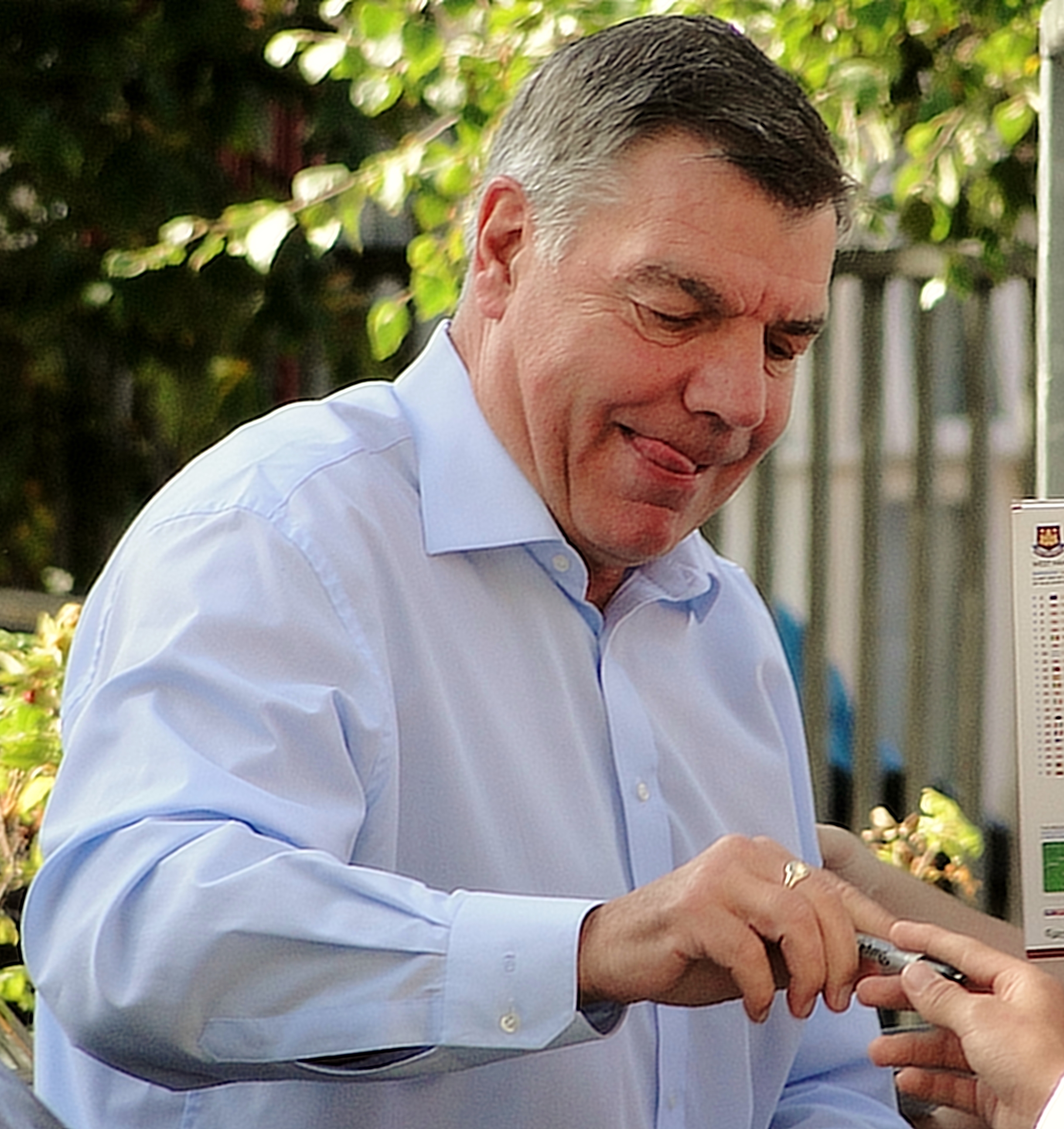
Sam Allardyce
English footballer and manager (born 1954)
Samuel Allardyce (born 19 October 1954) is an English football manager and former professional player. Allardyce made 578 league and cup appearances in a 21-year career spent mostly in the Football League, as well as brief spells in the North American Soccer League and League of Ireland. He was signed by Bolton Wanderers from Dudley Town in 1969 and spent nine years at Bolton, helping the club to win the Second Division title in 1977–78. He spent the 1980s as a journeyman player, spending time with Sunderland, Millwall, Tampa Bay Rowdies, Coventry City, Huddersfield Town, Bolton Wanderers (for a second spell), Preston North End, and West Bromwich Albion (also working as assistant manager). During this time, he helped Preston win promotion out of the Fourth Division in 1986–87.
Moving into management, he took charge of Irish club Limerick in 1991, leading the club to the League of Ireland First Division (second tier) title in 1991–92. He returned to England as a youth coach at Preston North End and served briefly as caretaker-manager. He took up his first permanent management role in England at Blackpool in July 1994 but was dismissed after two years, having narrowly failed to achieve promotion. He spent January 1997 to October 1999 in charge at Notts County, taking them to the Third Division title in 1997–98. He then returned to Bolton Wanderers as manager, leading the club to promotion out of the First Division via the play-offs in 2001, as well as a League Cup final and UEFA Cup qualification on two occasions.
Following a spell at Newcastle United from May 2007 to January 2008, Allardyce managed Blackburn Rovers for two years from December 2008. He was appointed West Ham United manager in June 2011, leading the club to promotion out of the Championship via the play-offs in 2012 before leaving West Ham in May 2015 after criticism from fans over his playing style. He was appointed Sunderland manager in October 2015, saving the club from relegation. He was appointed as manager of the England national team for a brief spell in July 2016 before taking charge at Crystal Palace five months later. After helping Palace avoid relegation that season, he resigned in May 2017. He has since had spells as manager at Everton from 2017 to 2018, West Bromwich Albion from 2020 to 2021, and Leeds United in May 2023.
Some analysts have labelled Allardyce a long ball manager, though he has disputed this perception as "totally and utterly wrong". He takes a modern technology—and statistics-centred approach to tactics and coaching and has been praised for his organizational and man-management skills. Allardyce has faced allegations of misconduct in two separate undercover media investigations, though he denied wrongdoing and was ultimately not charged in either case. In September 2006, he and his son, Craig, were implicated in a BBC Panorama documentary for taking bribes, allegations which they denied. In September 2016, undercover Daily Telegraph reporters posing as businessmen recorded him offering to help them to get around FA third party ownership rules and provisionally agreeing a £400,000 contract. Following the Daily Telegraph investigation, Allardyce resigned as England manager in a mutual agreement with the Football Association on 27 September.
Early life
Samuel Allardyce was born in October 1954 on the Old Park Farm Estate, Dudley, the son of Robert Allardyce (27 April 1916 – 23 August 1989) and Mary Agnes Maxwell Allardyce née Duff (7 June 1918 – 3 July 1991). His father was a police sergeant. Both parents originated from Scotland: his father from Nairn and his mother from Dumfries. He has an older sister, Mary, born in Scotland in 1939, and an older brother, Robert Junior, born in 1951. Allardyce was educated at Sycamore Green Primary School and later at Mons Hill School, having been unsuccessful in his Eleven-plus exam. He discovered in later life that he has dyslexia. As a child, he supported Wolverhampton Wanderers and dreamed that one day he would play at and manage the club.
Club career
Bolton Wanderers
Allardyce spent his youth with semi-professional side Dudley Town, making his debut at 14. He quickly learned how to play centre-half in the highly physical West Midlands (Regional) League. He trained with local Football League clubs West Bromwich Albion and Wolverhampton Wanderers. He had an unsuccessful trial with Aston Villa. He was spotted by Bolton Wanderers just before leaving school at the age of 15 and signed an apprenticeship with the club. To supplement his income before officially starting his apprenticeship he worked in a factory producing record decks. The Bolton under-18s were very successful, winning the Lancashire Youth Cup and reaching the quarter-finals of the FA Youth Cup, and Allardyce quickly rose through the B-team into the A-team. He signed his first professional contract on his 17th birthday, receiving a £125 signing on fee and wages of £14 a week.
Manager Jimmy Armfield gave Allardyce his debut for the "Trotters" on 6 November 1973, in a 2–1 League Cup defeat to Millwall at Burnden Park. He made his Second Division debut eleven days later, in a 2–1 defeat to Notts County. However he failed to establish himself in the first team under Armfield, and only got a run of games under new manager Ian Greaves, who played Allardyce in the last ten games of the 1974–75 season after he sold Don McAllister to Tottenham Hotspur. He impressed during this short run, winning himself the club's Young Player of the Year award.
Bolton lost to Newcastle United after two replays in the FA Cup Fifth Round in the 1975–76 season, and went on to miss out on promotion out of the league by a single point. They were similarly disappointed in the 1976–77 campaign, reaching the semi-finals of the League Cup, and again finished just one point outside the promotion places. Allardyce played alongside Paul Jones at centre-half, and a scouting report for England manager Don Revie in 1977 described Allardyce and Jones as "one of the best central defensive pairings in the Football League." Despite this, however, he was never called up to the England team. Promotion was finally achieved in the 1977–78 season, as Bolton returned to the First Division as champions of the Second Division. Bolton consolidated their top-flight status with a 17th-place finish in 1978–79. However the 1979–80 season proved difficult, and manager Greaves was dismissed as the club went seven months without a league victory, whilst his replacement Stan Anderson was unable to steer the club away from relegation and a last-place finish. Allardyce decided to leave Bolton at the end of the season as he felt that he was underpaid at Bolton and did not get on with Anderson.
Sunderland and Millwall
Allardyce was offered a contract by Norwich City manager John Bond. The offer was bettered by Colin Addison at Derby County, and he verbally agreed a three-year contract with Derby. However, before signing the contract, he received a late offer from Ken Knighton to play for Sunderland on a £300 a week contract with a £20,000 signing on fee – which more than quadrupled his wage at Bolton. Allardyce signed for Sunderland on 1 July 1980 for £150,000. Knighton appointed him as club captain. However, Allardyce soon wearied of the long-distance travel from Sunderland to his home in Bolton, and put in a transfer request when chairman Tom Cowie refused to help finance the purchase of a home in Sunderland. Cowie dismissed Knighton late in the 1980–81 season, leaving caretaker manager Mick Docherty in charge to steer the club out of the First Division relegation zone. New manager Alan Durban left Allardyce out of the team at the start of the 1981–82 campaign, leaving Allardyce's departure from Roker Park inevitable.
He was offered the chance to return to Bolton Wanderers, but manager George Mulhall was only able to offer 50% of Allardyce's wages at Sunderland. Instead he made a surprise £95,000 move to Third Division side Millwall, who were able to match Sunderland's wages and also pay out a £30,000 signing on fee and a £10,000 loyalty bonus. Millwall player-manager Peter Anderson had seen Allardyce as the successor to long-serving central defender Barry Kitchener, and as Anderson was also a property developer he allowed Allardyce to live rent free in a six-bedroom mansion. The "Lions" ended the 1981–82 season in mid-table, and Anderson was dismissed in November 1982. Chairman Alan Thorne offered Allardyce the vacant management position, but Allardyce rejected the offer as he felt that at aged 28 he was far too young to enter management. Instead it was George Graham who took up his first management position, and Graham immediately froze Allardyce out of the first team on both matchdays and training after Allardyce insisted that he would not report teammates who broke Graham's rules. He came close to joining Charlton Athletic on a free transfer in March 1983, but Charlton boss Lennie Lawrence did not complete the move before the end of the transfer deadline. Graham agreed to pay Allardyce £15,000 to cancel his contract, acting under the assumption that Allardyce would struggle to find a club willing to offer him £300 a week.
Content sourced from Wikipedia under CC BY-SA 4.0


