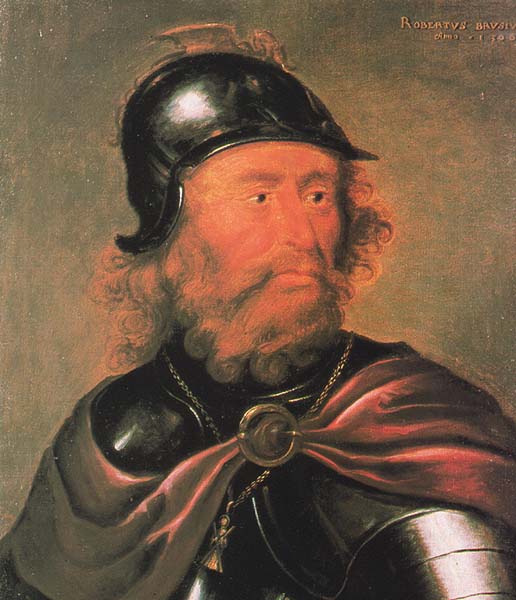
Robert the Bruce
King of Scotland from 1306 to 1329
Robert I (11 July 1274 – 7 June 1329), popularly known as Robert the Bruce (Scottish Gaelic: Raibeart am Brusach), was King of Scots from 1306 until his death in 1329. Robert led Scotland during the First War of Scottish Independence against England. He fought successfully during his reign to restore Scotland to an independent kingdom and is regarded in Scotland as a national hero. Robert was a fourth-great-grandson of King David I, and his grandfather, Robert de Brus, 5th Lord of Annandale, was one of the claimants to the Scottish throne during the "Great Cause".
As Earl of Carrick, Robert the Bruce supported his family's claim to the Scottish throne and took part in William Wallace's campaign against Edward I of England. Appointed in 1298 as a Guardian of Scotland alongside his chief rival for the throne, John Comyn of Badenoch, and William Lamberton, Bishop of St Andrews, Robert resigned in 1300 because of his quarrels with Comyn and the apparently imminent restoration of John Balliol to the Scottish throne. After submitting to Edward I in 1302 and returning to "the king's peace", Robert inherited his family's claim to the Scottish throne upon his father's death.
Bruce's involvement in John Comyn's murder in February 1306 led to his excommunication by Pope Clement V (although he received absolution from Robert Wishart, Bishop of Glasgow). Bruce moved quickly to seize the throne and was crowned king of Scots on 25 March 1306. Edward I's forces defeated Robert in the Battle of Methven, forcing him to flee into hiding, before re-emerging in 1307 to defeat an English army at Loudoun Hill and wage a highly successful guerrilla war against the English.
Robert I defeated his other opponents, destroying their strongholds and devastating their lands, and in 1309 held his first parliament. A series of military victories between 1310 and 1314 won him control of much of Scotland, and at the Battle of Bannockburn in 1314, Robert defeated a much larger English army under Edward II of England, confirming the re-establishment of an independent Scottish kingdom. The battle marked a significant turning point, with Robert's armies now free to launch devastating raids throughout northern England, while he also expanded the war against England by sending armies to invade Ireland, and appealed to the Irish to rise against Edward II's rule.
Despite Bannockburn and the capture of the final English stronghold at Berwick in 1318, Edward II refused to renounce his claim to the overlordship of Scotland. In 1320, the Scottish nobility submitted the Declaration of Arbroath to Pope John XXII, declaring Robert as their rightful monarch and asserting Scotland's status as an independent kingdom. In 1324, the Pope recognised Robert I as king of an independent Scotland, and in 1326, the Franco-Scottish alliance was renewed in the Treaty of Corbeil. In 1327, the English deposed Edward II in favour of his son, Edward III, and peace was concluded between Scotland and England with the Treaty of Edinburgh–Northampton in 1328, by which Edward III renounced all claims to sovereignty over Scotland.
Robert I died in June 1329 and was succeeded by his son, David II. Robert's body is buried in Dunfermline Abbey, while his heart was interred in Melrose Abbey, and his internal organs were embalmed and placed in St Serf's Church, Dumbarton.
Early life (1274–1292)
Birth
Robert the Bruce was born on 11 July 1274. His place of birth is not known for certain. It most likely was Turnberry Castle in Ayrshire, the head of his mother's earldom, despite claims that he may have been born in Lochmaben in Dumfriesshire, or Writtle in Essex. Robert de Brus, 1st Lord of Annandale, the first of the Bruce (de Brus) line, had settled in Scotland during the reign of King David I, and was granted the Lordship of Annandale in 1124. The future king was one of ten children, and the eldest son, of Robert de Brus, 6th Lord of Annandale, and Marjorie, Countess of Carrick. From his mother, he inherited the Earldom of Carrick, and through his father, the Lordship of Annandale and a royal lineage as a fourth great-grandson of David I that would give him a claim to the Scottish throne. In addition to the lordship of Annandale, the Bruces also held lands in Aberdeenshire and Dundee, and substantial estates in England (in Cumberland, County Durham, Essex, Middlesex, Northumberland and Yorkshire) and in County Antrim in Ireland.
Childhood
Very little is known of his youth. He was probably brought up in a mixture of the Anglo-Norman culture of northern England and south-eastern Scotland, and the Gaelic culture of southwest Scotland and most of Scotland north of the River Forth. Annandale was thoroughly feudalised, and the form of Northern Middle English that would later develop into the Scots language was spoken throughout the region. Carrick was historically an integral part of Galloway, and though the earls of Carrick had achieved some feudalisation, the society of Carrick at the end of the thirteenth century remained emphatically Celtic and Gaelic speaking.
Robert the Bruce would most probably have become trilingual at an early age. He would have been schooled to speak, read and possibly write in the Anglo-Norman language of his Scots-Norman peers and the Scoto-Norman portion of his family. He would also have spoken both the Gaelic language of his Carrick birthplace and his mother's family and the early Scots language. As the heir to a considerable estate and a pious layman, Robert would also have been given working knowledge of Latin, the language of charter lordship, liturgy and prayer. This would have afforded Robert and his brothers access to basic education in the law, politics, scripture, saints' Lives (vitae), philosophy, history and chivalric instruction and romance.
Barbour reported that Robert read aloud to his band of supporters in 1306, reciting from memory tales from a twelfth-century romance of Charlemagne, Fierabras, as well as relating examples from history such as Hannibal's defiance of Rome.
As king, Robert certainly commissioned verse to commemorate Bannockburn and his subjects' military deeds. Contemporary chroniclers Jean Le Bel and Thomas Grey would both assert that they had read a history of his reign 'commissioned by King Robert himself.' In his last years, Robert would pay for Dominican friars to tutor his son, David, for whom he would also purchase books. A parliamentary briefing document of c. 1364 would also assert that Robert 'used continually to read, or have read in his presence, the histories of ancient kings and princes, and how they conducted themselves in their times, both in wartime and in peacetime; from these he derived information about aspects of his own rule.'
Tutors for the young Robert and his brothers were most likely drawn from unbeneficed clergy or mendicant friars associated with the churches patronised by their family. However, as growing noble youths, outdoor pursuits and great events would also have held a strong fascination for Robert and his brothers. They would have had masters drawn from their parents' household to school them in the arts of horsemanship, swordsmanship, the joust, hunting and perhaps aspects of courtly behaviour, including dress, protocol, speech, table etiquette, music and dance, some of which may have been learned before the age of ten while serving as pages in their father's or grandfather's household.
As many of these personal and leadership skills were bound up within a code of chivalry, Robert's chief tutor was surely a reputable, experienced knight, drawn from his grandfather's crusade retinue. This grandfather, known to contemporaries as Robert the Noble, and to history as "Bruce the Competitor", seems to have been an immense influence on the future king. Robert's later performance in war certainly underlines his skills in tactics and single combat.
The family would have moved between the castles of their lordships – Lochmaben Castle, the main castle of the lordship of Annandale, and Turnberry and Loch Doon Castle, the castles of the earldom of Carrick. A significant and profound part of the childhood experience of Robert, Edward and possibly the other Bruce brothers (Neil, Thomas and Alexander), was also gained through the Gaelic tradition of being fostered to allied Gaelic kindreds – a traditional practice in Carrick, southwest and western Scotland, the Hebrides and Ireland.
There were a number of Carrick, Ayrshire, Hebridean and Irish families and kindreds affiliated with the Bruces who might have performed such a service (Robert's foster brother is referred to by Barbour as sharing Robert's precarious existence as an outlaw in Carrick in 1307–1308). This Gaelic influence has been cited as a possible explanation for Robert the Bruce's apparent affinity for "hobelar" warfare, using smaller sturdy ponies in mounted raids, as well as for sea-power, ranging from oared war-galleys ("birlinns") to boats.
Content sourced from Wikipedia under CC BY-SA 4.0


