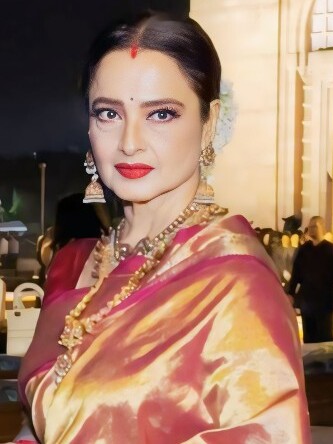
Rekha
Indian actress (born 1954)
Bhanurekha Ganesan (pronounced [ˈbʱaːnuɾeːkʰa ɡaɳeːʃan]; born 10 October 1954), better known by her mononymous stage name Rekha, is an Indian actress who appears predominantly in Hindi films. Acknowledged as one of the finest actresses in Indian cinema, she has starred in more than 200 films and is the recipient of several accolades, including one National Film Award and three Filmfare Awards. She has often played strong and complicated female characters, from fictional to literary, in both mainstream and independent films. Though her career has gone through certain periods of decline, Rekha has gained a reputation for reinventing herself numerous times and has been credited for her ability to sustain her status. In 2010, the Government of India honoured her with Padma Shri, India's fourth highest civilian honour.
The daughter of actors Pushpavalli and Gemini Ganesan, Rekha started her career as a child actress in Telugu films Inti Guttu (1958) and Rangula Ratnam (1966). Her first film as a lead happened with the Kannada movie Operation Jackpot Nalli C.I.D 999 (1969). Her Hindi debut with Sawan Bhadon (1970) established her as a rising star, but despite the success of several of her early films, she was often panned in the press for her looks and weight. Motivated by criticism, she started working on her appearance and put effort into improving her acting technique and command of the Hindi language, resulting in a well-publicised transformation. Early recognition in 1978 for her performances in Ghar and Muqaddar Ka Sikandar marked the beginning of the most successful period of her career, and she was one of Hindi cinema's leading stars through most of the 1980s and early 1990s.
For her performance in the comedy Khubsoorat (1980), Rekha received her first Filmfare Award for Best Actress. She followed it with roles in Baseraa (1981), Ek Hi Bhool (1981), Jeevan Dhaara (1982) and Agar Tum Na Hote (1983). While mostly prolific in popular Hindi cinema, during this time she ventured into parallel cinema, a movement of neo-realist arthouse films. These films included dramas such as Kalyug (1981), Vijeta (1982) and Utsav (1984), and her portrayal of a classical courtesan in Umrao Jaan (1981) won her the National Film Award for Best Actress. After a short setback in the mid-1980s, she was among the actresses who led a new trend of women-centred revenge films, starting with Khoon Bhari Maang (1988), for which she won a second Best Actress award at Filmfare.
Rekha's work was much less prolific in subsequent decades. Her roles in early 1990s mostly met with lukewarm reviews. In 1996, she played against type in the role of an underworld don in the action thriller Khiladiyon Ka Khiladi (1996), for which she won a third Filmfare Award in the Best Supporting Actress category, and further appeared in Kama Sutra: A Tale of Love (1996) and Aastha: In the Prison of Spring (1997) to critical acclaim but some public scrutiny. During the 2000s, she was praised for her supporting roles in the 2001 dramas Zubeidaa and Lajja, and started playing mother roles, among which was her role in the science fiction Koi... Mil Gaya (2003) and its superhero sequel Krrish (2006), both commercial successes. The lattermost emerged as her highest-grossing release.
Apart from acting, Rekha served as a Member of Parliament for the Rajya Sabha from 2012 to 2018. Her private life and public image have been the subject of frequent media interest and discussion. Starting in the 1970s, her pairing opposite Amitabh Bachchan in a number of successful films was accompanied by enduring speculation about a love affair between the two, culminating in their starring film Silsila (1981), which was reflective of media projections. Her only marriage to the Delhi-based industrialist and television manufacturer Mukesh Agarwal in March 1990 ended seven months later when he died by suicide. Rekha's public image has often been tied to her perceived sex appeal. She is often reluctant to give interviews or discuss her life, which has resulted in her being labelled a recluse.
Early life and work
Rekha was born Bhanurekha Ganesan in Madras (present-day Chennai) on 10 October 1954 to South Indian actors Gemini Ganesan and Pushpavalli, when the couple were unmarried. Ganesan was already married to T. R. "Bobjima" Alamelu and had four children: the Illinois-based radiation oncologist Revathi Swaminathan, the gynecologist Kamala Selvaraj, The Times of India's journalist Narayani Ganesan, and the medical doctor Jaya Shreedhar. He had two more children with actress Savitri—Vijaya Chamundeswari, a fitness expert, and Sathish Kumaar. Meanwhile, Pushpavalli had two children (Babuji and Rama) from her earlier marriage to the lawyer I. V. Rangachari. Ganesan and Pushpavalli had another daughter, Radha (born 1955). Nagaprasad and the actress Shubha are her cousins, while Vedantam Raghavayya and his wife Suryaprabha are her uncle and aunt, respectively. Born to a Tamil father and a Telugu mother, Rekha is fluent in Tamil and Telugu. She has mentioned that "at home we used to talk in English" and that she thinks in English. She is also fluent in Hindi.
Rekha did not reveal her family background until mid-1970s. During her unstable childhood, her relationship with her father Ganesan was estranged. Ganesan did not want to recognize her as his daughter and give her a living. He rarely met both of his children with Pushpavalli, who subsequently married K. Prakash, a cinematographer from Madras, and she legally changed her name to K. Pushpavalli. She gave birth to two more children, Dhanalakshmi (who later married the actor Tej Sapru) and the dancer Seshu (died 21 May 1991). Due to her mother's hectic acting schedule at the time, Rekha would often stay with her grandmother. Asked in an interview by Simi Garewal about her father, Rekha believed he was never even aware of her existence. She recalled that her mother often spoke about him and added that despite never having lived with him, she felt his presence all through. Even so, the relationship started to improve five years after Pushpavalli died in 1991. He told a Cine Blitz interviewer of his happiness about this and stated, "Rekha and I have such a good rapport. We are really close." He died in 2005.
Rekha was one year old when she played a small role in the Telugu-language drama Inti Guttu. Directed by Vedantam Raghavayya, the film was released in late 1958 and became a commercial success. She was enrolled at a kindergarten when she was at the age of three and next joined the Sacred Heart Convent School, Church Park, Chennai, during her adolescence. She also met Narayani, Ganesan and Aramelu's second daughter, at the school when the latter was around nine or ten years old. Always an awkward and lonely girl, she admitted that she experienced childhood obesity. In a 1990 interview to The Illustrated Weekly of India, she called herself as "the fattest girl in the school". In this period, she developed a love for dances and sports, although never participated in them due to her weight. Because of this, she was bullied by many of her schoolmates, who called her lotta (Tamil for "metal pot"). Rekha, describing herself as a "firm believer" in God and destiny, used to spend her time at the school's chapel. Another brief screen role came with the release of Rangula Ratnam (1966)—a political satire which was popular among the audience—co-starring Pushpavalli and sister Radha.
According to her biographer Yasser Usman, Rekha was asked by Pushpavalli to start an acting career when their family faced financial troubles in 1968, as the latter was sure that it would help them. Although never interested in acting, Rekha (who initially aspired to be a flight attendant) obeyed her mother and, at the age of 13 or 14—while she was in ninth grade— dropped out from school to start a full-time career in acting; she later regretted not having completed her education. Being a protective sister, she did not allow her younger sister Radha to join her line of work, because she wanted Radha to finish her education.
Film career
Early roles (1968–1970)
In late 1968, the Nairobi-based businessman Kuljeet Pal visited Gemini Studios in search of a newcomer for his new project Anjana Safar (an adaption of H. Rider Haggard's 1885 novel King Solomon's Mines). He spotted Rekha at the studio and cast her as the film's second female lead after Vanisri. Pal went to Pushpavalli's house to give Rekha a screen test, dictating a number of sentences in Hindi, which were rewrote by Rekha in Latin script, and then told her to memorize it. A few moments later, Rekha recited the sentences completely and Pal was impressed of her native Hindi-speaker-like voice. He gave her a five-year contract to star in four films from him and his brother Shatrujeet Pal each.
Content sourced from Wikipedia under CC BY-SA 4.0


