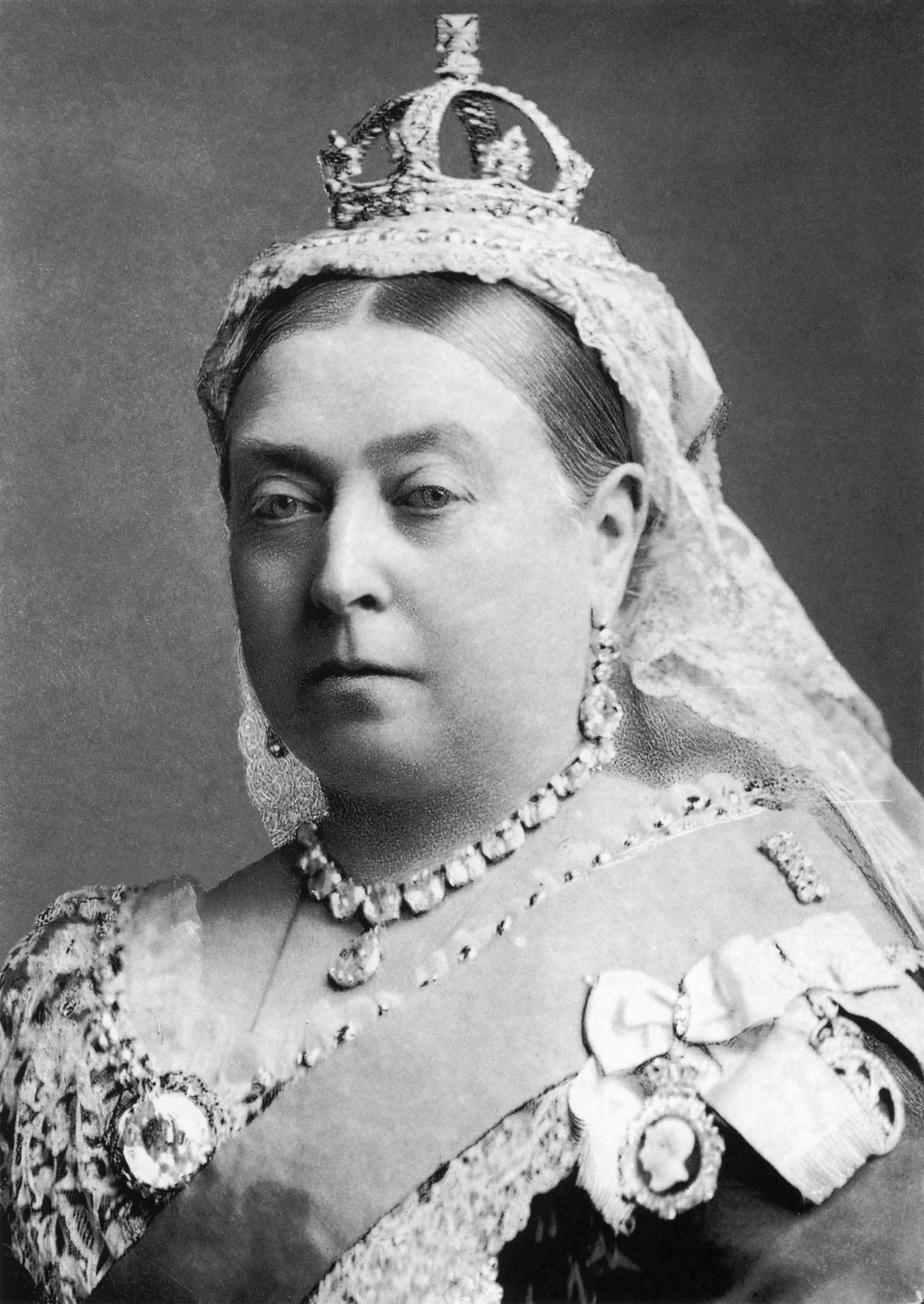
Queen Victoria
Queen of the United Kingdom from 1837 to 1901
Victoria (Alexandrina Victoria; 24 May 1819 – 22 January 1901) was Queen of the United Kingdom of Great Britain and Ireland from 20 June 1837 until her death in 1901. Her reign of 63 years and 216 days, which was longer than those of any of her predecessors, constituted the Victorian era, a period of industrial, political, scientific, and military change within the United Kingdom marked by a great expansion of the British Empire. In 1876, the British parliament voted to grant her the additional title of Empress of India.
Victoria was the daughter of Prince Edward, Duke of Kent and Strathearn (the fourth son of King George III), and Princess Victoria of Saxe-Coburg-Saalfeld. After the deaths of her father and grandfather in 1820, she was raised under close supervision by her mother and her comptroller, John Conroy. She inherited the throne aged 18 after her father's three elder brothers died without surviving legitimate issue. Victoria attempted privately to influence government policy and ministerial appointments; publicly, she became a national icon who was identified with strict standards of personal morality.
Victoria married her maternal first cousin, Prince Albert of Saxe-Coburg and Gotha, in 1840. Their nine children married into royal and noble families across the continent, earning Victoria the sobriquet "grandmother of Europe". After Albert's death in 1861, Victoria plunged into deep mourning and avoided public appearances. As a result of her seclusion, British republicanism temporarily gained strength, but in the latter half of her reign, her popularity recovered. Her Golden and Diamond jubilees were times of public celebration. Victoria died at Osborne House on the Isle of Wight, at the age of 81. The last British monarch of the House of Hanover, she was succeeded by her son Edward VII.
Early life
Birth and ancestry
Victoria's father was Prince Edward, Duke of Kent and Strathearn, the fourth son of King George III and Queen Charlotte. Until 1817, King George's only legitimate grandchild was Edward's niece Princess Charlotte of Wales, the daughter of George, Prince Regent (who would become George IV). Charlotte's death in 1817 precipitated a succession crisis that brought pressure on Edward and his unmarried brothers to marry and have children. In 1818, the Duke of Kent married Princess Victoria of Saxe-Coburg-Saalfeld, a widowed German princess with two children—Carl and Feodora—by her first marriage to Emich Carl, 2nd Prince of Leiningen. Her brother Leopold was Charlotte's widower and later the first king of Belgium. Victoria was born at 4:15 am on Monday, 24 May 1819 at Kensington Palace in London and was the Duke and Duchess of Kent's only child.
Victoria was christened privately by the Archbishop of Canterbury, Charles Manners-Sutton, on 24 June in the Cupola Room at Kensington Palace. She was baptised Alexandrina after one of her godparents, Tsar Alexander I of Russia, and Victoria, after her mother. Additional names proposed by her parents—Georgina (or Georgiana), Charlotte, and Augusta—were dropped on the instructions of the Prince Regent.
At birth, Victoria was fifth in the line of succession after the four eldest sons of George III: George, Prince Regent (later George IV); Frederick, Duke of York; William, Duke of Clarence (later William IV); and Victoria's father, Edward, Duke of Kent. Prince George had no surviving children, and Frederick had no children; further, both were estranged from their wives, who were both past child-bearing age, so the two eldest brothers were unlikely to have any further legitimate children. William married in 1818, in a joint ceremony with his brother Edward, but both of William's legitimate daughters died as infants. The first of these was Princess Charlotte, who was born and died on 27 March 1819, two months before Victoria was born. Victoria's father died in January 1820, when Victoria was less than a year old. A week later her grandfather died and was succeeded by his eldest son as George IV. Victoria was then third in line to the throne after Frederick and William. She was fourth in line while William's second daughter, Princess Elizabeth, lived, from 10 December 1820 to 4 March 1821.
Heir presumptive
Frederick died in 1827, followed by George IV in 1830; their next surviving brother succeeded to the throne as William IV, and Victoria became heir presumptive. The Regency Act 1830 made special provision for Victoria's mother to act as regent in case William died while Victoria was still a minor. King William distrusted the Duchess's capacity to be regent, and in 1836 he declared in her presence that he wanted to live until Victoria's 18th birthday, so that a regency could be avoided.
Victoria later described her childhood as "rather melancholy". Her mother was extremely protective, and Victoria was raised largely isolated from other children under the so-called "Kensington System", an elaborate set of rules and protocols devised by the Duchess and her ambitious and domineering comptroller, Sir John Conroy, who was rumoured to be the Duchess's lover. The system prevented the princess from meeting people whom her mother and Conroy deemed undesirable (including most of her father's family), and was designed to render her weak and dependent upon them. The Duchess avoided the court because she was scandalised by the presence of King William's illegitimate children. Victoria shared a bedroom with her mother every night, studied with private tutors to a regular timetable, and spent her play-hours with her dolls and her King Charles Spaniel, Dash. Her lessons included French, German, Italian, and Latin, but she spoke only English at home. At age ten, she wrote and illustrated a children's story, The Adventures of Alice Laselles, which was eventually published in 2015.
In 1830, the Duchess and Conroy took Victoria across the centre of England to visit the Malvern Hills, stopping at towns and great country houses along the way. Similar journeys to other parts of England and Wales were taken in 1832, 1833, 1834 and 1835. To the King's annoyance, Victoria was enthusiastically welcomed in each of the stops. William compared the journeys to royal progresses and was concerned that they portrayed Victoria as his rival rather than his heir presumptive. Victoria disliked the trips; the constant round of public appearances made her tired and ill, and there was little time for her to rest. She objected on the grounds of the King's disapproval, but her mother dismissed his complaints as motivated by jealousy and forced Victoria to continue the tours. At Ramsgate in October 1835, Victoria contracted a severe fever, which Conroy initially dismissed as a childish pretence. While Victoria was ill, Conroy and the Duchess unsuccessfully badgered her to make Conroy her private secretary. As a teenager, Victoria resisted persistent attempts by her mother and Conroy to appoint him to her staff. Once queen, she banned him from her presence, but he remained in her mother's household.
By 1836, Victoria's maternal uncle Leopold, who had been King of the Belgians since 1831, hoped to marry her to Prince Albert, the son of his brother Ernest I, Duke of Saxe-Coburg and Gotha. Leopold arranged for Victoria's mother to invite her Coburg relatives to visit her in May 1836, with the purpose of introducing Victoria to Albert. William IV, however, disapproved of any match with the Coburgs, and instead favoured the suit of Prince Alexander of the Netherlands, second son of the Prince of Orange. Victoria was aware of the various matrimonial plans and critically appraised a parade of eligible princes. According to her diary, she enjoyed Albert's company from the beginning. After the visit she wrote, "[Albert] is extremely handsome; his hair is about the same colour as mine; his eyes are large and blue, and he has a beautiful nose and a very sweet mouth with fine teeth; but the charm of his countenance is his expression, which is most delightful." Alexander, on the other hand, she described as "very plain".
Victoria wrote to King Leopold, whom she considered her "best and kindest adviser", to thank him "for the prospect of great happiness you have contributed to give me, in the person of dear Albert ... He possesses every quality that could be desired to render me perfectly happy. He is so sensible, so kind, and so good, and so amiable too. He has besides the most pleasing and delightful exterior and appearance you can possibly see." However at 17, Victoria, though interested in Albert, was not yet ready to marry. The parties did not undertake a formal engagement, but assumed that the match would take place in due time.
Content sourced from Wikipedia under CC BY-SA 4.0


