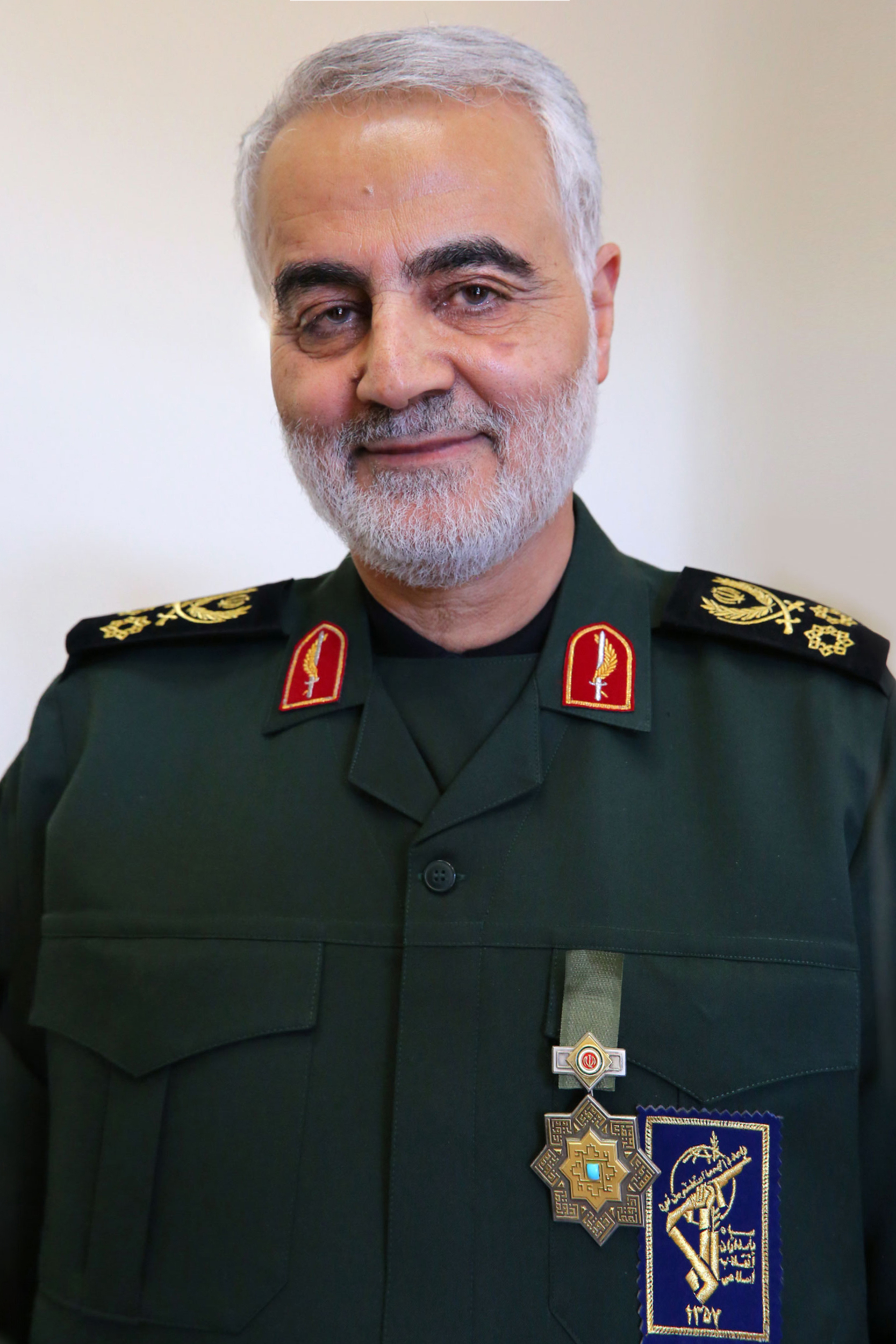
Qasem Soleimani
Iranian military officer (1957–2020)
Qasem Soleimani (Persian: قاسم سلیمانی, romanized: Qâsem Soleymâni; 11 March 1957 – 3 January 2020) was an Iranian military officer who served in the Islamic Revolutionary Guard Corps (IRGC). From 1998 until his assassination by the United States in 2020, he was the commander of the Quds Force, an IRGC division primarily responsible for extraterritorial and clandestine military operations, and played a key role in the Syrian civil war through securing Russian intervention. He was described as "the single most powerful operative in the Middle East" and a "genius of asymmetric warfare". Former Mossad director Yossi Cohen said Soleimani's strategies had "personally tightened a noose around Israel's neck".
In his later years, he was considered by some analysts to be the right-hand man of the supreme leader of Iran, Ali Khamenei, and the second-most powerful person in Iran behind Khamenei. For attacks orchestrated or attempted against Americans and other targets abroad, Soleimani was personally sanctioned by the United Nations and the European Union, and was designated as a terrorist by the United States in 2005.
Soleimani was assassinated by a targeted drone strike on 3 January 2020 in Baghdad, Iraq. Iranian government officials publicly mourned Soleimani's death and launched missiles against U.S. military bases in Iraq, wounding 110 American troops. Iranian outlets subsequently represented Soleimani as a national hero.
Early life
Soleimani was born on 11 March 1957, in the village of Qanat-e Malek, Kerman Province. His family belonged to the Soleimani tribe, an ethnic Lur tribe from Kerman. He left school at the age of 13 and moved to the city of Kerman to work on a construction site to help repay his father's agricultural debts. In 1975, he began working as a contractor for the Kerman Water Organization. When not at work, he spent his time with weight training in local gyms, or attending the sermons of Hojjat Kamyab, a preacher and a protégé of Ali Khamenei, who according to Soleimani encouraged him to "revolutionary activities".
Military career
Early career
Soleimani joined the Revolutionary Guard (IRGC) in 1979 following the Iranian Revolution, which saw the overthrow of the Shah and Ayatollah Khomeini take power. Reportedly, his training was minimal, but he advanced rapidly. Early in his career as a guardsman, he helped to prevent a Kurdish uprising in northwestern Iran. Soleimani gained much experience in Iranian Kurdistan which later benefitted him as he became an advisor for the Peshmerga against Saddam Hussein during the Iran–Iraq War.
On 22 September 1980, when Saddam Hussein launched an invasion of Iran, setting off the Iran–Iraq War (1980–1988), Soleimani joined the battlefield serving as the leader of a military company, consisting of men from Kerman whom he assembled and trained. He quickly earned a reputation for bravery, and rose through the ranks because of his role in successful operations to retake the lands Iraq had occupied, and eventually became the commander of the 41st Tharallah Division while still in his 20s, participating in most of the war's battles and major operations. He was mostly stationed at the southern front. He was seriously injured in Operation Tariq-ol-Qods. In a 1990 interview, he mentioned Operation Fath-ol-Mobin as "the best" operation he participated in and "very memorable", due to its difficulties yet positive outcome. He was also engaged in leading and organizing irregular warfare missions deep inside Iraq by the Ramadan Headquarters. It was at this point that Soleimani established relations with Kurdish Iraqi leaders and the Shia Badr Organization, both opposed to Saddam Hussein.
On 17 July 1985, Soleimani opposed the IRGC leadership's plan to deploy forces to two islands in western Arvand Rud, on the Shatt al-Arab River. In 1987, a division that Soleimani commanded was shelled with artillery containing chemical weapons by the Iraqi Army.
After the war, during the 1990s, he was an IRGC commander in Kerman Province. In this region, which is relatively close to Afghanistan, Afghan-grown opium travels to Turkey and on to Europe. Soleimani's military experience helped him earn a reputation as a successful fighter against drug trafficking.
Soleimani went to Mecca and Medina for Hajj with Commander Mahmood Khaleqi in 1992.
During the 1999 student protests in Tehran, Soleimani was one of the IRGC officers who signed a letter to President Mohammad Khatami warning that if he did not suppress the protests, the military would, and suggesting Khatami would be deposed. According to the former IRGC commander, Mohammad Ali Jafari, Soleimani also intervened in the 2009 protests to "control the insecurity and riots".
Command of the Quds Force
According to Dexter Filkins, Soleimani became the commander of the Quds Force, named after the Persian word for Jerusalem, in 1998. According to Ali Alfoneh, Soleimani was appointed as the commander of the IRGC's Quds Force between 10 September 1997 and 21 March 1998. Soleimani strengthened the relationship between Quds Force and Hezbollah upon his appointment, and supported the latter by sending in operatives to assist in forcing Israel's withdrawal and the end to the Israeli occupation of Southern Lebanon.
According to the Jerusalem Center for Public Affairs, an Israeli think tank, Soleimani "directed a network of insurgent groups in Iraq that killed over a thousand Americans." The Israeli think tank also claimed the Quds Force, also known as the Jerusalem Force, was reported by National Council of Resistance of Iran sources to The Telegraph to control a company that "specializes in anti-tank mines and operates under the aegis of the IRGC's al-Quds or Jerusalem Force" and was responsible for making bombs that killed American and British soldiers in Iraq starting in 2005. The Washington Post's Alex Horton reported that the Quds Force provided explosively formed penetrator "training and logistics to militants in Iraq". Defense One reported that a spokesperson from the United States Central Command claimed more than 500 American soldiers were killed by EFPs and other Iranian weapons in the Iraq War and attributed the presence of EFPs in Iraq to the Quds Force. The Pentagon later revised down this figure to 196, and a spokesperson for U.S. Senator Ted Cruz revised his statement accordingly, declining to comment because it was "immaterial" toward the question of "receiv[ing] sanctions relief to the tune of millions of dollars". Weisgerber also cited Columbia Journalism Review, debunking the notion that Iran was exclusively supplying the weapons, though leaving the door open for it providing help in terms of training and technology. Further, in 2006, Common Dreams reported not only that the U.S. military command knew that domestic production had been going on "for years" at the time of accusation against the Quds Force, they also "had considerable evidence that the Mahdi Army had gotten the technology and the training on how to use it from Hezbollah rather than Iran", in line with Hezbollah's claim of autonomy. The Mahdi Army Shia militant group had spearheaded the 2004 Iraq spring fighting.
Soleimani played a role in advising Hezbollah for its defense from Israel in the 2006 Lebanon War and at least once accompanied Imad Mughniyeh. In an interview aired in October 2019, he said he was in Lebanon during the 2006 Israel–Hezbollah War to manage the conflict.
On 11 January 2007, the United States raided the Iranian Liaison Office in Erbil, Iraq, believing that IRGC Commander-in-Chief Mohammad Ali Jafari and Soleimani were there, and detained five Iranians with diplomatic passports.
Nine days later, on 20 January, "an al-Qaida-linked Sunni militant group" or "illegally armed militia group", reported by Dexter Filkins to be Asa'ib Ahl al-Haq, with the Iran-trained Hezbollah commander Ali Musa Daqduq, infiltrated the U.S. Army's Karbala Provincial Joint Coordination Headquarters and killed five American soldiers, in what was reported as "perhaps the boldest and most sophisticated" attack of the Iraq War. The attackers were wearing American uniforms and had American weapons. Following the attack, a U.S. Department of Defense official, major general Kevin Bergner, claimed the Quds Force had knowledge of and planned the attack. On the same day, 13 American soldiers died in a helicopter crash and seven others were killed throughout Iraq, making it the third worst day for U.S. troops during the entire war. Soleimani was considered one of the possible successors to the post of commander of the IRGC when General Yahya Rahim Safavi left this post in 2007. In 2008, he led a group of Iranian investigators looking into the death of Imad Mughniyeh. Soleimani helped arrange a ceasefire between the Iraqi Army and Mahdi Army in March 2008.
Content sourced from Wikipedia under CC BY-SA 4.0


