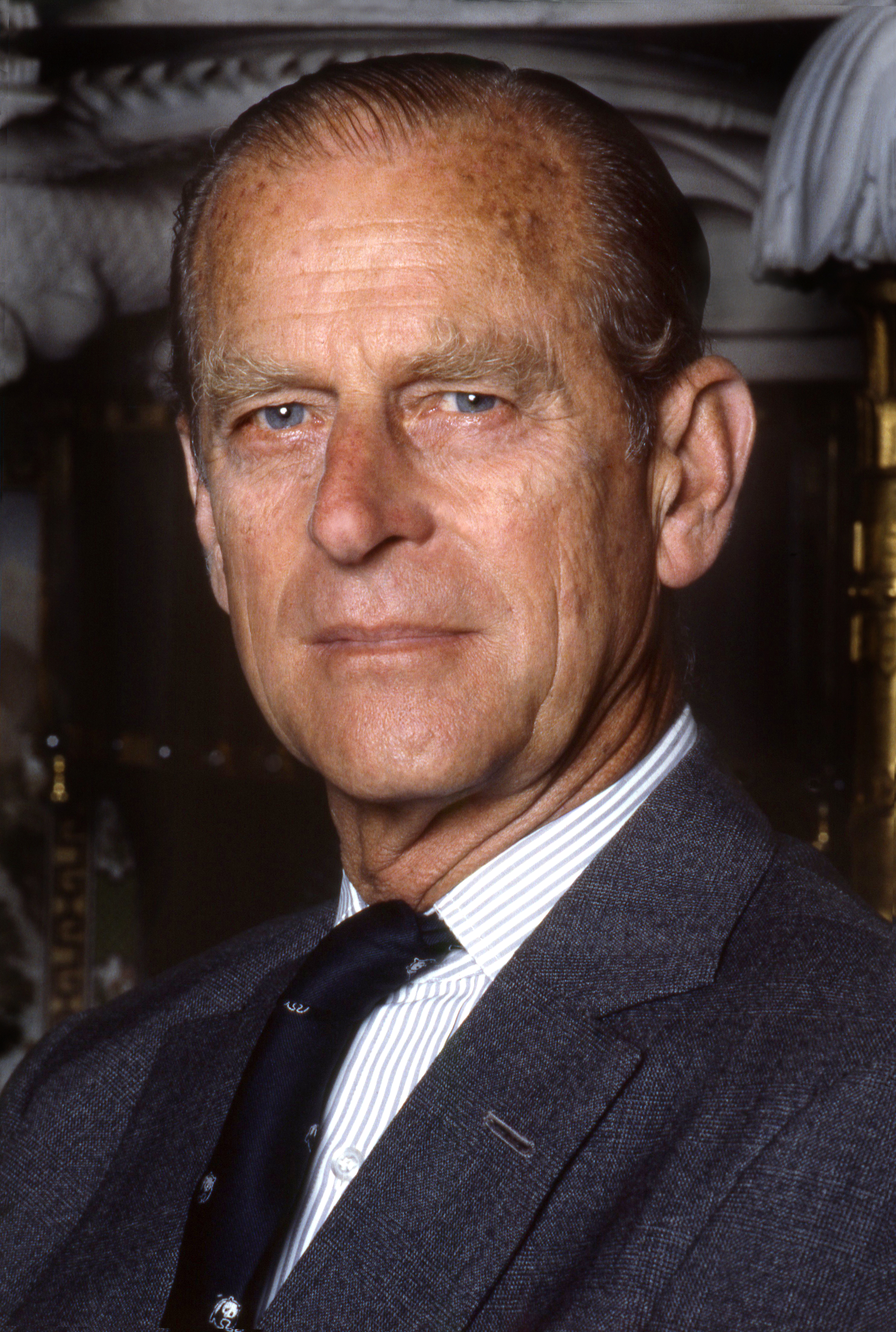
Prince Philip, Duke of Edinburgh
Consort of Elizabeth II from 1952 to 2021
Prince Philip, Duke of Edinburgh (born Prince Philip of Greece and Denmark, later Philip Mountbatten; 10 June 1921 – 9 April 2021) was the husband of Queen Elizabeth II and served as consort of the British monarch from her accession on 6 February 1952 until his death in 2021, making him the longest-serving royal consort in British history.
Philip was born in Greece into the Greek and Danish royal families. His family was exiled from the country when he was eighteen months old. Educated in France, Germany, and the United Kingdom, he joined the Royal Navy in 1939 at the age of 18. In July 1939, he began corresponding with Princess Elizabeth, then aged 13, the elder daughter and heir presumptive of King George VI. During the Second World War, Philip served with distinction in the Mediterranean and Pacific fleets of the Royal Navy.
In the summer of 1946, King George VI granted Philip permission to marry Elizabeth, who was then 20. Prior to the official announcement of their engagement in July 1947, Philip renounced his Greek and Danish royal titles and styles, became a naturalised British subject, and adopted the surname Mountbatten from his maternal grandparents. In November 1947, he married Elizabeth, was granted the style His Royal Highness, and was created Duke of Edinburgh, Earl of Merioneth, and Baron Greenwich. They had four children: Charles, Anne, Andrew, and Edward. Following Elizabeth’s accession to the throne in 1952, Philip left active naval service, having attained the rank of commander. In 1957, he was formally created a British prince.
A keen sportsman, Philip played a significant role in the development of the equestrian discipline of carriage driving. He served as patron, president, or member of more than 780 organisations, including the World Wide Fund for Nature, and was chairman of The Duke of Edinburgh's Award, an international youth awards programme for people aged 14 to 24. Philip is the longest-lived male member of the British royal family. He retired from public duties in 2017 at the age of 96, having completed 22,219 solo engagements and delivered 5,493 speeches since 1952. He died at Windsor Castle two months before his 100th birthday.
Early life and education
Family, infancy and exile from Greece
Philip (Greek: Φίλιππος, romanised: Phílippos) was born on 10 June 1921 on the dining room table at Mon Repos, a villa on the Greek island of Corfu. He was the only son and fifth and final child of Prince Andrew of Greece and Denmark and his wife, Princess Alice of Battenberg. Philip's father was the fourth son of King George I and Queen Olga of Greece, and his mother was the eldest child of Louis Mountbatten, 1st Marquess of Milford Haven, and Victoria Mountbatten, Marchioness of Milford Haven (formerly Prince Louis of Battenberg and Princess Victoria of Hesse and by Rhine). A member of the House of Glücksburg, Philip was a prince of both Greece and Denmark by virtue of his patrilineal descent from George I of Greece and George's father, Christian IX of Denmark; he was from birth in the line of succession to both thrones. Philip's four elder sisters were Margarita, Theodora, Cecilie, and Sophie. He was baptised in the Greek Orthodox rite at St. George's Church in the Old Fortress in Corfu. His godparents were his paternal grandmother, Queen Olga of Greece; his cousin George, Crown Prince of Greece; his uncle Lord Louis Mountbatten; and the municipality of Corfu, represented by its mayor, Alexandros Kokotos, and by the president of the council, Stylianos Maniarizis.
Shortly after Philip's birth, his maternal grandfather died in London. The Marquess of Milford Haven was a naturalised British subject who, after a career in the Royal Navy, had renounced his German titles and adopted the surname Mountbatten—an Anglicised version of Battenberg—during the First World War, owing to anti-German sentiment in the United Kingdom. After visiting London for his grandfather's memorial service, Philip and his mother returned to Greece, where Prince Andrew had remained to command a Greek Army division embroiled in the Greco-Turkish War.
Greece suffered significant losses in the war, while the Turks made substantial gains. Philip's uncle and high commander of the Greek expeditionary force, King Constantine I, was blamed for the defeat and was forced to abdicate in September 1922. The new military government arrested Andrew, along with others. General Georgios Hatzianestis, who was commanding officer of the army, and five senior politicians were arrested, tried, and executed in the Trial of the Six. Andrew's life was also believed to be in danger and Alice was under surveillance. Finally, in December, a revolutionary court banished Andrew from Greece for life. The British naval vessel HMS Calypso evacuated Andrew's family, with Philip carried to safety in a fruit box.
Upbringing in France, Britain and Germany
Philip's family settled in a house in the Paris suburb of Saint-Cloud lent to them by his wealthy aunt Princess George of Greece and Denmark. During his time there, Philip was first educated at The Elms, an American school in Paris run by Donald MacJannet, who described Philip as a "know it all smarty person, but always remarkably polite". In 1930 Philip was sent to Britain to live with his maternal grandmother at Kensington Palace and his uncle George Mountbatten, 2nd Marquess of Milford Haven, at Lynden Manor in Bray, Berkshire. He was then enrolled at Cheam School. Over the next three years, his four sisters married German princes and moved to Germany, his mother was diagnosed with schizophrenia and placed in an asylum, and his father took up residence in Monte Carlo. Philip had little contact with his mother for the remainder of his childhood.
In 1933 Philip was sent to Schule Schloss Salem in Germany, which had the "advantage of saving school fees", because it was owned by the family of his brother-in-law Berthold, Margrave of Baden. With the rise of Nazism in Germany, Salem's Jewish founder, Kurt Hahn, fled persecution and founded Gordonstoun School in Scotland, to which Philip moved after two terms at Salem. In 1937, his sister Cecilie; her husband, Georg Donatus, Hereditary Grand Duke of Hesse; their two sons; and Georg Donatus's mother were killed in an air crash at Ostend; Philip, then 16 years old, attended the funeral in Darmstadt. Cecilie and Georg Donatus were members of the Nazi Party. The following year, Philip's uncle and guardian Lord Milford Haven died of bone marrow cancer. Milford Haven's younger brother Lord Louis took parental responsibility for Philip for the remainder of his youth.
Philip did not speak Greek because he had left Greece as an infant. In 1992 he said that he "could understand a certain amount". He stated that he thought of himself as Danish and spoke mostly English, while his family was multilingual. Known for his charm in his youth, Philip was linked to several women, including Osla Benning.
Naval and wartime service
After leaving Gordonstoun in early 1939, Philip completed a term as a cadet at the Royal Naval College, Dartmouth, then repatriated to Greece, living with his mother in Athens for a month in mid-1939. At the behest of King George II of Greece, his first cousin, he returned to Britain in September to resume training for the Royal Navy. He graduated from Dartmouth the next year as the best cadet in his course. During the Second World War, he continued to serve in the British forces, while two of his brothers-in-law, Prince Christoph of Hesse and Berthold, Margrave of Baden, fought on the opposing German side. Philip was appointed as a midshipman in January 1940. He spent four months on the battleship HMS Ramillies, protecting convoys of the Australian Expeditionary Force in the Indian Ocean, followed by shorter postings on HMS Kent, on HMS Shropshire, and in British Ceylon. After the invasion of Greece by Italy in October 1940, he was transferred from the Indian Ocean to the battleship HMS Valiant in the Mediterranean Fleet.
Philip was commissioned as a sub-lieutenant on 1 February 1941 after a series of courses at Portsmouth, in which he gained the top grade in four out of five sections of the qualifying examination. Among other engagements, he was involved in the Battle of Crete and was mentioned in dispatches for his service during the Battle of Cape Matapan, in which he controlled the battleship's searchlights. He was also awarded the Greek War Cross. In June 1942, he was appointed to the destroyer HMS Wallace, which was involved in convoy escort tasks on the east coast of Britain, as well as the Allied invasion of Sicily.
Content sourced from Wikipedia under CC BY-SA 4.0


