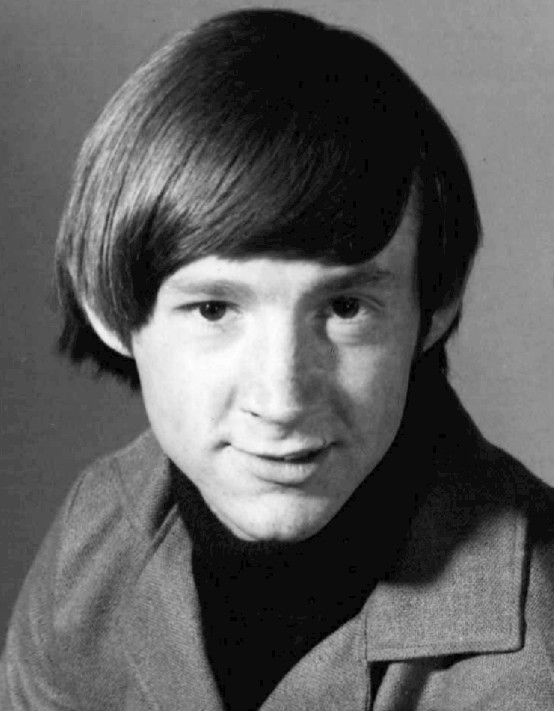
Peter Tork
American musician and actor (1942–2019)
Peter Halsten Thorkelson (February 13, 1942 – February 21, 2019), better known by his stage name Peter Tork, was an American musician and actor. He was best known as the bass guitarist and keyboardist of the Monkees and co-star of the NBC television series of the same name (1966–68).
Tork grew up in Connecticut, and in the mid-1960s as part of the Greenwich Village folk scene in New York City, he befriended musician Stephen Stills. After moving to Los Angeles with Stills, he auditioned for a new musical television sitcom, The Monkees. The series ran from 1966 to 1968 and made Tork and his co-stars teen idols. In addition to albums released with the band, Tork released on Beachwood Recordings one solo album, Stranger Things Have Happened (1994), and later toured with James Lee Stanley, with whom he also recorded three duet albums (Two Man Band, Once Again and Live/Backstage at the Coffee Gallery), as well as his band, Shoe Suede Blues.
Early life
Tork was born at the former Doctors Hospital in Washington, D.C., in 1942, though many news articles incorrectly report him as having been born in 1944 in New York City—the date and location listed in early press releases for The Monkees television show. He was the son of Virginia Hope (née Straus) and Halsten John Thorkelson, an economics professor at the University of Connecticut. His paternal grandfather was of Norwegian descent, while his mother was of half German Jewish and half Irish American ancestry.
Tork began studying piano at the age of nine, showing an aptitude for music by learning to play several different instruments, including the banjo, acoustic bass, and guitar. He attended Windham High School in Willimantic, Connecticut, and was a member of the first graduating class at E. O. Smith High School in Storrs, Connecticut. He attended Carleton College before he moved to New York City, where he became part of the folk music scene in Greenwich Village during the first half of the 1960s. While there, he befriended other up-and-coming musicians, such as Stephen Stills.
The Monkees
In 1965, auditions were held for a new television sitcom called The Monkees, about a fictional pop-rock band called The Monkees. Stephen Stills auditioned but was rejected because the show's producers felt his hair and teeth were not photogenic. When Stills was asked if he knew of someone with a similar "open, Nordic look", Stills recommended Tork. Tork was chosen along with musician Michael Nesmith, actor/musician Micky Dolenz, and Davy Jones (who was already under contract to Screen Gems). Tork was the oldest member of the group.
Tork was a proficient musician before he joined the Monkees. Though other members of the band were not allowed to play their instruments on their first two albums, he played what he described as "third-chair guitar" on Michael Nesmith's song "Papa Gene's Blues" on their first album. He subsequently played keyboard, bass guitar, banjo, harpsichord, and other instruments on the band's recordings. He co-wrote, along with Joey Richards, the closing theme song of the second season of The Monkees, "For Pete's Sake". On the show, he was relegated to acting as the "lovable dummy", a persona he had developed as a folk singer in Greenwich Village.
The DVD release of the first season of the show contains commentary from various band members. In it, Nesmith states that Tork was better at playing guitar than bass. Tork commented that Davy Jones was a good drummer, and had the live performance lineups been based solely on playing ability, it should have been him on guitar, Nesmith on bass, and Jones on drums, with Micky Dolenz taking the fronting role (instead of Nesmith on guitar, Tork on bass, and Dolenz on drums). Jones filled in briefly for Tork on bass when Tork played keyboard.
Recording and producing as a group was Tork's main interest, and he hoped that the four members would continue working together as a band on future recordings. However, the four did not have enough in common regarding their musical interests. In his commentary for the DVD release of the second season of the show, Tork said that Dolenz was "incapable of repeating a triumph". Dolenz felt that once he had accomplished something and became a success at it, there was no artistic sense in repeating a formula.
In 1967, free from Don Kirshner's restrictions, Tork contributed instrumental flourishes, such as the piano introduction to "Daydream Believer" and the banjo part on "You Told Me", as well as exploring occasional songwriting with the likes of "For Pete's Sake" and "Lady's Baby".
Tork was close to his maternal grandmother, Catherine McGuire Straus, staying with her sometimes during his Greenwich Village days and after he became a Monkee. "Grams" was one of his most ardent supporters and managed his fan club, often writing personal letters to members and visiting music stores to make sure they carried Monkees records.
Six albums were produced with the original Monkees lineup, four of which reached No. 1 on the Billboard chart. This success was supplemented by two years of the television program, a series of successful concert tours across America and abroad, and a trippy psychedelic movie, Head, which is considered by some to have been ahead of its time. However, musical and personal tensions were increasing within the group. The band finished a Far East tour in October 1968 (where Tork's copy of Naked Lunch was confiscated by Australian Customs) and then filmed an NBC television special, 33⅓ Revolutions per Monkee.
No longer getting the group dynamic he wanted, and pleading "exhaustion" from the grueling schedule, Tork bought out the remaining four years of his contract for $160,000, leaving him with little income. In the DVD commentary for the 33⅓ Revolutions per Monkee TV special – originally broadcast April 14, 1969 – Dolenz noted that Nesmith gave Tork a gold watch as a going-away present, with the engraving "From the guys down at work." Jones noted at the time that "Peter's soul left us two and a half years ago. He was a banjo player from Greenwich Village who was made into an actor and finally decided that he didn't want to be a Marx Brother forever. His heart was back in the Village, that's all." Dolenz reflected on Tork's departure, saying, "Three of us more or less play ourselves in the series. The odd one out is Peter Tork. Offstage he's a real serious guy who thinks a lot about things like religion and problems in the world. But in the show, he throws off all that and becomes a dumb-but-likable character who is always doing the wrong thing at the wrong time. He kind of moons around with a lovesick expression on his face — not like the real Peter Tork at all."
Post-Monkees
During a trip to London in December 1967, Tork contributed banjo to George Harrison's soundtrack to the 1968 film Wonderwall. His playing was featured in the movie, but not on the official Wonderwall Music soundtrack album released in November 1968. Tork's brief five-string banjo piece can be heard 16 minutes into the film, as Professor Collins (Jack MacGowran) is caught by his mother while spying on his neighbor Penny Lane (Jane Birkin).
Tork went solo with a group called Peter Tork And/Or Release with then-girlfriend Reine Stewart on drums (she had played drums on part of 33⅓ Revolutions Per Monkee), Riley "Wyldflower" Cummings (formerly of the Gentle Soul) on bass and – sometimes – singer/keyboard player Judy Mayhan. Tork said in April 1969, "We sometimes have four. We're thinking of having a rotating fourth. Right now, the fourth is that girl I'm promoting named Judy Mayhan." "We're like Peter's backup band", added Stewart, "except we happen to be a group instead of a backup band." Release hoped to have a record out immediately, and Tork said that they did record some demos that he may still have stored away somewhere. According to Stewart, the band was supposed to go to Muscle Shoals as the backing band for Mayhan's Atlantic Records solo album Moments (1970), but they were ultimately replaced. They mainly played parties for their "in" friends, and one of their songs was considered for the soundtrack to Easy Rider, but the producers – who had also produced Head – eventually decided not to include it. The Release could not secure a record contract, and by 1970, Tork was once again a solo artist. As he later recalled, "I didn't know how to stick to it. I ran out of money and told the band members, 'I can't support us as a crew anymore, you'll just have to find your own way.'"
Tork's record and movie production entity, the Breakthrough Influence Company (BRINCO), also failed to launch, despite such talent as future Little Feat guitarist Lowell George. He sold his house in 1970, and he and a pregnant Reine Stewart moved into the basement of David Crosby's home. Tork was credited with co-arranging a Dolenz solo single on MGM Records in 1971 ("Easy on You" backed with "Oh Someone"). An arrest and conviction for possession of hashish resulted in three months in an Oklahoma penitentiary in 1972. He moved to Fairfax in Marin County, California, in the early 1970s, where he joined the 35-voice Fairfax Street Choir and played guitar for a shuffle blues band called Osceola. Tork returned to southern California in the mid-1970s, where he married, had a son, and took a job teaching at Pacific Hills School in West Hollywood for a year and a half. He spent a total of three years as a teacher of music, social studies, math, French and history, and coached baseball at several schools.
Content sourced from Wikipedia under CC BY-SA 4.0


