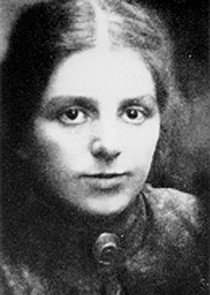
Paula Modersohn-Becker
German expressionist painter and draftswoman (1876–1907)
Paula Modersohn-Becker (8 February 1876 – 20 November 1907) was a German Expressionist painter and draftswoman of the late 19th and early 20th centuries. She is noted for the many self-portraits, including nudes. She is considered one of the most important representatives of early expressionism, producing more than 700 paintings and over 1000 drawings during her active painting life. She is recognized both as the first known woman painter to paint nude self-portraits, and the first woman to have a museum devoted exclusively to her art (the Paula Modersohn-Becker Museum, founded 1927). Additionally, she is believed to be the first woman artist to depict herself pregnant.
Her career was cut short when she died from postpartum pulmonary embolism at the age of 31.
Biography
Early life
Becker was born and grew up in Dresden, in the Friedrichstadt area. She was the third of seven children in her family. Her father, Carl Woldemar Becker (1841–1901), the Odessa-born son of a Russian university professor of French, was employed as an engineer with the German railway. Her mother, Mathilde (1852–1926), was from the aristocratic von Bültzingslöwen family, and her parents provided their children a cultured and intellectual household environment.
Despite these advantages of family, the Beckers found themselves in socially constrained circumstances. In 1861, Oskar Becker, Carl's brother, in an unsuccessful assassination attempt, had shot King Wilhelm of Prussia in the neck. The King was not severely injured, and Oskar was pardoned five years later for the crime (on condition that he permanently leave the country), but the constraints of opportunity for Carl Becker's family would linger.
In 1888 the family moved from Dresden to Bremen, where Carl Becker had obtained a position on the building board of the Prussian Railway Administration. The family interacted with Bremen's local artistic and intellectual circles, and Paula began to learn to draw. In the summer of 1892, her parents sent her to relatives in England to learn English. While living with a maternal aunt in London, Becker received her first instruction in drawing at St John's Wood Art School.
After returning to Bremen, she studied at a teachers' training school from 1893 to 1895, as her father wished (two sisters also attended this program). Concurrently she received private painting lessons from local German painter Bernhard Wiegandt.
She worked as a painter from around 1893, at age 16, and was allowed to set up her first studio in the extension of her parents' house in Bremen (later Haus Paula Becker, with Becker's early studio intact). From this period comes a series of portraits of her siblings and also the first self-portrait (1893). She completed her teacher's course "with flying colors", but it was clear that she had little intention of pursuing a career in that profession.
In the spring of 1896, Paula was able to travel to Berlin to take part in a six-week drawing and painting course organized by the Berlin Artists' Association (Verein der Berliner Künstlerinnen), staying with members of her mother's family while completing her course. After graduating, she stayed on in Berlin, and in February 1897 was admitted to the first class of painting at the Women's Academy. Paula additionally used her Berlin time to visit its art museums, studying the works of German and Italian artists. An encounter with an important proponent for German feminism, Natalie von Milde, made a deep impression, although swift intervention from her family cut that connection short.
After these years of study, Becker returned to Bremen. She convinced her family to allow her to attend a further course at the nearby artists' colony in the northern German town of Worpswede.
Worpswede
Becker had become familiar with the Worpswede colony as early as 1895, when Fritz Mackensen, Otto Modersohn, Fritz Overbeck and Heinrich Vogeler presented their paintings in Bremen's art museum, the Kunsthalle Bremen. The colony had begun when Mackensen and Heinrich Vogeler had retreated to the countryside, partly as a protest against the domination of the art-academy style and life in the big city, and also to save on expenses.
Becker joined the colony in 1898, initially as a student of Mackensen. At this time she began close friendships with the sculptor Clara Westhoff (1875–1954), the painter Ottilie Reylaender (1882-1965), and the poet Rainer Maria Rilke (1875–1926). It became quickly evident, however, that Worpswede was not suited to Becker's rapidly developing artistic style. In her journal, Becker wrote: "the way Mackensen portrays people is not broad enough, too genre-like for me."
Two paintings she exhibited at the Bremen Kunsthalle in December 1899 were sharply criticized and had to be removed during the exhibition, having been subject to a "hysterical" attack by the art critic Arthur Fitger. He was later regarded as having been more outraged by the inclusion of female artists in the show than in anything particular portrayed by the actual artworks. While the community at Worpswede remained rooted in romanticized traditions of landscape, her own artistic interests were shifting noticeably toward Paris and leaving her feeling increasingly alienated.
Paris
Paris at the turn of the 20th century was the acknowledged epicenter of artistic exploration, and many artists of the time felt its pull. Westhoff, Becker's close friend, left Bremen in early 1899 to study in Paris with Auguste Rodin. Rilke also went with her, serving for a time as Rodin's secretary. By December of that year, Becker, having come into a small inheritance, followed her friend there, and in 1900 she began to study anatomy at the Académie Colarossi in the Latin Quarter. She also visited museums or exhibitions and galleries alone or with Westhoff to get to know modern French painters. She was particularly impressed by the paintings of Paul Cézanne, and Les Nabis, who emphasized the importance of colored areas in paintings following the example of Paul Gauguin. "In her painting, she followed the inspiration of the contemporary artists she had encountered in Paris, moving increasingly far from the conventional painting her colleagues at Worpswede were producing." These artists inspired her to use simplified forms and symbolic, rather than naturalistic colour.
In April 1900, the great World's Fair Centennial Exhibition opened in Paris. Otto Modersohn, a Worpswede painter who had been an on-and-off resident of the colony since 1897, arrived in town with mutual friends to attend. His sick wife Helene had remained behind in Worpswede, and she died during Modersohn's short time in Paris. Modersohn hurried back to Germany. Shortly thereafter, Becker returned to Worpswede herself. It was clear to Becker's parents that the two had become romantically involved, but their disapproval was of little impact.
Marriage with Otto Modersohn
In May 1901, Becker and Modersohn married. Modersohn was 11 years older than Becker, with an infant daughter, Elsbeth. In the two years that followed, Becker tried to combine her responsibilities as wife, housewife and stepmother with her artistic ambitions. She set up a small studio on a nearby farm, where she went to paint for several hours a day. A series of paintings of children was created, among them Girl in the Garden Next to a Glass Sphere (1901–02), Portrait of a Girl (1901), Head of a Little Girl (1902). She functioned in this uneasy balance for two years, then returned again to Paris, accompanied by Otto, for two months in 1903. She spent most of her time drawing in the Louvre from ancient and Egyptian models. With Otto, she visited Auguste Rodin, also taking time to study the newly popular Japanese style and visit with painters Pierre Bonnard and Edouard Vuillard. In February 1905 Becker again returned to Paris. Otto briefly came to see her, and together they saw Paul Gauguin's paintings. After this visit, Becker "accepted the fact that modern artists such as Matisse, whose works fascinated her, had no appeal for Otto." She took drawing courses at the Julian Academy, but became increasingly aware that she had already developed her own painting style. After returning to Worpswede, her interest focused on still life. While before 1905 only ten still lifes can be traced in her work, from 1905 to 1907 there are almost 50. She and Modersohn lived mostly apart for the next two years, with 1906 marking an artistically productive year, spent mostly in Paris. During her stays in Paris in 1905 and 1906, she lived in her studio on Avenue du Maine, where she created, among other things, portraits of Clara (Rilke-)Westhoff and Clara's husband Rainer Maria Rilke.
Content sourced from Wikipedia under CC BY-SA 4.0


