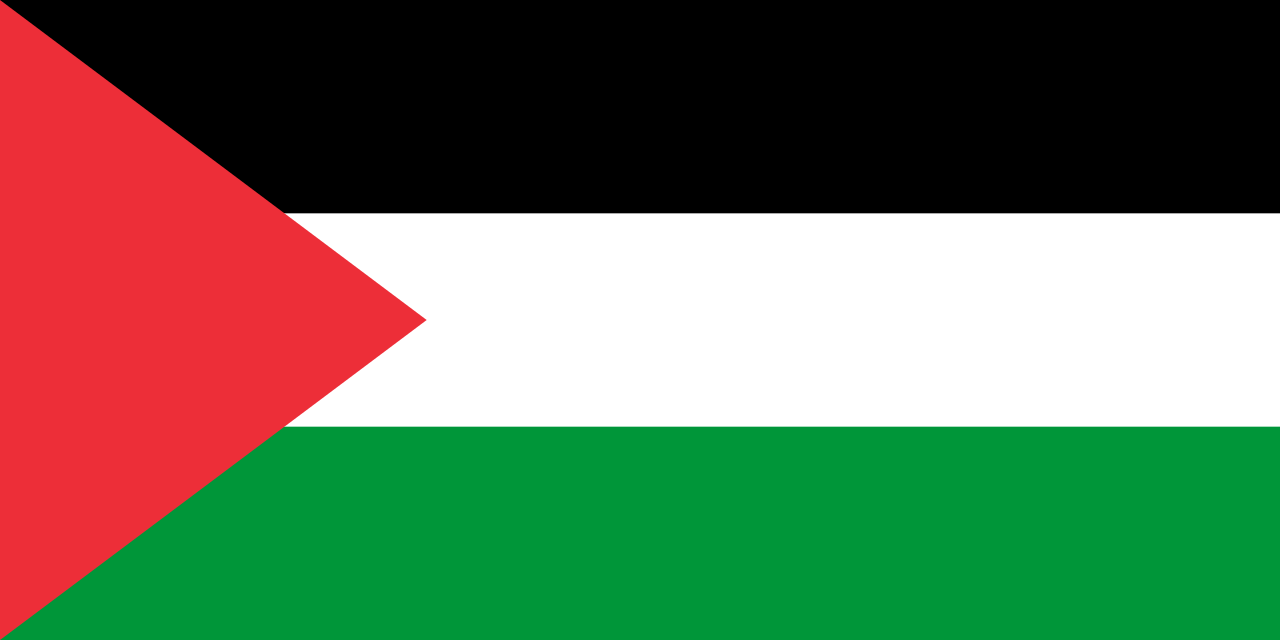
Palestine
Country in West Asia
Palestine, officially the State of Palestine, is a country in West Asia. It encompasses the Israeli-occupied West Bank, including East Jerusalem, and the Gaza Strip, collectively known as the Palestinian territories, or occupied Palestinian territory. The territories share the vast majority of their borders with Israel, with the West Bank bordering Jordan to the east and the Gaza Strip bordering Egypt to the southwest. It has a total land area of 6,020 square kilometers (2,320 sq mi) while its population exceeds five million. Its proclaimed capital is Jerusalem, while Ramallah serves as its de facto administrative center. Gaza was its largest city prior to evacuations in 2023.
Situated at a continental crossroad, the Palestine region was ruled by various empires and experienced various demographic changes from antiquity to the modern era. It was treading ground for the Nile and Mesopotamian armies and merchants from North Africa, China and India. The region has religious significance. The ongoing Israeli–Palestinian conflict dates back to the rise of the Zionist movement, supported by the United Kingdom during World War I. The war saw Britain occupying Palestine from the Ottoman Empire, where it set up Mandatory Palestine under the auspices of the League of Nations. Increased Jewish immigration led to intercommunal conflict between Jews and Palestinian Arabs, which escalated into a civil war in 1947 after a proposed partitioning by the United Nations was rejected by the Palestinians and other Arab nations.
The 1948 Palestine war saw the forcible displacement of a majority of the Arab population, and consequently the establishment of Israel; these events are referred to by Palestinians as the Nakba ('catastrophe'). In the Six-Day War in 1967, Israel occupied the West Bank and the Gaza Strip, which had been held by Jordan and Egypt respectively. The Palestine Liberation Organization (PLO) declared independence in 1988. In 1993, the PLO signed the Oslo Accords with Israel, creating limited PLO governance in the West Bank and Gaza Strip through the Palestinian Authority (PA). Israel withdrew from Gaza in its unilateral disengagement in 2005, but the territory is still considered to be under military occupation and has been blockaded by Israel. In 2007, internal divisions between political factions led to a takeover of Gaza by Hamas. Since then, the West Bank has been governed in part by the Fatah-led PA, while the Gaza Strip has remained under the control of Hamas.
Israel has constructed large settlements in the occupied West Bank and East Jerusalem since 1967, which currently house more than 670,000 Israeli settlers, which are illegal under international law. In 2023, Hamas launched the October 7 attacks against Israel, citing Israel's blockade of Gaza, Israeli occupation, and violence against Palestinians. In response, Israel launched a military campaign in Gaza, which has caused large-scale loss of life, mass population displacement, a humanitarian crisis, and an ongoing famine in the Gaza Strip. Israel has committed genocide against the Palestinian people during its ongoing invasion and bombing of the Gaza Strip.
Palestine is permanent non-member observer state at the United Nations (UN) and is recognized as a sovereign state by 157 of the UN's 193 member states. The questions of Palestine's borders, legal and diplomatic status of Jerusalem, and the right of return of Palestinian refugees remain unsolved. Some of the other challenges to Palestine include restrictions on movement, ineffective government and Israeli settlements and settler violence, as well as an overall poor security situation. Despite these challenges, the country maintains an emerging economy and sees frequent tourism. Arabic is the official language of the country. While the majority of Palestinians practice Islam, Christianity also has a presence. Palestine is also a member of several international organizations, including the Arab League and the Organization of Islamic Cooperation, UNESCO, and a delegation of parliamentarians sit at the Parliamentary Assembly of the Council of Europe.
Etymology
The term "Palestine" (in Latin, Palæstina) comes via ancient Greek from a Semitic toponym for the general area dating back to the late second millennium BCE, a reflex of which is also to be found in the Biblical ethnonym Philistines. The term "Palestine" has been used to refer to the area at the southeast corner of the Mediterranean Sea beside Syria. In the 5th century BCE, Herodotus, in his work The Histories, used the term to describe a "district of Syria, called Palaistínē" (Ancient Greek: Συρίη ἡ Παλαιστίνη καλεομένη), in which Phoenicians interacted with other maritime peoples.
Currently, the terms "Palestine", "State of Palestine", and "occupied Palestinian territory (oPt or OPT)" are interchangeable depending on context. Specifically, the term "occupied Palestinian territory" refers as a whole to the geographical area of the Palestinian territory occupied by Israel since 1967. Palestine can, depending on contexts, be referred to as a country or a state, and its authorities can generally be identified as the Government of Palestine.
History
From prehistory to the Ottoman era
Rise of Palestinian nationalism
Though Palestinian elites, in particular urban notable families who worked within the Ottoman bureaucracy, generally retained their loyalty to the Ottomans, they also played a significant role proportionately in the rise of Arab nationalism, and the Pan-Arabic movements that arose in response to both the emergence of the Young Turks movement and the subsequent weakening of Ottoman power in World War I. The onset of the Zionist movement, which sought to establish a Jewish homeland in Palestine, also exercised a strong influence on Palestinian national consciousness.
Abdul Hamid, the last sultan of the Ottoman Empire to exert effective control over a fracturing state, opposed the Zionist movement's efforts in Palestine. The end of the Ottoman Empire's rule in Palestine coincided with the conclusion of World War I. The failure of Emir Faisal to establish a Greater Syria in the face of French and British colonial claims to the area, also shaped Palestinian elites' efforts to secure local autonomy. In the aftermath of the war, Palestine came under British control with the implementation of the British Mandate for Palestine in 1920.
British Mandate
The defeat of the Ottoman Empire in World War I resulted in the dismantling of their rule. In 1920, the League of Nations granted Britain the mandate to govern Palestine, leading to the subsequent period of British administration. In 1917, Jerusalem was captured by British forces led by General Allenby, marking the end of Ottoman rule in the city. By 1920, tensions escalated between Jewish and Arab communities, resulting in violent clashes and riots across Palestine.
The League of Nations approved the British Mandate for Palestine in 1922, entrusting Britain with the administration of the region. Throughout the 1920s, Palestine experienced growing resistance from both Jewish and Arab nationalist movements, which manifested in sporadic violence and protests against British policies. In 1929, violent riots erupted in Palestine due to disputes over Jewish immigration and access to the Western Wall in Jerusalem.
The 1930s witnessed the outbreak of the Arab Revolt, as Arab nationalists demanded an end to Jewish immigration and the establishment of an independent Arab state. In response to the Arab Revolt, the British deployed military forces and implemented stringent security measures in an effort to quell the uprising.
Arab nationalist groups, led by the Arab Higher Committee, called for an end to Jewish immigration and land sales to Jews. The issuance of the 1939 White Paper by the British government aimed to address escalating tensions between Arabs and Jews in Palestine. This policy document imposed restrictions on Jewish immigration and land purchases, with the intention to limit the establishment of a Jewish state. Met with strong opposition from the Zionist movement, the White Paper was perceived as a betrayal of the Balfour Declaration and Zionist aspirations for a Jewish homeland.
In response to the White Paper, the Zionist community in Palestine organized a strike in 1939, rallying against the restrictions on Jewish immigration and land acquisition. This anti-White Paper strike involved demonstrations, civil disobedience, and a shutdown of businesses. Supported by various Zionist organizations, including the Jewish Agency and the Histadrut (General Federation of Jewish Labor), the anti-White Paper strike aimed to protest and challenge the limitations imposed by the British government.
In the late 1930s and 1940s, several Zionist militant groups, including the Irgun, Hagana, and Lehi, carried out acts of violence against British military and civilian targets in their pursuit of an independent Jewish state. Menachem Begin and Yitzhak Shamir, who later became Prime Ministers of Israel, were behind these terrorist attacks. In 1946, a bombing orchestrated by the Irgun at the King David Hotel in Jerusalem resulted in the deaths of 91 people, including British officials, civilians, and hotel staff.
Content sourced from Wikipedia under CC BY-SA 4.0


