Pacific Palisades, Los Angeles
Neighborhood in California, US
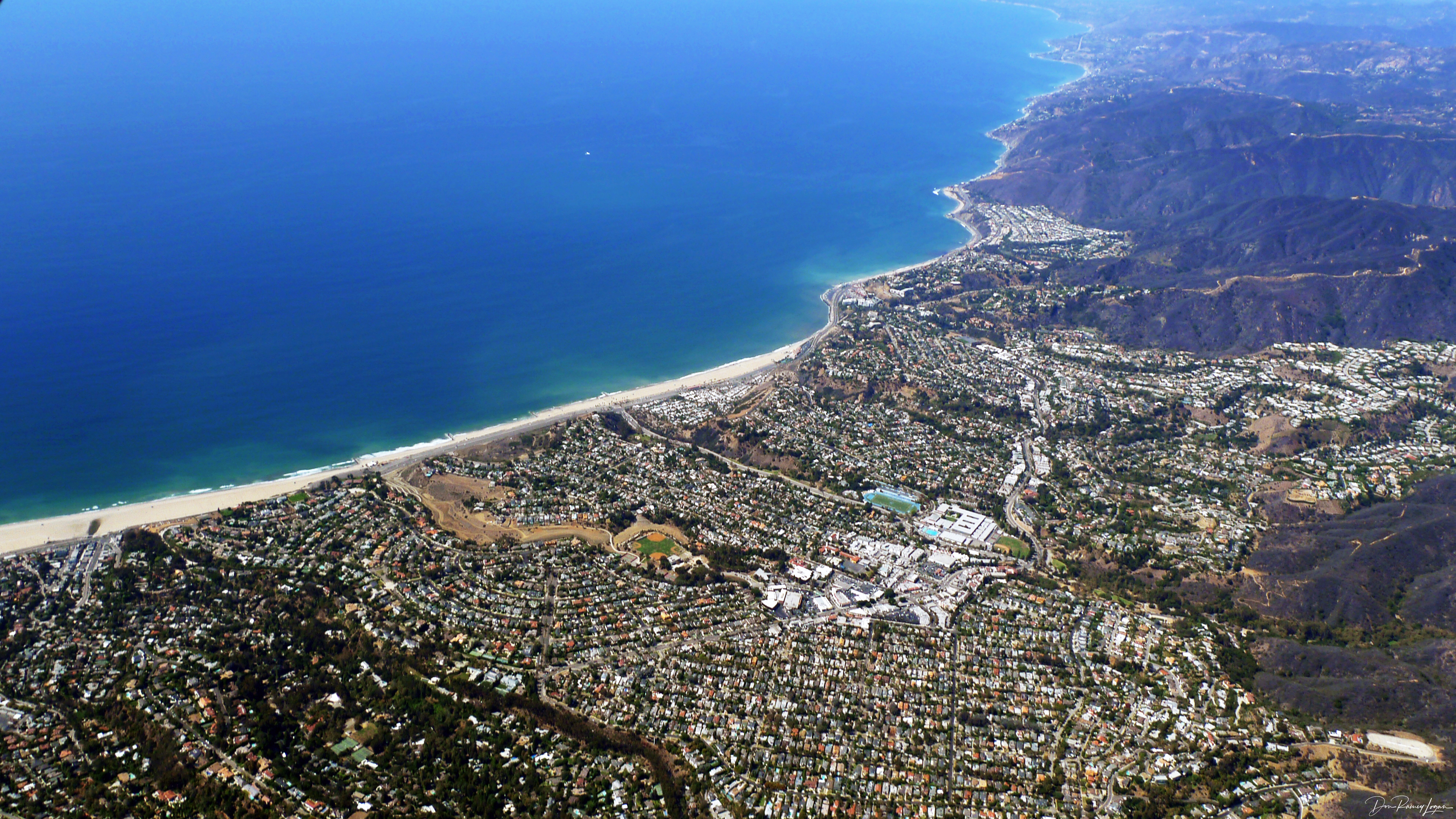
Pacific Palisades is a neighborhood in the Westside region of the city of Los Angeles, California, situated about 20 miles (32 km) west of downtown. It was founded in 1921 by a Methodist organization, and is known for its seclusion, Mediterranean climate, hilly topography, abundance of parkland and hiking trails, a 3-mile (4.8 km) strip of coastline, and for being home to several architecturally significant homes.
The neighborhood is bounded by Brentwood to the east, the unincorporated community of Topanga to the west, Santa Monica to the southeast, the Santa Monica Bay to the southwest, and the Santa Monica Mountains to the north. Parks and beaches in the Palisades include the Santa Monica State Beach, Will Rogers State Beach, Santa Monica Mountains National Recreation Area, and Will Rogers State Historic Park.
In January 2025, thousands of structures were destroyed by the Palisades Fire, amounting to several billion dollars in damages, as part of the wider outbreak of Southern California wildfires.
History
Native American period
Archeological evidence shows Native American Indians living in the Santa Monica Mountains and the surrounding area including Pacific Palisades for over 10,000 years. Prior to European contact, the western sections of the Santa Monica mountains were inhabited by the Tongva people. The closest Tongva settlement to Pacific Palisades with a written record is the village of Topa'nga. The village of Topa'nga sits on the westernmost edge of Tongva territory, neighboring the territory of the Chumash people to the north. Due to this close proximity to the Chumash, the culture in western Tongva territory contained elements of Chumash influence.
Mexican period
During the period of Mexican rule of California, the land that became Pacific Palisades belonged to Rancho Boca de Santa Monica, granted by the governor of California to Francisco Marquez and Ysidro Reyes in 1839. The Ysidro Reyes Adobe was the first adobe home ever built in Santa Monica Canyon, erected in the year 1838 on land now known as Pampas Ricas Blvd in Pacific Palisades. Sketches of adobe dwelling exist in the collection of the UCLA Library. A memorial plaque sits in a boulder on Pampas Ricas Blvd commemorating the adobe house, dedicated in the 1950s. Ysidro Reyes died in 1863. Reyes left his portion of Rancho Boca de Santa Monica to his widow, Maria Antonia Villa, who sold it to developer and railroad magnate Robert Symington Baker in 1875.
1911–1922: Inceville and Hartville
In 1911, film director Thomas Ince constructed his historic film studio Inceville on a 460-acre (1.9 km2) tract of land he leased called Bison Ranch at Sunset Boulevard and Pacific Coast Highway in the Santa Monica Mountains. Today this is where the Self-Realization Fellowship Lake Shrine is located, a Pacific Palisades landmark. By the following year, Ince had earned enough money to purchase the ranch and was able to lease an additional 18,000 acres (73 km2) lot in what is now in the Palisades Highlands neighborhood, stretching 7.5 miles (12.1 km) up Santa Ynez Canyon. This was the first major development built in the Palisades since the Mexican rancho era.
This was the first studio in the area which featured silent stages, production offices, printing labs, a commissary large enough to serve lunch to hundreds of workers, dressing rooms, props houses, elaborate sets, all in one central location.
When Inceville was completed, the streets were lined with many types of structures, from humble cottages to mansions, mimicking the style and architecture of different countries. Extensive outdoor western sets were built and used on the site for several years. According to Katherine La Hue in her book, Pacific Palisades: Where the Mountains Meet the Sea:
Ince invested $35,000 in building, stages and sets ... a bit of Switzerland, a Puritan settlement, a Japanese village ... beyond the breakers, an ancient brigantine weighed anchor, cutlassed men swarming over the sides of the ship, while on the shore performing cowboys galloped about, twirling their lassos in pursuit of errant cattle ... The main herds were kept in the hills, where Ince also raised feed and garden produce. Supplies of every sort were needed to house and feed a veritable army of actors, directors and subordinates.
While the cowboys, Native Americans and assorted workers lived at Inceville, the main actors came from Los Angeles and other communities as needed, often taking the red trolley cars to the Long Wharf in what is now the Temescal Canyon neighborhood, where buckboards conveyed them to the set.
Ince lived in a house overlooking the vast studio in what is now the Marquez Knolls neighborhood. Indeed, "Inceville" became a prototype for Hollywood film studios of the future, with a studio head (Ince), producers, directors, production managers, production staff, and writers all working together under one organization and under the supervision of a General Manager, Fred J. Balshofer.
On January 16, 1916, a fire broke out at Inceville, the first of many that eventually destroyed all of the buildings. Ince later gave up on the studio and sold it to William S. Hart, who renamed it Hartville. Three years later, Hart sold the lot to Robertson-Cole Pictures Corporation, which continued filming there until 1922. La Hue writes that the place was virtually a ghost town when the last remnants of Inceville were burned on July 4, 1922, leaving only a "weatherworn old church, which stood sentinel over the charred ruins."
1921–1931: Methodist Episcopal Church
A decade later, the Rev. Charles H. Scott and the Southern California Methodist Episcopal Church bought the land; in 1922, Scott founded Pacific Palisades, envisioning an elaborate religious-intellectual commune. Believers snapped up choice lots and lived in tents during construction. By 1925, the Palisades had 100 homes. In one subdivision, streets were named in alphabetical order for Methodist missionaries (the "Alphabet Streets"). The tents eventually were replaced by cabins, then by bungalows, and ultimately by multimillion-dollar homes. The climate of the area was a big selling point. Temperatures are much cooler than inland Los Angeles during summer, but usually sunnier and less foggy than areas south along the coast (e.g. Santa Monica).
The name "Pacific Palisades" comes from the term for a tall wooden fence or defensive wall, by analogy with the cliff-like bluffs situated on the western side of the neighborhood bordered by the Pacific Ocean. These bluffs were said to resemble those in the Palisades section of New Jersey, on the western side of the lower Hudson River.
Pacific Palisades enjoyed steady growth throughout the Roaring 20s. The paving of Sunset Boulevard in 1925 brought an increased flow of traffic through the community and offered more convenient access to nearby Westwood and Beverly Hills.
In 1928, the Los Angeles Police Department began renting temporary office space in the now-historic Business Block building for the price of $10 a month. The following year, a motorcycle officer was assigned to make nightly patrols in the area. The Palisades finally acquired its own fire station in 1929, located on Sunset, adjacent to where the local Chase Bank branch now stands in the Village neighborhood.
By 1929 the town consisted of about 365 homes with about 1,000 residents, who mostly resided in the "Alphabet Streets" neighborhood, although residential construction was now expanding into what would later become the Castellammare, Huntington and Paseo Miramar neighborhoods. On August 18 of that year, the cornerstone was laid for the foundation of the Methodist Episcopal Church on Via de la Paz, which at that time was the community's only church. Directly across the street, planning was underway for the town's first permanent school building which would later become known as "Palisades Elementary", which was dedicated on June 12, 1931.
By the end of the decade, nearly all remaining open areas of Pacific Palisades were being developed, reflecting the period's booming growth and the Palisades' coastal allure. Golfers were already enjoying the Riviera Country Club, opened in 1927, and the Bel-Air Bay Club opened in March 1930.
1930–present
During the 1930s and 40s, the Palisades attracted German, German-Jewish and Austrian-Jewish intellectuals and artists fleeing from Hitler’s Holocaust, including associated with the Exilliteratur literary movement, such as Thomas Mann, Lion Feuchtwanger, Theodor W. Adorno, Vicki Baum, Herbert Zipper, and Emil Ludwig. Some of these exiles had previously sought refuge in the south of France, but fled to the United States after the fall of France. They were surprised by the similarities with the Mediterranean climate and topography. Villa Aurora on Paseo Miramar, the Spanish colonial home of Feuchtwanger and his wife, Marta, became the focal point of the expatriate community, which was nicknamed "Weimar by the Sea". Some non-Jewish exiles who were married to people with Jewish ancestry chose to settle in the Palisades as well, such as Thomas Mann and his wife Katia Mann who resided at 1550 San Remo Drive in the Riviera neighborhood.
Content sourced from Wikipedia under CC BY-SA 4.0


