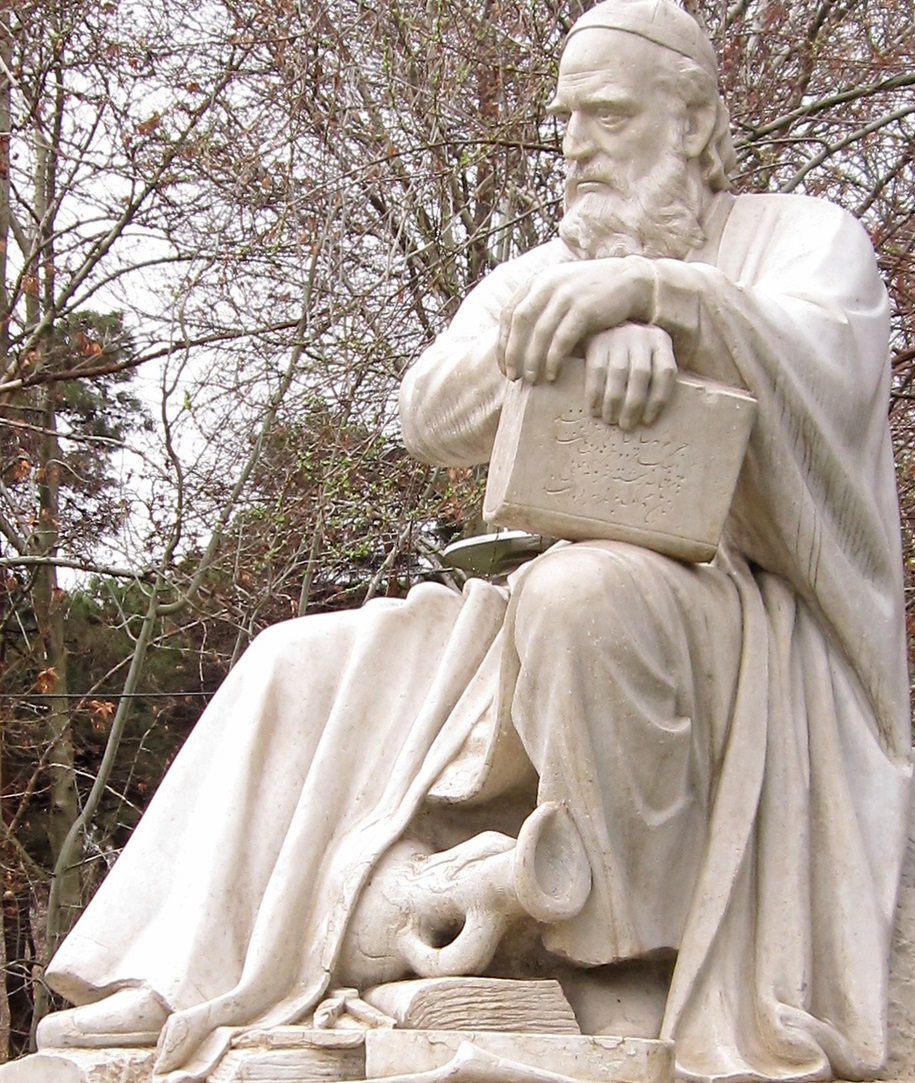
Omar Khayyam
Persian polymath and poet (1048–1131)
Omar Khayyam (1048–1131) was a Persian poet and polymath, known for his contributions to mathematics, astronomy, philosophy, and Persian literature. He was born in Nishapur, Iran and lived during the Seljuk era, around the time of the First Crusade.
As a mathematician, Omar Khayyam was the first to provide a general solution for all third-degree equations by using the intersection of two conic sections, a method often later attributed to Descartes. Unlike Descartes, Khayyam performed these geometric calculations by selecting a unit length while strictly adhering to the rule of homogeneity. Additionally, in his work On the Division of a Quarter of a Circle, he attempted to derive approximate numerical solutions for cubic equations using trigonometric tables. He also contributed to a deeper understanding of Euclid's parallel axiom. The Saccheri quadrilateral is sometimes called a Khayyam–Saccheri quadrilateral to credit Omar Khayyam who described it in his 11th century book Risāla fī šarḥ mā aškala min muṣādarāt kitāb Uqlīdis (Explanations of the difficulties in the postulates of Euclid). As an astronomer, he calculated the duration of the solar year with remarkable precision and accuracy, and designed the Jalali calendar, a solar calendar with a very precise 33-year intercalation cycle which provided the basis for the Persian calendar that is still in use after nearly a millennium.
There is a tradition of attributing poetry to Omar Khayyam, written in the form of quatrains (rubāʿiyāt رباعیات). This poetry became widely known to the English-reading world in a translation by Edward FitzGerald (Rubaiyat of Omar Khayyam, 1859), which enjoyed great success in the Orientalism of the fin de siècle.
Life
Ghiyāth al-Dīn Abū al-Fatḥ ʿUmar ibn Ibrāhīm Nīshāpūrī was born in Nishapur—a metropolis in Khorasan province of the Seljuk Empire, of Persian stock, in 1048. In medieval Persian texts he is usually simply called Omar Khayyam. Although open to doubt, it has often been assumed that his forebears followed the trade of tent-making, since Khayyam means 'tent-maker' in Arabic. The historian Bayhaqi, who was personally acquainted with Khayyam, provides the full details of his horoscope: "he was Gemini, the sun and Mercury being in the ascendant[...]". This was used by modern scholars to establish his date of birth as 18 May 1048.
Khayyam's boyhood was spent in Nishapur, a leading metropolis in the Seljuk Empire, which had earlier been a major center of the Zoroastrian religion. His full name, as it appears in Arabic sources, was Abu’l Fath Omar ibn Ibrahim al-Khayyam. Having memorized much of the Quran at a young age, Khayyam studied religious sciences, Arabic grammar, and literature under Mawlana Qadi Muhammad. He later transferred to the tutelage of Khawjah Abu’l-Hasan al-Anbari to pursue mathematics, astronomy, and cosmological doctrines, including Ptolemy's major work, the Almagest. His gifts were recognized by his early tutors, who sent him to study under Imam Muwaffaq Nishaburi, the greatest teacher of the Khorasan region, who tutored the children of the highest nobility, and Khayyam developed a firm friendship with him through the years. Khayyam might have met and studied with Bahmanyar, a disciple of Avicenna. After studying science, philosophy, mathematics and astronomy at Nishapur, about the year 1068 he traveled to the province of Bukhara, where he frequented the renowned library of the Ark. In about 1070 he moved to Samarkand, where he started to compose his famous Treatise on Algebra under the patronage of Abu Tahir Abd al-Rahman ibn ʿAlaq, the governor and chief judge of the city. Khayyam was kindly received by the Karakhanid ruler Shams al-Mulk Nasr, who according to Bayhaqi, would "show him the greatest honour, so much so that he would seat [Khayyam] beside him on his throne".
In 1073–4 peace was concluded with Sultan Malik-Shah I, who had made incursions into Karakhanid dominions. Khayyam entered the service of Malik-Shah in 1074 when he was invited by the Grand Vizier Nizam al-Mulk to meet Malik-Shah in the city of Marv. Khayyam was subsequently commissioned to set up an observatory in Isfahan and lead a group of scientists in carrying out precise astronomical observations aimed at the revision of the Persian calendar. The undertaking probably began with the opening of the observatory in 1074 and ended in 1079, when Omar Khayyam and his colleagues concluded their measurements of the length of the year, reporting it as 365.24219858156 days. Given that the length of the year is changing in the sixth decimal place over a person's lifetime, this is outstandingly accurate. For comparison, the length of the year at the end of the 19th century was 365.242196 days, while today it is 365.242190 days.
After the death of Malik-Shah and his vizier (murdered, it is thought, by the Ismaili order of Assassins), Khayyam fell from favor at court, and as a result, he soon set out on his pilgrimage to Mecca. A possible ulterior motive for his pilgrimage reported by Al-Qifti, was a public demonstration of his faith with a view to allaying suspicions of skepticism and confuting the allegations of unorthodoxy (including possible sympathy or adherence to Zoroastrianism) levelled at him by a hostile clergy. He was then invited by the new Sultan Sanjar to Marv, possibly to work as a court astrologer. He was later allowed to return to Nishapur owing to his declining health. Upon his return, he seems to have lived the life of a recluse.
Omar Khayyam died at the age of 83 in his hometown of Nishapur on 4 December 1131, and he is buried in what is now the Mausoleum of Omar Khayyam. One of his disciples Nizami Aruzi relates the story that sometime during 1112–3 Khayyam was in Balkh in the company of Isfizari (one of the scientists who had collaborated with him on the Jalali calendar) when he made a prophecy that "my tomb shall be in a spot where the north wind may scatter roses over it". Four years after his death, Aruzi located his tomb in a cemetery in a then large and well-known quarter of Nishapur on the road to Marv. As it had been foreseen by Khayyam, Aruzi found the tomb situated at the foot of a garden-wall over which pear trees and apricot trees had thrust their heads and dropped their flowers so that his tombstone was hidden beneath them.
Mathematics
Khayyam was famous during his life as a mathematician. His surviving mathematical works include
- (i) Commentary on the Difficulties Concerning the Postulates of Euclid's Elements (Risāla fī Sharḥ mā Ashkal min Muṣādarāt Kitāb Uqlīdis), completed in December 1077,
- (ii) Treatise On the Division of a Quadrant of a Circle (Risālah fī Qismah Rub‘ al-Dā’irah), undated but completed prior to the Treatise on Algebra, and
- (iii) Treatise on Algebra (Risālah fi al-Jabr wa'l-Muqābala), most likely completed in 1079.
He furthermore wrote a treatise on the binomial theorem and extracting the nth root of natural numbers, which has been lost.
Theory of parallels
Part of Khayyam's Commentary on the Difficulties Concerning the Postulates of Euclid's Elements deals with the parallel axiom. The treatise of Khayyam can be considered the first treatment of the axiom not based on petitio principii, but on a more intuitive postulate. Khayyam refutes the previous attempts by other mathematicians to prove the proposition, mainly on grounds that each of them had postulated something that was by no means easier to admit than the Fifth Postulate itself. Drawing upon Aristotle's views, he rejects the usage of movement in geometry and therefore dismisses the different attempt by Ibn al-Haytham. Unsatisfied with the failure of mathematicians to prove Euclid's statement from his other postulates, Khayyam tried to connect the axiom with the Fourth Postulate, which states that all right angles are equal to one another.
Khayyam was the first to consider the three distinct cases of acute, obtuse, and right angle for the summit angles of a Khayyam-Saccheri quadrilateral. After proving a number of theorems about them, he showed that Postulate V follows from the right angle hypothesis, and refuted the obtuse and acute cases as self-contradictory. His elaborate attempt to prove the parallel postulate was significant for the further development of geometry, as it clearly shows the possibility of non-Euclidean geometries. The hypotheses of acute, obtuse, and right angles are now known to lead respectively to the non-Euclidean hyperbolic geometry of Gauss-Bolyai-Lobachevsky, to that of elliptic geometry, and to Euclidean geometry.
Content sourced from Wikipedia under CC BY-SA 4.0


