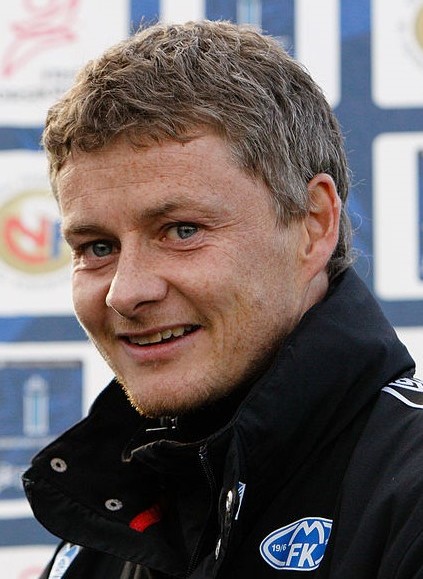
Ole Gunnar Solskjær
Norwegian footballer and manager (born 1973)
Ole Gunnar Solskjær (Norwegian pronunciation: [ˈûːlə ˈɡʉ̂nːɑr ˈsûːlʂæːr] ; born 26 February 1973) is a Norwegian professional football manager and former player, who was most recently manager of Beşiktaş. He spent the majority of his playing career with Manchester United and made 67 appearances for the Norway national team.
A forward, Solskjær began his career in his native Norway with Clausenengen, where he scored 115 goals in 109 league appearances over five seasons, helping the club earn promotion to the Norwegian Second Division in 1993. He then moved to Molde, newly promoted to the highest league in Norway, Tippeligaen, for the 1995 season. His goals helped Molde finish second and qualify for the UEFA Cup.
In July 1996, Solskjær joined Manchester United for a transfer fee of £1.5 million. Nicknamed "the Baby-faced Assassin", he made 366 appearances for United and scored 126 goals during a successful period for the club. Renowned as a "super-sub" for his knack of scoring late goals off the bench, he famously netted the dramatic injury-time winner against Bayern Munich in the 1999 UEFA Champions League final. That goal secured the treble for United, who had trailed 1–0 as the match entered stoppage time. He remained a regular player for the side until a serious knee injury sustained in 2003 began to plague his career. After several attempts to return, he announced his retirement from football in 2007.
Solskjær remained at Manchester United after retiring, taking on both a coaching role and ambassadorial duties. In 2008, he was appointed manager of the club's reserve team. He returned to Norway in 2011 to manage his former club, Molde, leading them to their first-ever Tippeligaen titles in his first two seasons. He added a third major honour by winning the 2013 Norwegian Football Cup. In 2014, Solskjær took charge of Cardiff City, though the club was relegated from the Premier League during his tenure. In late 2018, he returned to Manchester United as caretaker manager following the departure of José Mourinho, taking charge for the remainder of the 2018–19 season.
On 28 March 2019, after winning 14 of his first 19 matches in charge, Solskjær was appointed manager of Manchester United on a permanent basis with a three-year contract. He led the club to the 2021 UEFA Europa League final, where they were defeated by Villarreal in a penalty shoot-out. Following a poor run of results during the 2021–22 season, he was sacked by the club in November 2021. In January 2025, after three years out of management, Solskjær was appointed manager of Turkish Süper Lig club Beşiktaş, but was sacked in August 2025 after failing to qualify for European football.
Early life
Solskjær was born in Kristiansund, Møre og Romsdal to Øyvind, a Greco-Roman wrestling champion, and Brita Solskjær. At the age of seven, he joined local football club Clausenengen, who were in the 3. divisjon. Solskjær supported Liverpool as a child. Between the ages of eight and ten, he followed in his father's footsteps and trained as a Greco-Roman wrestler, but gave it up due to being tossed around too much. Between 1992 and 1993, Solskjær completed a mandatory year's national service in the Norwegian Army.
Club career
Early career at Clausenengen
Solskjær debuted for Clausenengen (CFK) at 17 years old in 1990. He participated in the Otta Cup, scoring seventeen goals in six matches. On 21 May 1993, CFK faced Molde in the Norwegian Football Cup, with Solskjær scoring Clausenengen's only goal in their 6–1 defeat. Clausenengen were promoted to the 2. divisjon in 1993, winning the 3. division by 12 points. Solskjær's final season at the club was in 1994, with him scoring 31 of CFK's 47 goals, helping the club achieve a mid-table finish of sixth place. In Solskjær's five years playing for Clausenengen, he averaged more than a goal a game in the league, scoring 115 goals in 109 matches.
Molde
1995 season
On 14 February 1995, ahead of the start of the new season, he was signed by Åge Hareide, manager of newly promoted top-flight club Molde, for a fee of NOK150,000. On 22 April 1995, Solskjær made his debut for Molde against Brann, scoring twice in a 6–0 victory. In his second game on 29 April, Solskjær scored a hat-trick helping Molde 5–4 win over Viking. On 14 May, he scored another brace in a 2–1 win over Hamarkameratene. Two days later, he netted a hat-trick as Molde thrashed Hødd 7–2. Solskjær scored a penalty in Molde's 4–1 victory over Strindheim on 30 July.
On 10 August, Solskjær played in his first European competition, the qualification round for UEFA Cup Winners' Cup, against Belarusian team Dinamo-93 Minsk. Molde conceded in the first half but Solskjær managed to equalise in the 85th minute. He also scored in the second leg as Molde won 2–1 (3–2 on aggregate) and qualified for the UEFA Cup Winners' Cup proper. Molde were subsequently drawn against French team Paris Saint-Germain, Solskjær scored in the first leg on 14 September as the team lost 3–2 at Molde Stadion. He played in the away leg on 28 September, but Molde were outmatched and lost 3–0. Molde finished the season in second place, runners-up to Rosenborg by 15 points. In Solskjær's first season at Molde, he scored 20 goals in 26 matches in the 1995 Tippeligaen. Solskjær also formed a good strike-partnership with fellow forwards Arild Stavrum and Ole Bjørn Sundgot; because their surnames all started with the same letter, this led to them being referred to as "The Three S's".
1996 season
Solskjær began the 1996 Tippeligaen in defeat, losing 2–0 to Rosenborg. However, in his next match on 21 April 1996 against Moss, he scored a hat-trick as Molde won 8–0. He scored a brace against Tromsø on 19 May in a 3–0 victory, and his goal-scoring form led to interest from Hamburg of Germany and Italian club Cagliari. Molde's then-manager, Åge Hareide, made Solskjær available to both Everton and Hareide's old club Manchester City for £1.2 million. However, neither Everton nor City were willing to take a risk on Solskjær, and the interest from Hamburg and Cagliari fell through after Manchester United submitted a bid of £1.5 million during Euro 1996, which Molde accepted. Solskjær made his final appearance for Molde on 21 July 1996 in a 5–1 win against Start, scoring the fourth goal in the 85th minute, before throwing his shirt to the crowd in celebration and receiving applause as he was substituted. He finished his time at Molde with 41 goals in 54 games in all competitions.
Manchester United
1996–97 season: Debut
Solskjær joined Manchester United under Alex Ferguson on 29 July 1996, and was something of a surprise acquisition as he was almost unknown outside his homeland and at the time United were still in the hunt for Blackburn Rovers and England striker Alan Shearer, who then joined Newcastle United for a world-record £15 million. As the only striker to arrive at Old Trafford that year, it was widely expected that his first season would be spent as a backup to Eric Cantona and Andy Cole with only occasional first-team opportunities. However, within weeks of his arrival it was clear that he would be a key part of the first team sooner than had been anticipated, and would also prove himself to be one of the biggest Premier League bargains of the season.
He was issued with the number 20 shirt for the 1996–97 season, a squad number he would retain for the rest of his Manchester United career. He scored six minutes into his debut as a substitute against Blackburn Rovers on 25 August 1996, after replacing David May in the 64th minute. Solskjær made his first start on 14 September in a 4–1 win against Nottingham Forest, scoring United's first goal in the 22nd minute. On 25 September, he netted his first European goal for Manchester United in their 2–0 win over Rapid Wien, opening the scoring in the 20th minute. He scored his first brace for United against Tottenham Hotspur on 29 September, scoring the only goals of the game in the 38th and 58th minutes.
On 21 December, Solskjær scored his second brace of the season as United beat Sunderland 5–0, scoring in the 35th and 48th minutes. The Norwegian started in both of United's UEFA Champions League semi-final matches against Borussia Dortmund, which United lost 2–0 on aggregate to the eventual winners. He scored his third brace on 3 May 1997 against Leicester City in a 2–2 draw, netting in the 45th and 51st minutes. United clinched the title after Newcastle drew away at West Ham on 6 May, thus Solskjær won his first Premier League title. Solskjær scored 18 Premier League goals in 33 appearances (25 of which were starts) for United in his first season – the club's top goalscorer for that campaign. The British media nicknamed him "the Baby-faced Assassin" because of his youthful looks and his deadly finishing.
Content sourced from Wikipedia under CC BY-SA 4.0


