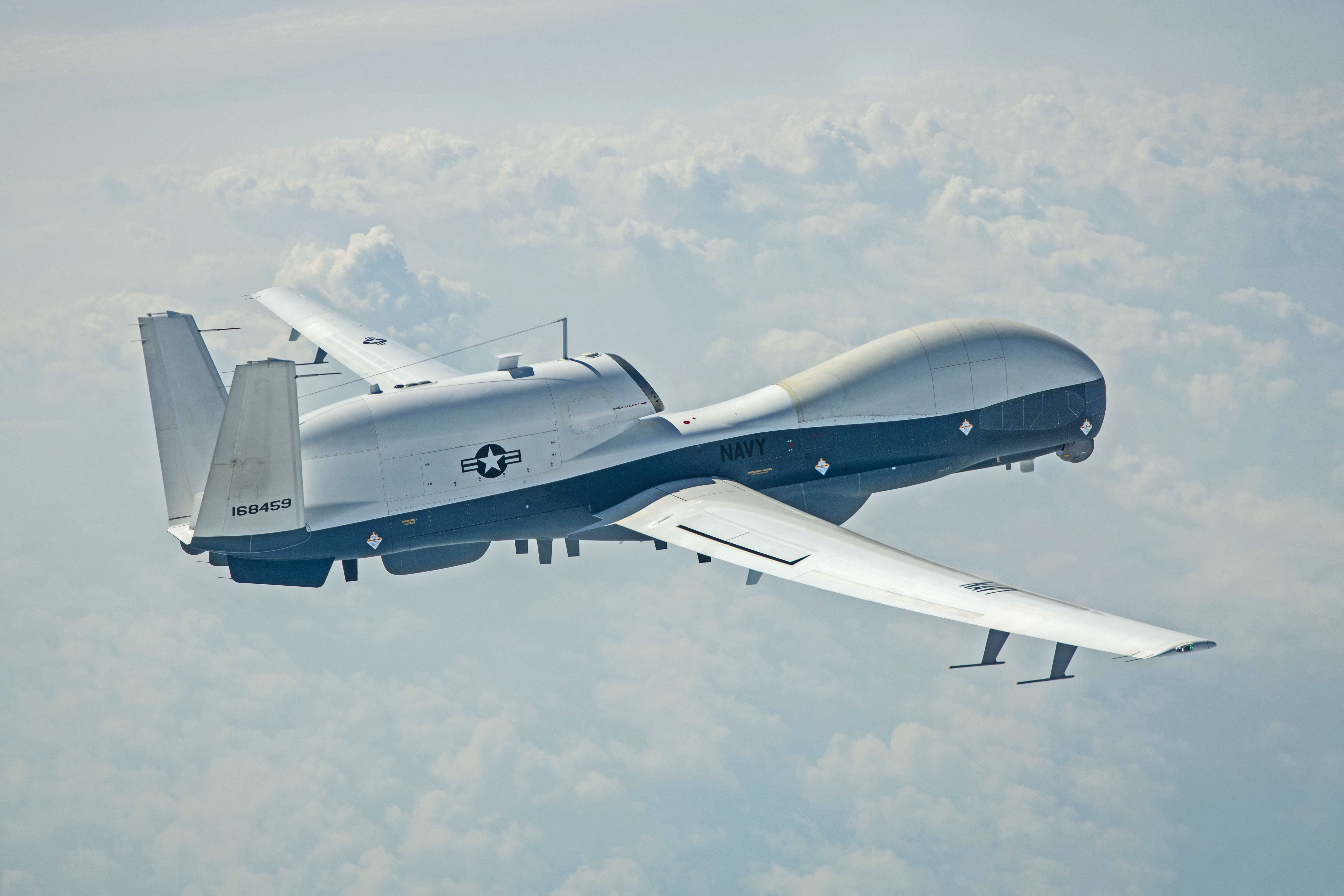
Northrop Grumman MQ-4C Triton
Maritime version of RQ-4 Global Hawk
The Northrop Grumman MQ-4C Triton is an American high-altitude long endurance unmanned aerial vehicle (UAV) developed for and flown by the United States Navy and Royal Australian Air Force as a surveillance aircraft. Together with its associated ground control station, it is an unmanned aircraft system (UAS). Developed under the Broad Area Maritime Surveillance (BAMS) program, the Triton is intended to provide real-time intelligence, surveillance and reconnaissance missions (ISR) over vast ocean and coastal regions, continuous maritime surveillance, conduct search and rescue missions, and to complement the Boeing P-8 Poseidon maritime patrol aircraft.
Triton builds on elements of the RQ-4 Global Hawk; changes include reinforcements to the airframe and wing, de-icing systems, and lightning protection systems. These allow the aircraft to descend through cloud layers to gain a closer view of ships and other targets at sea. The sensor suites help track ships by gathering their speed, location, and classification.
The MQ-4C System Development and Demonstration (SDD) aircraft was delivered in 2012 and the MQ-4C was expected to be operational with the US Navy by late 2015 with a total of 67 aircraft to be procured for the US Navy. Initial Operational Capability (IOC) for the MQ-4C was achieved in 2018 with Full Operating Capability (FOC) planned in 2023. Australia has ordered four Tritons, with the first entering service in June 2024.
Development
Key features
- Provides persistent maritime ISR 24 hours/7 days per week with 80% Effective Time on Station (ETOS)
- AN/ZPY-3 Multi-Function Active Sensor (MFAS) with active electronically scanned array
- Land-based air vehicle and sensor command and control
- 51,000-hour airframe life
- Due regard radar for safe separation
- Commercial off-the-shelf open architecture mission control system
- Net-ready interoperability solution (systems working together)
- Communications bandwidth management
- Dual redundant flight controls and surfaces
- Afloat Level II payload sensor data via line-of-sight
Contract competition
The competitors for the Broad Area Maritime Surveillance (BAMS) contract included:
- Boeing, with an unmanned version of the Gulfstream G550 business jet. It was optionally manned and has "commonality with other Boeing-built naval aircraft."
- Northrop Grumman, with a navalized RQ-4 Global Hawk. In order to begin testing the surveillance package early, Northrop Grumman contracted with Flight Test Associates of the Mojave Spaceport to modify a Grumman Gulfstream II as a flying testbed. California based aerospace company Swift Engineering also supported Northrop Grumman on the design and manufacturing of composite structures.
- Lockheed Martin, with a General Atomics MQ-9 Mariner
The BAMS UAS was acquired for the U.S. Navy as a Department of Defense Acquisition Category (ACAT) 1D program and on 22 April 2008, Northrop Grumman received the BAMS contract worth $1.16 billion. Lockheed Martin filed a formal protest with the U.S. Government Accountability Office (GAO) two weeks later. On 11 August 2008 the GAO upheld the Navy's selection of Northrop Grumman. In September 2010, the BAMS aircraft was designated the MQ-4C.
Initial development
During the official unveiling ceremony on 14 June 2012 at Palmdale, California, Navy officials announced that the aircraft had been named Triton. The first flight of the MQ-4C—aircraft Bureau Number (BuNo) 168457—occurred on 22 May 2013, followed by test flights at Edwards Air Force Base, California, and Naval Air Station Patuxent River, Maryland. Initial operational capability (IOC) was planned for December 2015 but slipped to 2017.
The U.S. Navy planned to buy 68 MQ-4Cs and 117 P-8As to replace its aging P-3C Orions. About 40 MQ-4Cs will be based at various sites, predominantly home stations or overseas deployment sites for Navy P-8A and P-3C aircraft. This includes an unspecified location in Hawaii (most likely MCAS Kaneohe Bay); NAS Jacksonville, Florida; Kadena Air Base, Japan; NAS Point Mugu, California, and NAS Sigonella, Italy. The Air Force Times reported on 14 September 2012, that the system will also be stationed at Andersen Air Force Base, Guam.
In August 2013, the Navy paused the development of the "sense and avoid" radar system that would enable the MQ-4C to avoid other aircraft. The Triton would have been the first unmanned aircraft to be fitted with such a system, but the system was behind schedule and over budget. The radar system remains a requirement in the program, but budgetary and technology pressures have forced the Navy to defer integrating it onto the aircraft. The Navy and Northrop Grumman are working to determine when the sense-and-avoid system can be included into the production line.
The Navy restarted the competition for a sense-and-avoid radar for the Triton in November 2014 with less ambitious requirements, including the ability to use data from ground radars as it approaches an airport, and a modular and scalable design that can be incrementally improved to meet evolving future operational and air traffic management requirements.
On 6 September 2013, the Navy awarded Northrop Grumman a $9.98 million contract for maintenance and support of the MQ-4C SDD aircraft to enable it to fly 15 missions per month, an increase from 9 per month as previously planned, with senior Navy commanders wanting to keep closer surveillance of activities in the ocean and coastal regions of the Middle East.
The Navy began considering in September 2014 cutting the number of Tritons it plans to buy. The intention was to have 20 MQ-4C aircraft operational at any one time, with the rest of the 68-plane order force being spares. In September 2015, the DoD Inspector General found the 70-aircraft force requirement justified. But the Navy decided in May 2023 to reduce the number of MQ-4C aircraft it would procure. The number of deployment sites was reduced from five to three, reducing the number of Tritons required to 12. Another 15 will be available for attrition, training, and maintenance for a revised total program of record procurement of 27 aircraft.
International sales
Australia
Australia has considered the MQ-4C, both as a military platform and as customs enforcement platform; senior customs officials have doubted the effectiveness of the planned seven MQ-4Cs to detect small boats in the country's northern waters, especially through cloud cover. In 2013, Air Marshal Geoff Brown, head of the Royal Australian Air Force, stated that Australia was considering purchasing more manned P-8A Poseidon aircraft and reducing the number of MQ-4Cs planned to be bought for the RAAF.
On 16 February 2014, it was reported that the Australian government would seek the purchase of seven Tritons; in addition to locating ships and aircraft, it would also be used to detect seaborne asylum seekers. Alongside the P-8A, the MQ-4C is to replace the elderly AP-3C Orion fleet.
On 13 March 2014, Prime Minister Tony Abbott announced Australia's intention to buy the MQ-4C Triton and become its first foreign customer. The announcement was made at RAAF Base Edinburgh, the base of the country's fleet of eighteen AP-3C Orion aircraft it will replace. The Triton buy is part of the Australian Defence Force's Project Air 7000 two-phase Orion replacement program; Phase 1B entails procuring the Triton, and Phase 2B was the acquisition of eight to twelve manned P-8A Poseidons in 2017. RAAF Tritons and Poseidons will be used in a similar complementary fashion as with U.S. Navy operations, where the MQ-4C performs high-altitude broad area maritime surveillance missions, allowing the P-8A to be more dedicated to anti-submarine and anti-surface warfare, search and rescue response, and electronic intelligence missions.
The Australian Government confirmed in its 2016 Defence White Paper that the Royal Australian Air Force was to acquire seven MQ-4C Triton aircraft as part of its "Intelligence, Surveillance and Reconnaissance capability stream".
On 26 June 2018, Australian Prime Minister Malcolm Turnbull announced the purchase of the first of six MQ-4C Tritons with consideration being given to purchase a seventh.
As of 2023, Australia had placed orders for four Tritons. A further two or three may be ordered in the future to meet a RAAF requirement for six to seven of the type. No. 9 Squadron was re-raised to operate the Tritons in June 2023, ahead of the expected delivery of the RAAF's first Triton in 2024. The first RAAF Triton arrived in Australia on 16 June 2024 and three are currently in service.
India
Northrop Grumman has also proposed the MQ-4C to India; the Indian Navy have considered the UAV in a complementary role to the twelve Boeing P-8I Poseidon maritime patrol aircraft it has on order.
Rumored sales
On 20 July 2014 there was a rumor that the UK planned to purchase a minimum eight MQ-4Cs to replace the cancelled BAE Systems Nimrod MRA4 after defence chiefs stated that the UK's nuclear deterrent Trident may have been compromised to the Russians. In the Strategic Defence and Security Review 2015 there was no such mention of a buy and that report is negated.
Norway will develop and operate maritime surveillance drones from Andøya Air Station, and the MQ-4C is rumored to be the main contender for the initial capability.
Content sourced from Wikipedia under CC BY-SA 4.0


