Northrop B-2 Spirit
American heavy strategic bomber
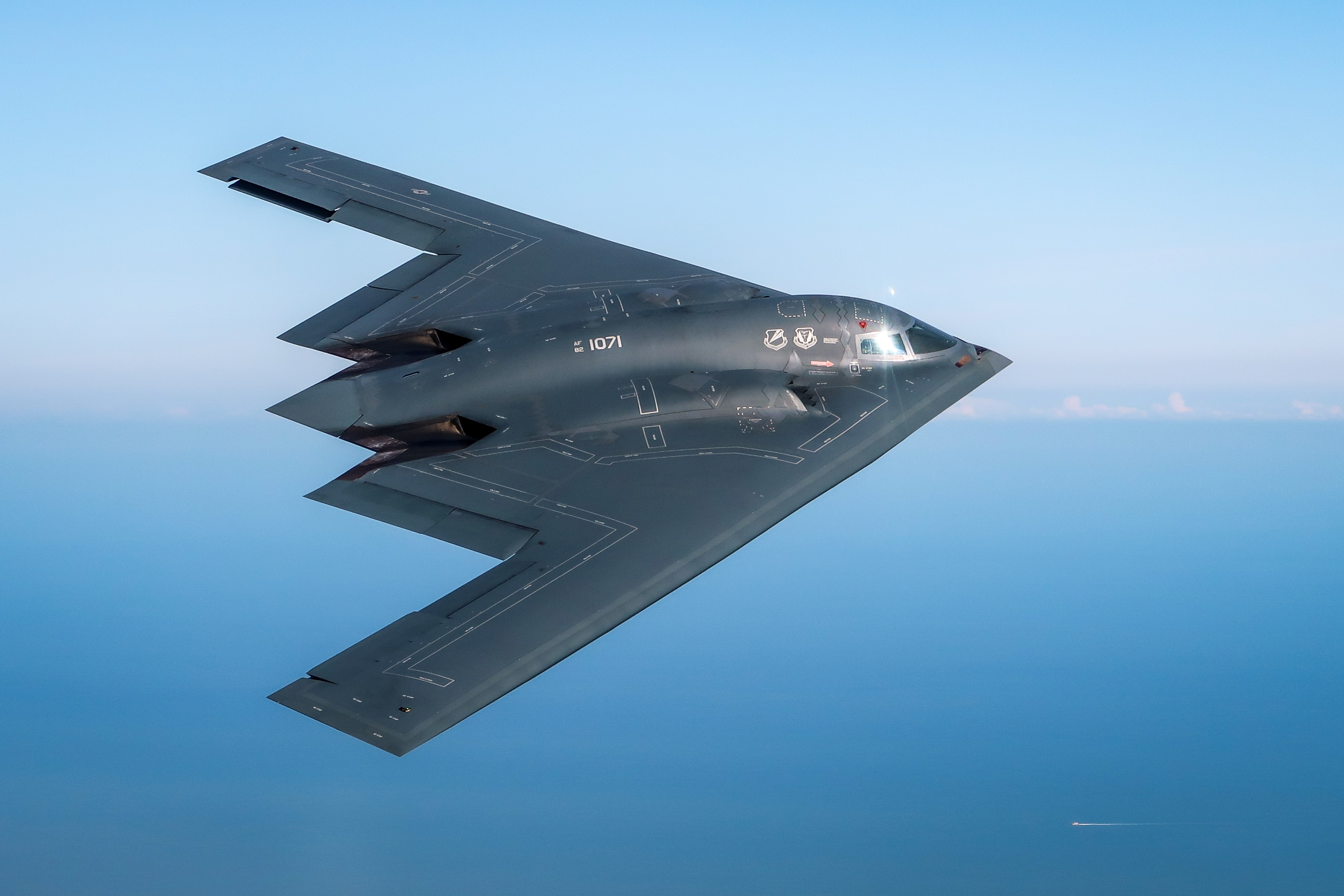
The Northrop B-2 Spirit is an American heavy strategic bomber that uses low-observable stealth technology to penetrate sophisticated anti-aircraft defenses. It is often referred to as a stealth bomber.
A subsonic flying wing and lambda wing with a crew of two, the B-2 was designed by Northrop (later Northrop Grumman) as the prime contractor, with Boeing, Hughes Aircraft Company, and Vought as principal subcontractors. It was produced from 1988 to 2000. The bomber can drop conventional and thermonuclear weapons, such as up to eighty 500-pound class (230 kg) Mk 82 JDAM GPS-guided bombs, or sixteen 2,400-pound (1,100 kg) B83 nuclear bombs. The B-2 is the only acknowledged in-service aircraft that can carry large air-to-surface standoff weapons in a stealth configuration.
Development began under the Advanced Technology Bomber (ATB) project during the Carter administration, which cancelled the Mach 2-capable B-1A bomber in part because the ATB showed such promise, but development difficulties delayed progress and drove up costs. Ultimately, the program produced 21 B-2s at an average cost of $2.13 billion each (~$4.27 billion in 2025 dollars), including development, engineering, testing, production, and procurement. Building each aircraft cost an average of US$737 million, while total procurement costs (including production, spare parts, equipment, retrofitting, and software support) averaged $929 million (~$1.14 billion in 2024 dollars) per plane. The project's considerable capital and operating costs made it controversial in the U.S. Congress even before the winding down of the Cold War dramatically reduced the desire for a stealth aircraft designed to strike deep in Soviet territory. Consequently, in the late 1980s and 1990s lawmakers shrank the planned purchase of 132 bombers to 21.
The B-2 can perform attack missions at altitudes of up to 50,000 feet (15,000 m); it has an unrefueled range of more than 6,000 nautical miles (11,000 km; 6,900 mi) and can fly more than 10,000 nautical miles (19,000 km; 12,000 mi) with one midair refueling. It entered service in 1997 as the second aircraft designed with advanced stealth technology, after the Lockheed F-117 Nighthawk attack aircraft. Primarily designed as a nuclear bomber, the B-2 was first used in combat to drop conventional, non-nuclear ordnance in the Kosovo War in 1999. It was later used in Iraq, Afghanistan, Libya, Yemen, and Iran.
The United States Air Force has nineteen B-2s in service as of 2024. One was destroyed in a 2008 crash, and another was likely retired from service after being damaged in a crash in 2022. The Air Force plans to operate the B-2s until 2032, when the Northrop Grumman B-21 Raider is to replace them.
Development
Origins
By the mid-1970s, military aircraft designers had learned of a new method to avoid missiles and interceptors, known today as "stealth". The concept was to build an aircraft with an airframe that deflected or absorbed radar signals so that little was reflected back to the radar unit. An aircraft having radar stealth characteristics would be able to fly nearly undetected and could be attacked only by weapons and systems not relying on radar. Although other detection measures existed, such as human observation, infrared scanners, and acoustic locators, their relatively short detection range or poorly developed technology allowed most aircraft to fly undetected, or at least untracked, especially at night.
In 1974, DARPA requested information from U.S. aviation firms about the largest radar cross-section of an aircraft that would remain effectively invisible to radars. Initially, Northrop and McDonnell Douglas were selected for further development. Lockheed had experience in this field with the development of the Lockheed A-12 and SR-71, which included several stealthy features, notably its canted vertical stabilizers, the use of composite materials in key locations, and the overall surface finish in radar-absorbing paint. A key improvement was the introduction of computer models used to predict the radar reflections from flat surfaces where collected data drove the design of a "faceted" aircraft. Development of the first such designs started in 1975 with the Have Blue, a model Lockheed built to test the concept.
Plans were well advanced by the summer of 1975, when DARPA started the Experimental Survivability Testbed project. Northrop and Lockheed were awarded contracts in the first round of testing. Lockheed received the sole award for the second test round in April 1976 leading to the Have Blue program and eventually the F-117 stealth attack aircraft. Northrop also had a classified technology demonstration aircraft, the Tacit Blue in development in 1979 at Area 51. It developed stealth technology, LO (low observables), fly-by-wire, curved surfaces, composite materials, electronic intelligence, and Battlefield Surveillance Aircraft Experimental. The stealth technology developed from the program was later incorporated into other operational aircraft designs, including the B-2 stealth bomber.
Advanced Technology Bomber program
By 1976, these programs had progressed to a position in which a long-range strategic stealth bomber appeared viable. U.S. president Jimmy Carter became aware of these developments during 1977, and it appears to have been one of the major reasons the B-1 was canceled. Further studies were ordered in early 1978, by which point the Have Blue platform had flown and proven the concepts. During the 1980 U.S. presidential election campaign in 1979, Ronald Reagan repeatedly stated that Carter was weak on defense and used the B-1 as a prime example. In response, on 22 August 1980 the Carter administration publicly disclosed that the United States Department of Defense was working to develop stealth aircraft, including a bomber.
The Advanced Technology Bomber (ATB) program began in 1979. Full development of the black project followed, funded under the code name "Aurora". After the evaluations of the companies' proposals, the ATB competition was narrowed to the Northrop/Boeing and Lockheed/Rockwell teams with each receiving a study contract for further work. Both teams used flying wing designs. The Northrop proposal was code named "Senior Ice", and the Lockheed proposal code named "Senior Peg". Northrop had experience developing flying wing aircraft: the YB-35 and YB-49. The Northrop design was larger and had curved surfaces while the Lockheed design was faceted and included a small tail. In 1979, designer Hal Markarian produced a sketch of the aircraft that bore considerable similarities to the final design. The final design would become one of the first combat aircraft to use a lambda wing design. The United States Air Force (USAF) originally planned to procure 165 ATB bombers.
The Northrop team's ATB design was selected over the Lockheed/Rockwell design on 20 October 1981. The Northrop design received the designation B-2 and the name "Spirit". The bomber's design was changed in the mid-1980s when the mission profile was changed from high-altitude to low-altitude, terrain-following. The redesign delayed the B-2's first flight by two years and added about US$1 billion to the program's cost. By 1989, the U.S. had secretly spent an estimated US$23 billion on research and development for the B-2. MIT engineers and scientists helped assess the mission effectiveness of the aircraft under a five-year classified contract during the 1980s. ATB technology was also fed into the Advanced Tactical Fighter program, which would produce the Lockheed YF-22 and Northrop YF-23, and later the Lockheed Martin F-22. Northrop was the B-2's prime contractor; major subcontractors included Boeing, Hughes Aircraft (now Raytheon), General Electric Aviation, and Vought Aircraft.
Secrecy and espionage
During its design and development, the Northrop B-2 program was a black project; all program personnel needed a secret clearance. Still, it was less closely held than the Lockheed F-117 program; more people in the federal government knew about the B-2, and more information about the project was available. Both during development and in service, considerable effort has been devoted to maintaining the security of the B-2's design and technologies. Staff working on the B-2 in most, if not all, capacities need a level of special-access clearance and undergo extensive background checks carried out by a special branch of the USAF.
A former Ford automobile assembly plant in Pico Rivera, California, was acquired and substantially rebuilt; the plant's employees were sworn to secrecy. To avoid suspicion, components were typically purchased through front companies, military officials would visit out of uniform, staff members were routinely subjected to polygraph examinations, and the business unit was named the "Advanced Systems Division". Nearly all information on the program was kept from the Government Accountability Office (GAO) and members of Congress until the mid-1980s.
Content sourced from Wikipedia under CC BY-SA 4.0


