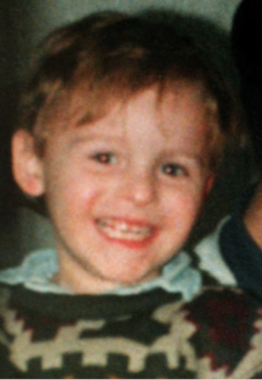
Murder of James Bulger
1993 child murder in Liverpool, England
On 12 February 1993 in Merseyside, England, two 10-year-old boys, Robert Thompson and Jon Venables, abducted, tortured, and murdered a two-year-old boy, James Patrick Bulger (16 March 1990 – 12 February 1993). Thompson and Venables led Bulger away from the New Strand Shopping Centre in Bootle, where Bulger was visiting shops with his mother. His mutilated body was found on a railway line 2+1⁄2 miles (4 kilometres) away in Walton, Liverpool, two days later.
Thompson and Venables were found guilty of abduction and murder on 24 November, making them the youngest convicted murderers in modern British history. They were sentenced to indefinite detention at Her Majesty's pleasure, and remained in custody until a Parole Board decision in June 2001 recommended their release on a life licence at age 18. Venables was sent to prison in 2010 for possessing child pornography images on his computer, was released on parole again in 2013, and in November 2017 was again sent to prison for again possessing child pornography images on his computer. His 2023 appeals for parole were rejected.
The Bulger case has prompted widespread debate about how to handle young offenders when they are sentenced or released from custody.
Abduction
Closed-circuit television (CCTV) at the New Strand Shopping Centre in Bootle on 12 February 1993 showed Thompson and Venables casually observing children, apparently selecting a target. The boys were playing truant from their primary school, which they did regularly. Throughout the day, Thompson and Venables were seen shoplifting various items, including sweets, batteries, a troll doll, and a can of blue Humbrol modelling paint. One of the boys later said that before they abducted Bulger, they were planning to abduct a child, lead him to the busy road alongside the shopping centre, and push him into the oncoming traffic.
That same afternoon, two-year-old James Bulger, from Kirkby, was at the New Strand Shopping Centre with his mother, Denise. At approximately 15:40, while in A.R. Tym's butcher's shop on the lower floor, Denise momentarily let go of James's hand to pay for her shopping and discovered he was missing. Thompson and Venables had approached Bulger, taken him by the hand, and led him out of the shopping centre. This act was caught on CCTV at 15:42.
Thompson and Venables took Bulger to the Leeds and Liverpool Canal, around 1⁄4 mile (400 metres) from the New Strand Shopping Centre. There, they dropped him on his head, causing facial injuries, and joked about pushing him into the canal. An eyewitness later described Bulger at the canal as "crying his eyes out". The boys took Bulger on a 2+1⁄2-mile (4-kilometre) walk across Liverpool, during which they were seen by around 38 people; however, most bystanders did not intervene. When questioned, Thompson and Venables claimed that Bulger was either their brother or a lost child they were taking to a police station. At one point, the boys took Bulger into a pet shop, from which they were ejected.
Torture and murder
Eventually, the boys arrived in Walton. With Walton Lane Police Station across the road, they hesitated, then led Bulger up a steep bank to a railway line near the former Walton & Anfield railway station. One of the boys threw the blue paint that they had shoplifted earlier into Bulger's left eye. They kicked him, stamped on him, and threw bricks and stones at him. They forced batteries into Bulger's mouth and may have inserted some into his anus, though none were found there. Finally, the boys dropped a 10 kg (22 lb) railway fishplate on Bulger, resulting in ten skull fractures. Pathologist Alan Williams concluded that Bulger sustained a total of 42 injuries, none of which could be identified as the fatal blow.
Thompson and Venables laid Bulger across the railway tracks and weighted his head down with rubble. Their intention was for a passing train to strike him, making his death appear accidental. His body was severed by a train after they had departed the scene. Bulger's remains were discovered by four boys looking for footballs two days later. Forensic examination later determined that Bulger had died from his injuries before being struck by the train.
Investigation
Upon discovering Bulger's body, police suspected sexual assault, as Bulger's shoes, socks, trousers, and underpants had been removed. The pathologist's report, which was read out in court, noted that Bulger's foreskin had been forcibly retracted. When questioned about this aspect of the attack, Thompson and Venables were reluctant to provide details. Years later, after Venables was released, his psychiatrist, Susan Bailey, reported his continued denial of any sexual element to the crime.
The police investigation quickly yielded low-resolution video images showing two unidentified boys abducting Bulger from the New Strand Shopping Centre. One boy, detained for questioning but later released, was forced to flee the city with his family due to threats from vigilantes. The breakthrough came when a woman, upon seeing enhanced images of the two boys on national television, recognised Venables. She recalled seeing him that day playing truant with Thompson in the Bootle area, and her call to the police led directly to their arrest.
Legal proceedings
Arrest
Forensic tests confirmed that both boys had the same blue paint on their clothing as was found on Bulger's body. Both had blood on their shoes; the blood on Thompson's shoe was matched to Bulger's through DNA profiling. A pattern of bruising on Bulger's right cheek matched the features of the upper part of a shoe worn by Thompson; a paint mark in the toecap of one of Venables's shoes indicated he must have used "some force" when he kicked Bulger. Thompson is said to have asked the police if they had taken Bulger to a hospital to "get him alive again".
The boys were each charged with the murder of James Bulger on 20 February 1993, and they appeared at South Sefton Youth Court on 22 February 1993, where they were remanded in custody to await trial. In the aftermath of their arrest, and throughout the media accounts of their trial, the boys were anonymised as "Child A" (Thompson) and "Child B" (Venables). Awaiting trial, they were held in the secure units where they would eventually be sentenced to be detained at Her Majesty's pleasure.
Trial
Up to 500 protesters gathered at the Magistrates' Court in the Metropolitan Borough of Sefton during the boys' initial court appearances. The full trial opened at Sessions House, Preston, on 1 November 1993, and was conducted as an adult trial with the accused in the dock away from their parents, and the judge and court officials in legal regalia. The boys denied the charges of murder, abduction and attempted abduction. The attempted abduction charge related to an incident at the New Strand Shopping Centre earlier on 12 February 1993, the day of Bulger's death. Thompson and Venables had attempted to lead away another two-year-old boy, but had been prevented from doing so by the boy's mother.
Each boy sat in view of the court on raised chairs so that they could see out of the dock designed for adults, and were accompanied by two social workers and guards. Although they were separated from their parents, they were within touching distance when their families attended the trial. News stories reported the demeanour of the defendants. These aspects of the trial were later criticised by the European Court of Human Rights, which ruled in 1999 that they had not received a fair trial by being tried in public in an adult court. At the trial, the lead prosecution counsel Richard Henriques successfully rebutted the principle of doli incapax, which presumes that young children cannot be held legally responsible for their actions.
Thompson and Venables were considered by the court to be capable of "mischievous discretion", meaning an ability to act with criminal intent as they were mature enough to understand that they were doing something seriously wrong. A child psychiatrist, Eileen Vizard, who interviewed Thompson before the trial, was asked in court whether he would know the difference between right and wrong, that it was wrong to take a young child away from his mother, and that it was wrong to cause injury to a child. Vizard replied, "If the issue is on the balance of probabilities, I think I can answer with certainty." Vizard also said that Thompson was suffering from post-traumatic stress disorder after the attack on Bulger. Susan Bailey, the Home Office's forensic psychiatrist who interviewed Venables, said unequivocally that he knew the difference between right and wrong.
Content sourced from Wikipedia under CC BY-SA 4.0


