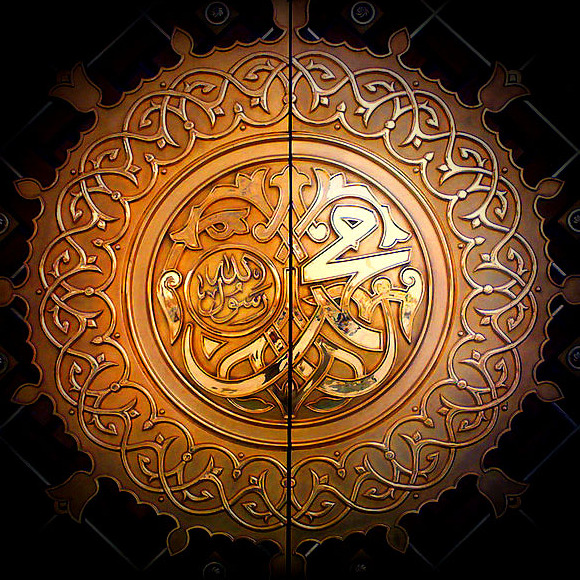
Muhammad
Founder of Islam (c. 570–632)
Muhammad (c. 570 – 8 June 632 CE) was an Arab religious, military and political leader, as well as the founder of Islam. According to Islam, he was a prophet who was divinely inspired to preach and confirm the monotheistic teachings of Adam, Noah, Abraham, Moses, Jesus, and other prophets. He is believed by Muslims to be the Seal of the Prophets, and along with the Quran, his teachings and normative examples form the basis for Islamic religious belief.
According to the traditional account, Muhammad was born in Mecca to the aristocratic Banu Hashim clan of the Quraysh. He was the son of Abdullah ibn Abd al-Muttalib and Amina bint Wahb. His father, Abdullah, the son of tribal leader Abd al-Muttalib ibn Hashim, died around the time Muhammad was born. His mother Amina died when he was six, leaving Muhammad an orphan. He was raised under the care of his grandfather, Abd al-Muttalib, and paternal uncle, Abu Talib. In later years, he would periodically seclude himself in a mountain cave named Hira for several nights of prayer. When he was 40, in c. 610, Muhammad reported being visited by Gabriel in the cave and receiving his first revelation from God. In 613, Muhammad started preaching these revelations publicly, proclaiming that "God is One", that complete "submission" (Islām) to God (Allāh) is the right way of life (dīn), and that he was a prophet and messenger of God, similar to other prophets in Islam.
Muhammad's followers were initially few in number, and experienced persecution by Meccan polytheists for 13 years. To escape ongoing persecution, he sent some of his followers to Abyssinia in 615, before he and his followers migrated from Mecca to Medina (then known as Yathrib) later in 622. This event, the Hijrah, marks the beginning of the Islamic calendar, also known as the Hijri calendar. In Medina, Muhammad united the tribes under the Constitution of Medina. In December 629, after eight years of intermittent fighting with Meccan tribes, Muhammad gathered an army of 10,000 Muslim converts and marched on the city of Mecca. The conquest went largely uncontested, and Muhammad seized the city with minimal casualties. In 632, a few months after returning from the Farewell Pilgrimage, he fell ill and died. By the time of his death, most of the Arabian Peninsula had converted to Islam.
The revelations (waḥy) that Muhammad reported receiving until his death form the verses (āyah) of the Quran, upon which Islam is based, and are regarded by Muslims as the verbatim word of God and his final revelation. Besides the Quran, Muhammad's teachings and practices, found in transmitted reports, known as hadith, and in his biography (sīrah), are also upheld and used as sources of Islamic law. Apart from Islam, Muhammad has received praise in Sikhism as an inspirational figure, in the Druze faith as one of the seven main prophets, and in the Baháʼí Faith as a Manifestation of God.
Biographical sources
Critical evaluation of sources is of particular importance in uncovering Muhammad's historical existence beyond the myths. Early sources for the life of Muhammad are authors from the 2nd and 3rd centuries AH (8th and 9th centuries CE), whose works constructed main biographical information to the Muslim traditions regarding his life, but the reliability of this information is contentious in academic circles due to the oral gap between the recorded dates of Muhammad's life and the dates when these writings begin to appear in sources. John Burton summarizes the information provided by the multitude of available sources, from a historian's perspective: states
In judging the content, the only resort of the scholar is to the yardstick of probability, and on this basis, it must be repeated, virtually nothing of use to the historian emerges from the sparse record of the early life of the founder of the latest of the great world religions ... so, however far back in the Muslim tradition one now attempts to reach, one simply cannot recover a scrap of information of real use in constructing the human history of Muhammad, beyond the bare fact that he once existed.
On the other hand, Karen Armstrong believes that —thanks to these early biographical efforts— more is known about Muhammad than almost about the founders of all the other major religions.
Early biographies
Important early sources for the life of Muhammad are authors from the 2nd and 3rd centuries AH (overlapping with the 8th and 9th centuries CE), whose works supplied additional biographical information to the Muslim traditions regarding his life. The information used in early Islamic historiography emerged as the sporadic products of storytellers (qāṣṣ, pl. quṣṣāṣ) -they were quite prestigious then- without details. At the same time the study of the earliest periods in Islamic history is made difficult by a lack of sources. While the narratives were initially in the form of a kind of heroic epics called magāzī, details were added later, edited and transformed into sirah compilations. Western historians describe the purpose of these early biographies as largely to convey a message, rather than to strictly and accurately record history.
The earliest written sira (biographies of Muhammad and quotes attributed to him) is Ibn Ishaq's Life of God's Messenger written c. 767 (150 AH). Although the original work was lost, this sira survives as extensive excerpts in works by Ibn Hisham and to a lesser extent by al-Tabari. However, Ibn Hisham wrote in the preface to his biography of Muhammad that he omitted matters from Ibn Ishaq's biography that "would distress certain people". Another early historical source is the history of Muhammad's campaigns by al-Waqidi (d. 207 AH), and the work of Waqidi's secretary Ibn Sa'd al-Baghdadi (d. 230 AH).
Hadith
Other important traditional sources include the hadith collections, accounts of verbal and physical teachings and approvals attributed to Muhammad. Hadiths were compiled several generations after his death by Muslims including Muhammad al-Bukhari, Muslim ibn al-Hajjaj, Muhammad ibn Isa at-Tirmidhi, Abd ar-Rahman al-Nasai, Abu Dawood, Ibn Majah, Malik ibn Anas, al-Daraqutni. The hadiths generally present an idealized view of Muhammad.
Muslim scholars placed more trust in hadith than in biographical literature because hadiths were generally based on a chain of transmission (isnad); the absence of such a chain in biographical literature made it, in their eyes, unverifiable. Hadiths were classified by Islamic scholars according to their reliability based on the chain of transmission; and different schools of thought relied on different collections. These sources, distrusted by Quranist scholars, are also viewed with suspicion by Western researchers. Western scholars widely believed that there was widespread fabrication of hadith during the early centuries of Islam to support certain theological and legal positions. In addition, the meaning of a hadith may have drifted from its original telling to when it was finally written down, even if the chain of transmission is authentic.
Although the "dominant paradigm" of Western scholars is to find their reliability questionable, some have - with caution - regarded them as accurate historical sources. Scholars such as Wilferd Madelung, on the other hand, do not reject the hadiths compiled in later periods, but evaluate them in their historical context. In other words, according to him, they contained clues not from the life of Muhammad, but from the mentality of the period in which they were written.
Quran
The Quran is the central religious text of Islam. Muslims believe it represents the word of God revealed to Muhammad by the archangel Gabriel. The Quran is primarily addressed to a single "Messenger of God," identified as Muhammad in a number of verses. In contrast to the hundreds of references to earlier prophets such as Moses and Jesus, it contains comparatively little direct information about Muhammad himself, or his companions. The text also briefly refers to episodes from Muhammad's career, such as the migration of his followers to Yathrib and the Battle of Badr.
Content sourced from Wikipedia under CC BY-SA 4.0


