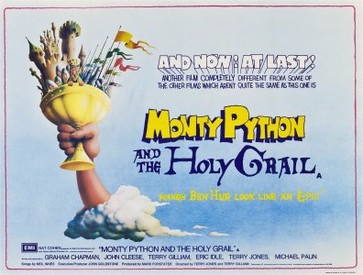
Monty Python and the Holy Grail
1975 British comedy film
Monty Python and the Holy Grail is a 1975 British comedy film based on the Arthurian legend, written and performed by the Monty Python comedy group (Graham Chapman, John Cleese, Terry Gilliam, Eric Idle, Terry Jones, and Michael Palin) and directed by Gilliam and Jones in their feature directorial debuts. It was conceived during the hiatus between the third and fourth series of their BBC Television series Monty Python's Flying Circus.
While the group's first film, And Now for Something Completely Different, was a compilation of sketches from the first two television series, Holy Grail is an original story that parodies the legend of King Arthur's quest for the Holy Grail. Thirty years later, Idle used the film as the basis for the 2005 Tony Award-winning musical Spamalot.
Monty Python and the Holy Grail grossed more than any other British film screened in the US in 1975, and has since been considered one of the greatest comedy films of all time. In the US, it was selected in 2011 as the second-best comedy of all time in the ABC special Best in Film: The Greatest Movies of Our Time behind Airplane!. In the UK, readers of Total Film magazine in 2000 ranked it the fifth-greatest comedy film of all time; a similar poll of Channel 4 viewers in 2006 placed it sixth.
Plot
In AD 932, King Arthur and his squire Patsy, who bangs coconut shells together as Arthur mimes riding a horse, travel Britain searching for men to join the Knights of the Round Table. Along the way, Arthur debates whether swallows could carry coconuts, passes through a town infected with a plague, recounts receiving Excalibur from the Lady of the Lake to two anarcho-syndicalist peasants, and defeats the Black Knight. At an impromptu witch trial, he recruits Sir Bedevere the Wise, later joined by Sir Lancelot the Brave, Sir Galahad the Pure, Sir Robin the Not-Quite-So-Brave-as-Sir-Lancelot, and the aptly named Sir Not-Appearing-in-this-Film, along with their squires and Robin's minstrels. Arthur leads the knights to Camelot, but changes his mind after the knights in the castle perform a musical number, deeming it "a silly place". God then appears and orders Arthur to find the Holy Grail.
Arthur and his knights arrive at a castle occupied by French soldiers, who claim to have the Grail and taunt the Britons, driving them back with a barrage of barnyard animals. Bedevere concocts a plan to sneak in using a Trojan Rabbit, but forgets to tell the others to hide inside it; the Knights are forced to flee when it is flung back at them. Arthur decides the knights should go their separate ways to search for the Grail. Meanwhile, a modern-day historian filming a documentary on the Arthurian legends is killed by an unknown knight on horseback, triggering a police investigation.
Arthur and Bedevere are given directions by an old man and attempt to satisfy the strange requests of the dreaded Knights Who Say "Ni!". Sir Robin avoids a fight with a Three-Headed Knight by running away while the heads are arguing amongst themselves. Sir Galahad is led by a grail-shaped beacon to Castle Anthrax, which is occupied exclusively by nubile young women, all of whom attempt to woo him, but is "rescued" against his will by Lancelot. Lancelot receives an arrow-shot note from the nearby Swamp Castle. Believing the author is a lady being forced to marry against her will, he storms the castle and slaughters several wedding party members, only to discover the author is an effeminate prince.
Arthur and his knights regroup and are joined by Brother Maynard, his monk brethren, and three new knights: Bors, Gawain and Ector. They meet Tim the Enchanter, a pyromancer who directs them to a cave where the location of the Grail is said to be written. The entrance to the cave is guarded by the Rabbit of Caerbannog. Underestimating it, the knights attack, but the Rabbit easily kills Bors, Gawain and Ector. Arthur uses the "Holy Hand Grenade of Antioch", provided by Brother Maynard, to destroy the creature; the police officers investigating the historian's murder hear the explosion and begin pursuing them. Inside the cave, they find an inscription from Joseph of Arimathea, directing them to "the Castle of Aarrgh". They are interrupted by an attack from the animated "Legendary Black Beast" that lives in the cave, which devours Brother Maynard and pursues the others. Arthur and the knights escape after the film's animator unexpectedly suffers a fatal heart attack, erasing the Black Beast.
The knights approach the Bridge of Death, where the soothsaying bridge-keeper demands they each answer three questions in order to pass or else be cast into the Gorge of Eternal Peril. Lancelot easily answers simple questions and crosses. An overly cocky Robin is defeated by an unexpectedly difficult question, and an indecisive Galahad fails an easy one; both are magically flung into the gorge. When Arthur asks for clarification on a question regarding the airspeed velocity of an unladen swallow, the bridge-keeper cannot answer and is himself thrown into the gorge.
Arthur and Bedevere cannot find Lancelot, unaware that he has been arrested by police investigating the historian's death. They find Castle Aarrgh occupied by the French soldiers from earlier in the film. After being repelled by showers of manure, they summon an army of knights and prepare to assault the castle. As the army charges, the police arrive, arrest Arthur and Bedevere on suspicion of the murder of the historian, and break the camera, abruptly ending the film.
Cast
- Graham Chapman as:
- Arthur, King of the Britons
- The hiccuping guard
- The middle head of the Three-Headed Giant
- The voice of God
- John Cleese as:
- Sir Lancelot the Brave
- The Black Knight
- French Taunter
- Tim the Enchanter
- And other roles
- Terry Gilliam as:
- Patsy (Arthur's servant)
- The Soothsaying Bridgekeeper
- The Green Knight
- Sir Bors
- the Weak-Hearted Animator
- And other roles
- Eric Idle as:
- Sir Robin the-not-quite-so-brave-as-Sir-Lancelot
- Lancelot's squire Concorde
- The collector of the dead
- Roger the Shrubber
- Brother Maynard
- And other roles
- Terry Jones as:
- Sir Bedevere the Wise
- Prince Herbert
- Dennis' mother
- The left head of the Three-Headed Giant
- And other roles
- Michael Palin as:
- Sir Galahad the Pure
- Leader of the Knights Who Say Ni
- Lord of Swamp Castle
- Dennis
- The right head of the Three-Headed Giant
- The Narrator
- And other roles
- Neil Innes as:
- Leader of Robin's Minstrels
- Head Monk
- Knight of Camelot
- Servant Crushed by Rabbit.
- Sandy Johnson as:
- Knight Who Says Ni
- Villager at Witch Burning
- Musician at Wedding
- Monk
- Knight in Battle
- Connie Booth as Miss Islington (the Witch)
- Carol Cleveland as Zoot and Dingo, the identical twin sisters
- Bee Duffell as the Old Crone
- John Young as Frank the Historian and the Old Man
- Rita Davies as Frank's Wife
- Avril Stewart as Dr. Piglet
- Sally Kinghorn as Dr. Winston
- Julian Doyle as Police Sergeant (uncredited)
- Charles Knode as Camp Guard and Robin's Minstrel (uncredited)
- Roy Forge Smith as Inspector at End of Film (uncredited)
- Maggie Weston as Page Turner (uncredited)
Production
Development
In January 1973, the Monty Python troupe wrote the first draft of the screenplay. Half of the material was set in the Middle Ages and half in the present day. The group decided to set the film during the Middle Ages and focus on the legend of the Holy Grail. By the fourth or fifth draft, the story was complete, and the cast joked that the fact that the Grail was never retrieved would be "a big let-down ... a great anti-climax". Graham Chapman said a challenge was incorporating scenes that did not fit the Holy Grail motif.
Neither Terry Gilliam nor Terry Jones had directed a film before, and described it as a learning experience in which they would learn to make a film by making an entire full-length film. The cast humorously described the novice directing style as employing the level of mutual disrespect always found in Monty Python's work.
Financing
According to Gilliam, the Pythons turned to rock bands like Pink Floyd and Led Zeppelin for financing because no studio would fund the film, and the rock stars saw it as "a good tax write-off" because the top rate of UK income tax was "as high as 90%" at the time. Idle and Gilliam had previously mentioned that Elton John also contributed to the financing of the film. A 2021 tweet by Eric Idle revealed that the entire original budget of £175,350 (about $410,000 in 1974) was provided by eight investors: Led Zeppelin (£31,500), Pink Floyd (£21,000), Jethro Tull's Ian Anderson (£6300), Holy Grail's co-producer Michael White (£78,750), Heartaches (a cricket team founded by lyricist Tim Rice) (£5,250), and three record companies: Island Records (£21,000), Chrysalis Records (£6,300), and Charisma Records (£5,250), the record label that had released Python's early comedy albums. The investors also received part of the proceeds from the 2005 musical Spamalot.
Content sourced from Wikipedia under CC BY-SA 4.0


