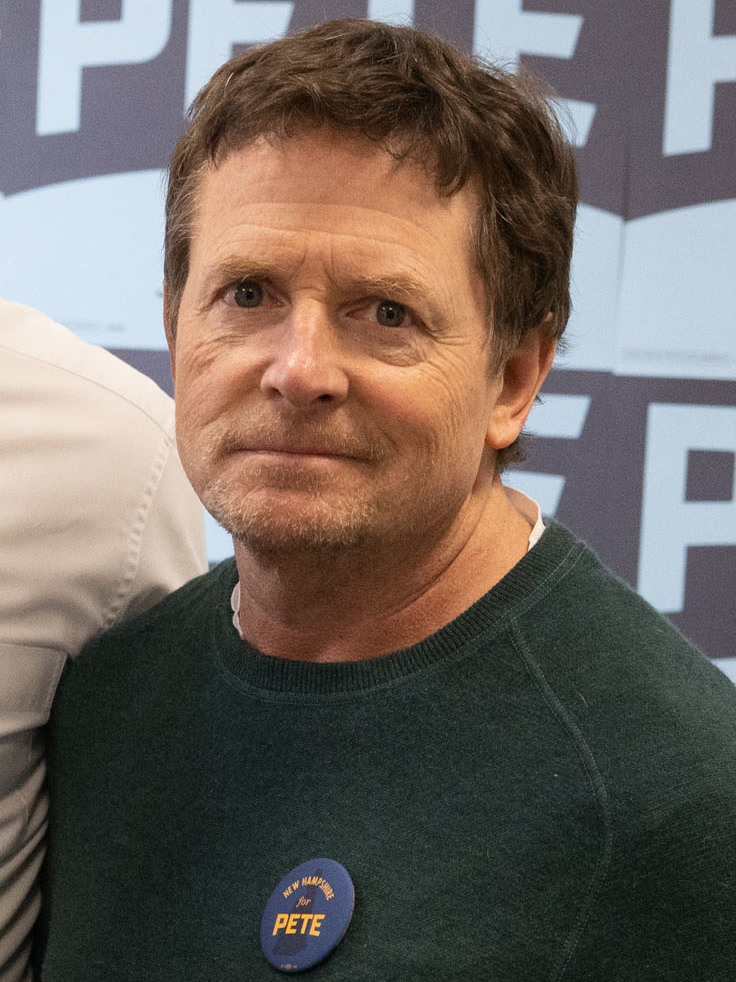
Michael J. Fox
Canadian-American actor and activist (born 1961)
Michael Andrew Fox (born June 9, 1961), known professionally as Michael J. Fox, is a Canadian and American actor and activist. Beginning his career as a child actor in the 1970s, he rose to prominence portraying Alex P. Keaton on the NBC sitcom Family Ties (1982–1989) and Marty McFly in the Back to the Future film trilogy (1985–1990). Fox went on to star in films such as Teen Wolf (1985), The Secret of My Success (1987), Casualties of War (1989), Doc Hollywood (1991) and The Frighteners (1996). He returned to television on the ABC sitcom Spin City in the lead role of Mike Flaherty (1996–2000).
In 1998, Fox disclosed his 1991 diagnosis of Parkinson's disease (PD). He became an advocate for finding a cure and founded The Michael J. Fox Foundation in 2000 to help fund research. Worsening symptoms forced him to reduce his acting work.
Fox voiced the lead roles in the Stuart Little films (1999–2005) and the animated film Atlantis: The Lost Empire (2001). He continued to make guest appearances on television, including comedy-drama Rescue Me (2009), the legal drama The Good Wife (2010–2016) and spin-off The Good Fight (2020) and the comedy series Curb Your Enthusiasm (2011, 2017). Fox's last major role was the lead on the short-lived sitcom The Michael J. Fox Show (2013–2014). He officially retired in 2020 due to his declining health, though he has made periodic acting appearances since then.
Fox has won five Emmy Awards, four Golden Globe Awards, two Screen Actors Guild Awards and a Grammy Award. He was appointed an Officer of the Order of Canada in 2010 and was inducted to Canada's Walk of Fame in 2000 and the Hollywood Walk of Fame in 2002. For his advocacy of a cure for Parkinson's disease, he received the Jean Hersholt Humanitarian Award from the Academy of Motion Pictures Arts and Sciences in 2022 and the Presidential Medal of Freedom in 2025.
Early life
Fox was born on June 9, 1961, in Edmonton, Alberta, Canada. His mother, Phyllis Evelyn (née Piper; 1929–2022), was a payroll clerk and actress, while his father, William Nelson "Bill" Fox (1928–1990), served as a regular soldier in the Royal Canadian Corps of Signals. When they met in Ladner, a village in the then-district municipality of Delta, British Columbia, Phyllis was working for The Ladner Optimist, a local newspaper, and Bill was serving at the nearby Vancouver Wireless Station. The couple married in 1950. Fox is the fifth of six children, with three sisters and two brothers. Phyllis's father was an English emigrant, and her mother was an emigrant from Belfast, Northern Ireland. Bill's mother was born in Alberta to American parents, and his father was an English emigrant.
The Fox family lived in various cities and towns across Canada due to Bill's career. Bill served in the army for 25 years, retiring in 1971. The family moved to Burnaby, British Columbia, the same year. Bill worked as a dispatcher for the Delta Police Department from the following year to 1985. Fox attended Burnaby Central Secondary School and has a theatre named for him at Burnaby South Secondary School. At the age of 16, he starred in the Canadian television series Leo and Me, produced by the Canadian Broadcasting Corporation. Fox moved to Los Angeles, California, in 1979 to further his acting career.
Fox was discovered by producer Ronald Shedlo and made his American debut in the television film Letters from Frank, credited under the name "Michael Fox". However, when he registered with the Screen Actors Guild, he discovered that Michael Fox, a veteran actor, was already registered under that name. Fox explained in his memoir Lucky Man:
The Screen Actors Guild prohibits any two members from working under the same stage name, and they already had a 'Michael Fox' on the books. My middle name is Andrew, but 'Andrew Fox' or 'Andy Fox' didn't cut it for me. 'Michael A. Fox' was even worse, the word fox having recently come into use as a synonym for attractive. (Presumptuous?) It also sounded uncomfortably Canadian – Michael Eh? Fox – but maybe I was just being oversensitive. And then I remembered one of my favorite character actors, Michael J. Pollard, the guileless accomplice in Bonnie and Clyde. I stuck in the J, which sometimes I tell people stands for either Jenuine or Jenius, and resubmitted my forms.
Acting career
1980–1984: Early roles and television
Fox's first feature film roles were Midnight Madness (1980) and Class of 1984 (1982), credited in both as Michael Fox. Shortly afterward, he began playing "Young Republican" Alex P. Keaton in the show Family Ties, which aired on NBC for seven seasons from 1982 to 1989. In an interview with Jimmy Fallon in April 2014, Fox stated he negotiated the role at a payphone at Pioneer Chicken. He received the role only after Matthew Broderick was unavailable. Family Ties had been sold to the television network using the pitch "Hip parents, square kids", with the parents originally intended to be the main characters. However, the positive reaction to Fox's performance led to his character becoming the focus of the show following the fourth episode.
Brandon Tartikoff, one of the show's producers, felt that Fox was too short in relation to the actors playing his parents, and tried to have him replaced. Tartikoff reportedly said that "this is not the kind of face you'll ever find on a lunchbox." After his later successes, Fox presented Tartikoff with a custom-made lunchbox with the inscription "To Brandon: This is for you to put your crow in. Love and Kisses, Michael J." Tartikoff kept the lunchbox in his office for the rest of his NBC career.
1985–1990: Back to the Future and stardom
In January 1985, Fox was cast to replace Eric Stoltz as Marty McFly, a teenager who is accidentally sent back in time from 1985 to 1955 in Back to the Future. Director Robert Zemeckis originally wanted Fox to play Marty, but Gary David Goldberg, the creator of Family Ties, on which Fox was working at the time, refused to allow Zemeckis even to approach Fox. Goldberg felt that, as Meredith Baxter was on maternity leave at the time, Fox's character Alex Keaton was needed to carry the show in her absence. Stoltz was cast and was already filming Back to the Future, but Zemeckis felt that Stoltz was not giving the right type of performance for the humour involved.
Zemeckis quickly replaced Stoltz with Fox, whose schedule was now more open with the return of Baxter. During filming, Fox rehearsed for Family Ties from 10 a.m. to 6 p.m.; he then rushed to the Back to the Future set, where he would rehearse and shoot until 2:30 a.m. This schedule lasted for two full months. Back to the Future was both a critical and commercial success. The film spent eight consecutive weekends as the number-one movie at the US box office in 1985, and it eventually earned a worldwide total of $381.11 million. Variety applauded the performances, opining that Fox and his co-star Christopher Lloyd imbued Marty and Doc Brown's friendship with a quality reminiscent of King Arthur and Merlin. Fox's performance in particular was praised, earning him a nomination for Best Actor in a Motion Picture – Musical or Comedy at the 43rd Golden Globe Awards. The film was followed by two successful sequels, Back to the Future Part II (1989) and Back to the Future Part III (1990), which were produced at the same time but released separately. While filming the scene where Buford "Mad Dog" Tannen tries to hang Marty in Part III, Fox was allowed to perform the stunt himself as long as he knew where to put his hand on the noose to keep himself from choking; however, on the third take, Fox accidentally placed his hand in the wrong spot, which resulted in him choking, passing out, and nearly dying until Zemeckis noticed him in peril and had him cut down.
As a result of working on Family Ties, and his back-to-back hit performances in Back to the Future and Teen Wolf (1985), Fox became a teen idol. The VH1 television series The Greatest later named him among their "50 Greatest Teen Idols".
During and immediately after the Back to the Future trilogy, Fox starred in Teen Wolf (1985), Light of Day (1987), The Secret of My Success (1987), and Bright Lights, Big City (1988). In The Secret of My Success, Fox played a recent graduate from Kansas State University who moves to New York City, where he deals with the ups and downs of the business world. The film was successful at the box office, grossing $110 million worldwide. Roger Ebert in the Chicago Sun-Times wrote, "Fox provides a fairly desperate center for the film. It could not have been much fun for him to follow the movie's arbitrary shifts of mood, from sitcom to slapstick, from sex farce to boardroom brawls."
Content sourced from Wikipedia under CC BY-SA 4.0


