Mars 2020
Astrobiology Mars rover mission by NASA
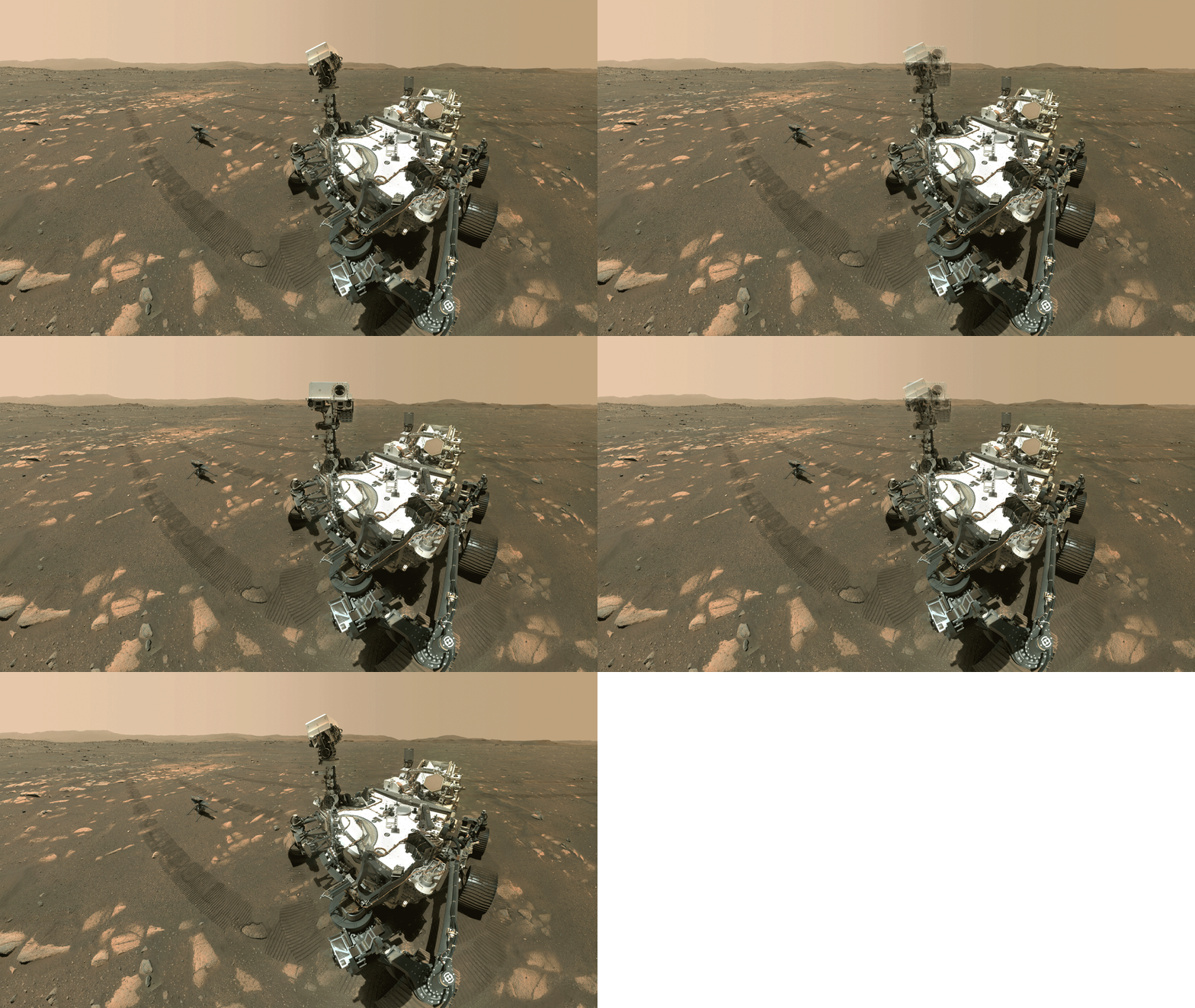
Mars 2020 is a NASA mission that includes the rover Perseverance, the now-grounded small robotic helicopter Ingenuity, and associated delivery systems, as part of the Mars Exploration Program. Mars 2020 was launched on an Atlas V rocket at 11:50:01 UTC on July 30, 2020, and landed in the Martian crater Jezero on February 18, 2021, with confirmation received at 20:55 UTC. On March 5, 2021, NASA named the landing site Octavia E. Butler Landing. As of 25 February 2026, Perseverance has been on Mars for 1784 sols (1833 total days; 5 years, 7 days). Ingenuity operated on Mars for 1042 sols (1071 total days; 2 years, 341 days) before sustaining serious damage to its rotor blades, possibly all four, causing NASA to retire the craft on January 25, 2024.
Perseverance is investigating an astrobiologically relevant ancient environment on Mars for its surface geological processes and history, and assessing its past habitability, the possibility of past life on Mars, and the potential for preservation of biosignatures within accessible geological materials. It will cache sample containers along its route for retrieval by a potential future Mars sample-return mission. The Mars 2020 mission was announced by NASA in December 2012 at the fall meeting of the American Geophysical Union in San Francisco. Perseverance's design is derived from the rover Curiosity, and it uses many components already fabricated and tested in addition to new scientific instruments and a core drill. The rover also employs nineteen cameras and two microphones, allowing for the audio recording of the Martian environment. On April 30, 2021, Perseverance became the first spacecraft to hear and record another spacecraft, the Ingenuity helicopter, on another planet.
The launch of Mars 2020 was the third of three space missions sent toward Mars during the July 2020 Mars launch window, with missions also launched by the national space agencies of the United Arab Emirates (the Emirates Mars Mission with the orbiter Hope on July 19, 2020) and China (the Tianwen-1 mission on July 23, 2020, with an orbiter, deployable and remote cameras, lander, and Zhurong rover).
Conception
The Mars 2020 mission was announced by NASA on December 4, 2012, at the fall meeting of the American Geophysical Union in San Francisco. The selection of Mars as the target of NASA's flagship mission elicited surprise from some members of the scientific community. Some criticized NASA for continuing to focus on Mars exploration instead of other Solar System destinations in constrained budget times. Support came from California U.S. Representative Adam Schiff, who said he was interested in the possibility of advancing the launch date, which would enable a larger payload. Science educator Bill Nye endorsed the Mars sample-return role, saying this would be "extraordinarily fantastic and world-changing and worthy."
Objectives
The mission is aimed at seeking signs of habitable conditions on Mars in the ancient past, and also at searching for evidence—or biosignatures—of past microbial life, and water. The mission was launched July 30, 2020, on an Atlas V-541, and the Jet Propulsion Laboratory manages the mission. The mission is part of NASA's Mars Exploration Program. The Science Definition Team proposed that the rover collect and package as many as 31 samples of rock cores and surface soil for a later mission to bring back for definitive analysis on Earth. In 2015, they expanded the concept, planning to collect even more samples and distribute the tubes in small piles or caches across the surface of Mars.
In September 2013, NASA launched an Announcement of Opportunity for researchers to propose and develop the instruments needed, including the Sample Caching System. The science instruments for the mission were selected in July 2014 after an open competition based on the scientific objectives set one year earlier. The science conducted by the rover's instruments will provide the context needed for detailed analyses of the returned samples. The chairman of the Science Definition Team stated that NASA does not presume that life ever existed on Mars, but given the recent Curiosity rover findings, past Martian life seems possible.
The Perseverance rover will explore a site likely to have been habitable. It will seek signs of past life, set aside a returnable cache with the most compelling rock core and soil samples, and demonstrate the technology needed for the future human and robotic exploration of Mars. A key mission requirement is that it must help prepare NASA for its long-term Mars sample-return mission and crewed mission efforts. The rover will make measurements and technology demonstrations to help designers of a future human expedition understand any hazards posed by Martian dust, and will test technology to produce a small amount of pure oxygen (O2) from Martian atmospheric carbon dioxide (CO2).
Improved precision landing technology that enhances the scientific value of robotic missions also will be critical for eventual human exploration on the surface. Based on input from the Science Definition Team, NASA defined the final objectives for the 2020 rover. Those became the basis for soliciting proposals to provide instruments for the rover's science payload in the spring of 2014. The mission will also attempt to identify subsurface water, improve landing techniques, and characterize weather, dust, and other potential environmental conditions that could affect future astronauts living and working on Mars.
A key mission requirement for this rover is that it must help prepare NASA for its Mars sample-return mission (MSR) campaign, which is needed before any crewed mission takes place. Such effort would require three additional vehicles: an orbiter, a fetch rover, and a two-stage, solid-fueled Mars ascent vehicle (MAV). Between 20 and 30 drilled samples will be collected and cached inside small tubes by the Perseverance rover, and will be left on the surface of Mars for possible later retrieval by NASA in collaboration with ESA. A "fetch rover" would retrieve the sample caches and deliver them to a two-stage, solid-fueled Mars ascent vehicle (MAV). In July 2018, NASA contracted Airbus to produce a "fetch rover" concept study. The MAV would launch from Mars and enter a 500 km orbit and rendezvous with the Next Mars Orbiter or Earth Return Orbiter. The sample container would be transferred to an Earth entry vehicle (EEV) which would bring it to Earth, enter the atmosphere under a parachute and hard-land for retrieval and analyses in specially designed safe laboratories.
In the first science campaign Perseverance performs an arching drive southward from its landing site to the Séítah unit to perform a "toe dip" into the unit to collect remote-sensing measurements of geologic targets. After that she will return to the Crater Floor Fractured Rough to collect the first core sample there. Passing by the Octavia B. Butler landing site concludes the first science campaign.
The second campaign shall start with several months of travel towards the "Three Forks" where Perseverance can access geologic locations at the base of the ancient delta of Neretva river, as well as ascend the delta by driving up a valley wall to the northwest.
Results
Spacecraft
Cruise stage and EDLS
The three major components of the Mars 2020 spacecraft are the 539 kg (1,188 lb) cruise stage for travel between Earth and Mars; the Entry, Descent, and Landing System (EDLS) that includes the 575 kg (1,268 lb) aeroshell descent vehicle + 440 kg (970 lb) heat shield; and the 1,070 kg (2,360 lb) (fueled mass) descent stage needed to deliver Perseverance and Ingenuity safely to the Martian surface. The Descent Stage carries 400 kg (880 lb) landing propellant for the final soft landing burn after being slowed down by a 21.5 m (71 ft)-wide, 81 kg (179 lb) parachute. The 1,025 kg (2,260 lb) rover is based on the design of Curiosity. While there are differences in scientific instruments and the engineering required to support them, the entire landing system (including the descent stage and heat shield) and rover chassis could essentially be recreated without any additional engineering or research. This reduces overall technical risk for the mission, while saving funds and time on development.
One of the upgrades is a guidance and control technique called "Terrain Relative Navigation" (TRN) to fine-tune steering in the final moments of landing. This system allowed for a landing inside 7.7 km × 6.6 km (4.8 mi × 4.1 mi) wide ellipse with a positioning error within 40 m (130 ft) and avoided obstacles. This is a marked improvement from the Mars Science Laboratory mission that had an elliptical area of 7 by 20 km (4.3 by 12.4 mi). In October 2016, NASA reported using the Xombie rocket to test the Lander Vision System (LVS), as part of the Autonomous Descent and Ascent Powered-flight Testbed (ADAPT) experimental technologies, for the Mars 2020 mission landing, meant to increase the landing accuracy and avoid obstacle hazards.
Content sourced from Wikipedia under CC BY-SA 4.0


