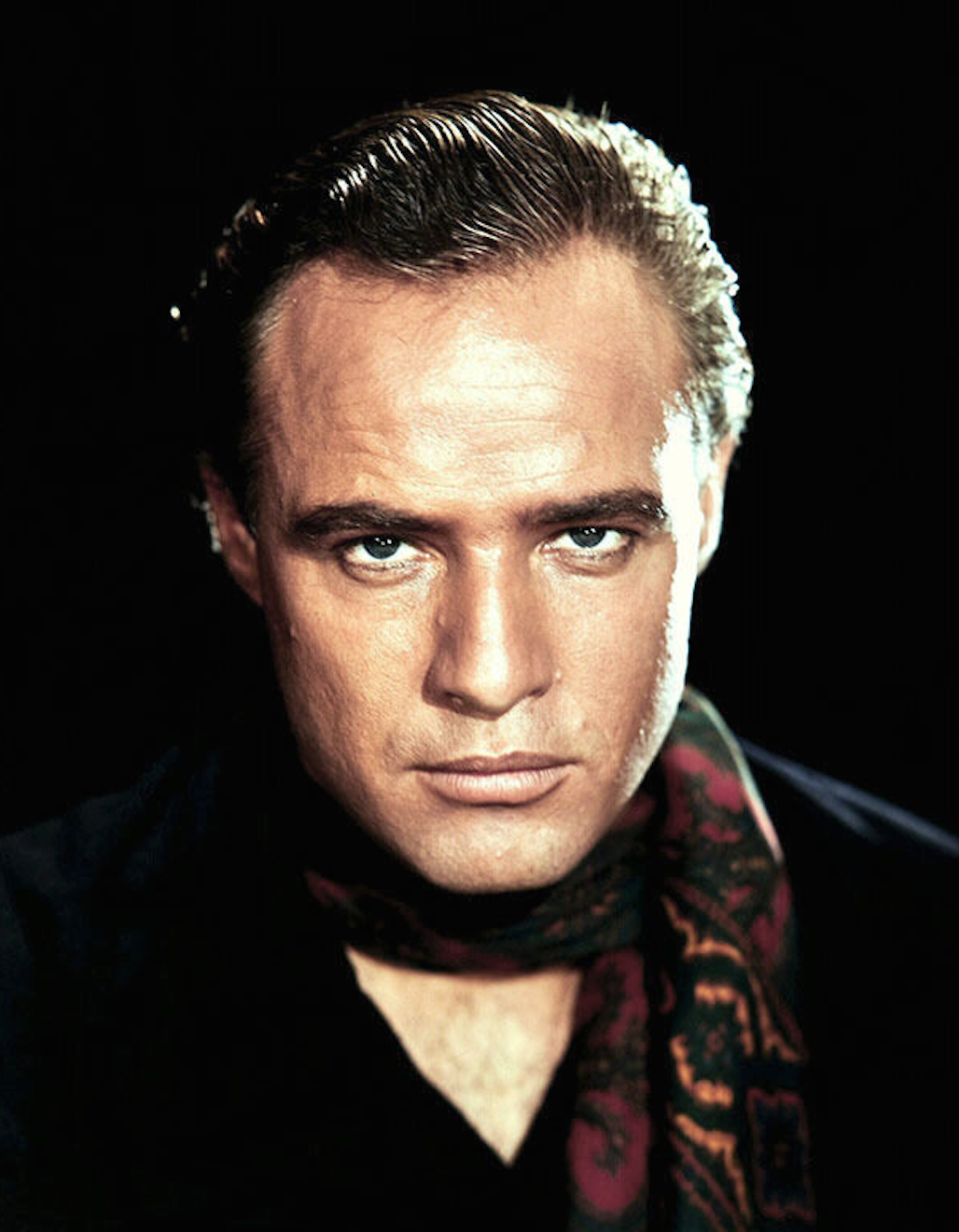
Marlon Brando
American actor (1924–2004)
Marlon Brando Jr. (April 3, 1924 – July 1, 2004) was an American actor widely regarded as one of the greatest and most influential performers in the history of cinema. His career spanned six decades, and he received numerous accolades, including two Academy Awards, two Golden Globe Awards, three BAFTAs, a Cannes Film Festival Award, and a Primetime Emmy Award. Brando is credited with being one of the first actors to bring the Stanislavski system of acting and method acting to mainstream audiences.
Brando came under the influence of Stella Adler and Stanislavski's system in the 1940s. He began his career on stage, where he was lauded for adeptly interpreting his characters. He made his Broadway debut in the play I Remember Mama (1944) and won Theater World Awards for his performances in Candida and Truckline Cafe (1946). He returned to Broadway as Stanley Kowalski in the Tennessee Williams play A Streetcar Named Desire (1947), a role he reprised in the 1951 film adaptation directed by Elia Kazan.
He made his film debut playing a wounded G.I. in The Men (1950) and won two Academy Awards for Best Actor for his performances as a dockworker in On the Waterfront (1954) and Vito Corleone in The Godfather (1972). He was also Oscar-nominated for playing Stanley Kowalski in A Streetcar Named Desire (1951), Emiliano Zapata in Viva Zapata! (1952), Mark Antony in Julius Caesar (1953), an air force pilot in Sayonara (1957), an American expatriate in Last Tango in Paris (1973), and a lawyer in A Dry White Season (1989).
Brando was known for portraying rebellious characters who later became popular icons, such as Johnny Strabler in The Wild One (1953), and he came to be seen as an emblem of the era's "generation gap". He also starred in films such as Guys and Dolls (1955), The Young Lions (1958), The Fugitive Kind (1960), The Chase (1966), Burn! (1969), The Missouri Breaks (1976), Superman (1978), Apocalypse Now (1979), and The Freshman (1990). He made his directorial debut with, and also starred in, the western drama One-Eyed Jacks (1961), which performed poorly at the box office.
On television, Brando won the Primetime Emmy Award for Outstanding Supporting Actor in a Limited Series or Movie for his role in the ABC miniseries Roots: The Next Generations (1979), after which he took a nine-year hiatus from acting. He later returned to film with varying degrees of commercial and critical success. The last two decades of his life were marked by controversy, and his troubled private life received significant public attention, including struggles with mood disorders and legal issues. His final films included The Island of Dr. Moreau (1996) and The Score (2001).
Early life and education
Marlon Brando Jr. was born on April 3, 1924, in Omaha, Nebraska, the only son of Marlon Brando Sr. and Dorothy Pennebaker. His father was a salesman who often travelled out-of-state and his mother was a stage actress, often away from home. His mother's absence resulted in Brando becoming attached to the family's housekeeper, who eventually left to get married, causing Brando to develop abandonment issues. His two elder sisters were Jocelyn and Frances.
Despite some of his most notable film roles, Brando did not have Italian ancestry. Brando's ancestry was mostly German, Dutch, English, and Irish. His patrilineal immigrant ancestor, Johann Wilhelm Brandau, arrived in New York City in the early 1700s from the Palatinate in Germany. He was also a descendant of Louis DuBois, a French Huguenot, who arrived in New York around 1660. His maternal great-grandfather, Myles Joseph Gahan, was an Irish immigrant who served as a medic in the American Civil War. In 1995, he gave an interview in Ireland in which he said, "I have never been so happy in my life. When I got off the plane I had this rush of emotion. I have never felt at home in a place as I do here. I am seriously contemplating Irish citizenship."
In 1930, when Brando was six years old, the family moved to Evanston, Illinois, where Brando mimicked other people, developed a reputation for pranking, and met Wally Cox, with whom he remained friends until Cox's death in 1973. In 1936, his parents separated and he and his siblings moved with their mother to Santa Ana, California. Two years later, his parents reconciled, and his father purchased a farmhouse in Libertyville, Illinois. Brando attended Libertyville High School, excelling at sports and drama, but failing in every other subject. Consequently, he was held back for a year, and with his history of misbehaving, he was expelled in 1941.
Brando was sent by his father to Shattuck Military Academy, where his father had also studied. There, Brando continued to excel at acting until 1943, when he was put on probation for being insubordinate to an officer during maneuvers. He was confined to the campus, but sneaked into town and was caught. The faculty voted to expel him, although he was supported by the students who thought expulsion was too harsh. Brando was invited back for the following year, but decided instead to drop out of high school. He then worked as a ditch-digger at a summer job arranged by his father and tried to enlist in the Army, but his routine physical revealed that a football injury he had sustained at Shattuck had left him with a trick knee; he was classified physically unfit for military service.
Brando decided to follow his sisters to New York, studying at the American Theatre Wing Professional School, part of the Dramatic Workshop of the New School, with influential German director Erwin Piscator. In a 1988 documentary, Marlon Brando: The Wild One, Brando's sister Jocelyn remembered, "He was in a school play and enjoyed it ... So he decided he would go to New York and study acting because that was the only thing he had enjoyed. That was when he was 18." In the A&E Biography episode on Brando, George Englund said Brando fell into acting in New York because "he was accepted there. He wasn't criticized. It was the first time in his life that he heard good things about himself." He spent his first few months in New York sleeping on friends' couches. For a time he lived with Roy Somlyo, who later became a four-time Emmy-winning Broadway producer.
Brando was an avid student and proponent of Stella Adler, from whom he learned the techniques of the Stanislavski system. This technique encouraged the actor to explore both internal and external aspects to fully realize the character being portrayed. Brando's remarkable insight and sense of realism were evident early on. Adler used to recount that, when teaching Brando, she had instructed the class to act like chickens, and added that a nuclear bomb was about to fall on them. Most of the class clucked and ran around wildly, but Brando sat calmly and pretended to lay an egg. Asked by Adler why he had chosen to react this way, he said, "I'm a chicken—what do I know about bombs?" Despite being commonly regarded as a method actor, Brando disagreed. He claimed to have abhorred Lee Strasberg's teachings:
After I had some success, Lee Strasberg tried to take credit for teaching me how to act. He never taught me anything. He would have claimed credit for the sun and the moon if he believed he could get away with it. He was an ambitious, selfish man who exploited the people who attended the Actors Studio and tried to project himself as an acting oracle and guru. Some people worshipped him, but I never knew why. I sometimes went to the Actors Studio on Saturday mornings because Elia Kazan was teaching, and there were usually a lot of good-looking girls, but Strasberg never taught me acting. Stella (Adler) did—and later Kazan.
Brando was the first to bring a natural approach to acting on film. According to Dustin Hoffman in his online Masterclass, Brando would often talk to cameramen and fellow actors about their weekend even after the director would call action. Once Brando felt he could deliver the dialogue as naturally as that conversation, he would start the dialogue. In his 2015 documentary, Listen to Me Marlon, he said that prior to that, actors were like breakfast cereals, meaning they were predictable. Critics would later say that this was Brando being difficult, but actors who worked opposite him said it was just all part of his technique.
Content sourced from Wikipedia under CC BY-SA 4.0


