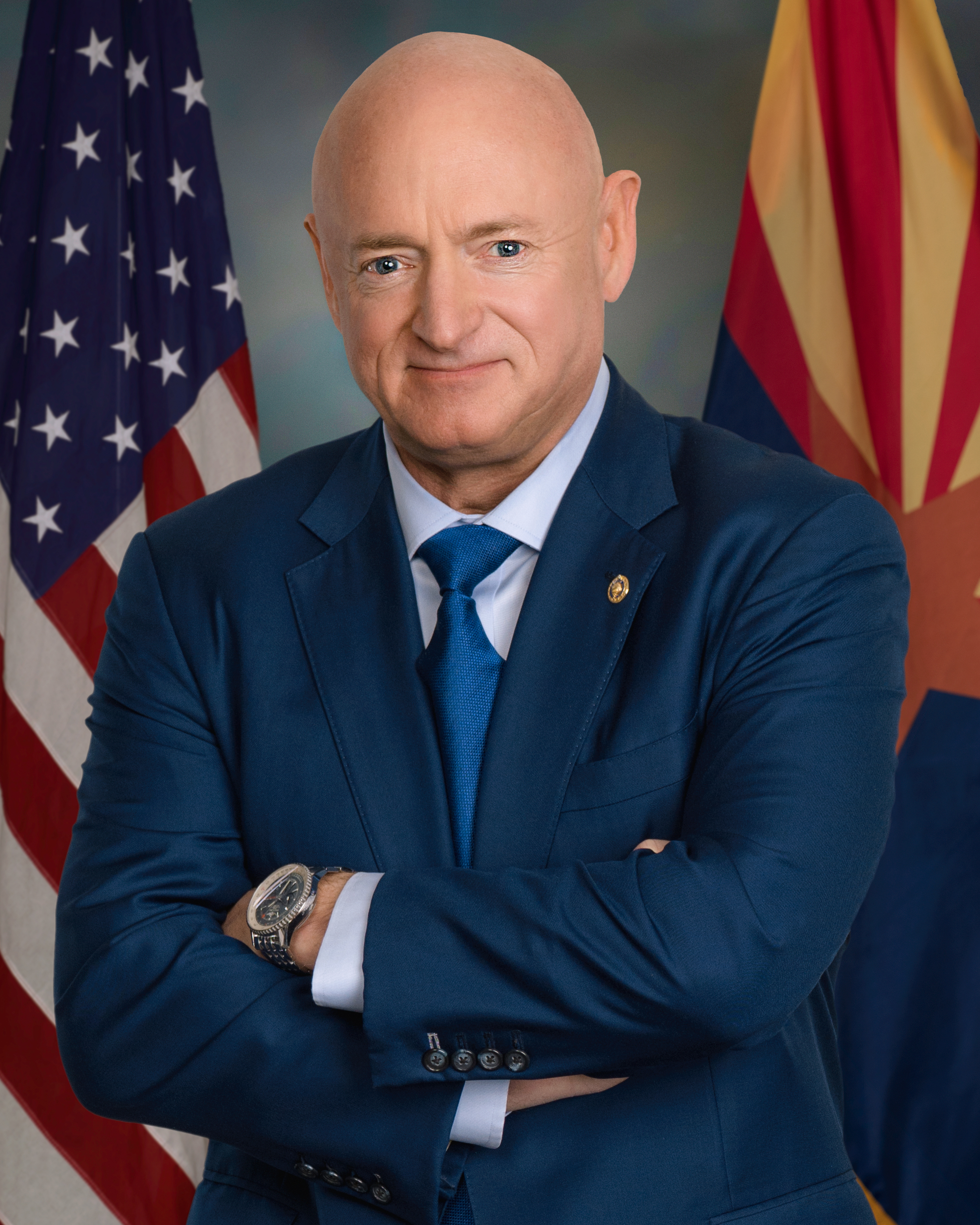
Mark Kelly
American politician, astronaut and naval officer (born 1964)
Mark Edward Kelly (born February 21, 1964) is an American politician and a retired astronaut and naval officer. He is the senior United States senator from Arizona, a seat he has held since 2020. He is a member of the Democratic Party.
Kelly flew combat missions during the Gulf War as a naval aviator before being selected as a NASA Space Shuttle pilot in 1996. His identical twin brother, Scott Kelly, also became a NASA astronaut that year. Mark flew his first space mission in 2001 as pilot of STS-108, then piloted STS-121 in 2006, and commanded STS-124 in 2008 and STS-134 (the final mission of Space Shuttle Endeavour) in 2011. In January 2011, Kelly's wife, then-Arizona Representative Gabby Giffords, was shot and nearly killed in an assassination attempt in Arizona. Kelly retired from the Navy and NASA that October. In 2013, Kelly and Giffords founded a nonprofit political action committee, Americans for Responsible Solutions (later merged into Giffords), which campaigned for gun control measures like universal background checks.
Kelly was first elected to the Senate in a 2020 special election triggered by the death of Senator John McCain. He defeated incumbent Republican Martha McSally in the general election, becoming the first Democrat to win the seat since 1962. Kelly was reelected to a full term in 2022.
Kelly was reportedly one of the three leading contenders for the Democratic vice presidential nomination in the 2024 U.S. presidential election, along with Pennsylvania governor Josh Shapiro and Minnesota governor Tim Walz.
Early life and education
Mark Kelly was born on February 21, 1964, in Orange, New Jersey, and raised in West Orange, New Jersey. He and his identical twin brother, Scott Kelly, are sons of Richard and Patricia (née McAvoy) Kelly, two retired police officers. Kelly is of Irish descent. Kelly graduated from Mountain High School in 1982. In 1986, he took highest honors in a marine engineering and nautical science BSc from the United States Merchant Marine Academy. In 1994, he received a MSc in aeronautical engineering from the U.S. Naval Postgraduate School.
Naval career (1987–2011)
In December 1987, Kelly became a naval aviator and received initial training on the A-6E Intruder attack aircraft. He was then assigned to Attack Squadron 115 (VA-115) at NAF Atsugi in Kanagawa, Japan. He was deployed twice with VA-115 to the Persian Gulf aboard the aircraft carrier USS Midway, which was homeported at Naval Station Yokosuka in Yokosuka, Japan. During Operation Desert Storm, Kelly flew 39 combat missions. After the Gulf War, Kelly received his master's degree and then attended U.S. Naval Test Pilot School from 1993 to 1994. As a naval aviator and test pilot, he has logged over 5,000 hours in more than 50 different aircraft and trapped over 375 carrier landings.
During his Navy career, Kelly received two Defense Superior Service Medals; one Legion of Merit; two Distinguished Flying Crosses; four Air Medals (two individual/two strike flight) with Combat "V"; two Navy Commendation Medals, (one with combat "V"); one Navy Achievement Medal; two Southwest Asia Service Medals; one Navy Expeditionary Medal; two Sea Service Deployment Ribbons; a NASA Distinguished Service Medal; and an Overseas Service Ribbon.
On June 21, 2011, Kelly announced his retirement from both the Navy and NASA, effective October 1, citing Gabby Giffords's needs during her recovery from the attempt on her life that January.
NASA career (1996–2011)
NASA selected both Kelly and his identical twin, Scott Kelly, to be Space Shuttle pilots in 1996. They joined the NASA Astronaut Corps in August of that year. They are the only siblings to have both traveled into orbit.
Spaceflight experience
STS-108
Kelly's first trip into space was as pilot of STS-108. After several delays, Endeavour lifted off on December 5, 2001, on the final Shuttle mission of 2001.
STS-108 Endeavour visited the ISS, delivering over three tons of equipment, supplies, and a fresh crew to the orbiting outpost. The hatches were opened between Endeavour and the ISS Destiny Laboratory on December 7, enabling the 10 crew members to greet one another. The Expedition 3 crew officially ended their 117-day residency on board the ISS on December 8 as their custom Soyuz seat-liners were transferred to Endeavour for the return trip home. The transfer of the Expedition 4 seat-liners to the Soyuz return vehicle attached to the station marked the official exchange of crews.
Kelly and Mission Specialist Linda Godwin used the shuttle's robotic arm to lift the Raffaello Multi-Purpose Logistics Module from the shuttle payload bay and attach it to a berth on the station's Unity node. The crews began unloading supplies the same day. Mission managers extended Endeavour's flight duration to 12 days to allow the crew to assist with additional maintenance tasks on the station, including work on a treadmill and replacing a failed compressor in one of the air conditioners in the Zvezda Service Module. A change of command ceremony took place on December 13 as Expedition 3 ended and Expedition 4 began. STS-108 returned to Earth with the previous ISS crew of three men.
Kelly traveled over 4.8 million miles and orbited the Earth 186 times over 11 days and 19+ hours.
STS-121
In July 2006, Kelly piloted STS-121 Discovery, the second "Return to Flight" mission after the loss of Columbia in February 2003. Because of weather delays, STS-121 became the first shuttle mission to launch on the Fourth of July. In 2006, Kelly discussed the risks aboard the Space Shuttle:
The Space Shuttle's a very complex machine. It's got a lot of moving parts that move and operate at pretty much the limit of what we've been able to engineer. Spaceflight is risky. I think with regards to the tank, we've reduced some of the risk there. We've changed the design a little bit and we've made some pretty big strides in trying to get foam not to shed from the tank anymore. So there is some risk reduction there and I guess overall the risk is probably a little less. But this is a risky business, but it's got a big reward. Everybody on board Discovery and the space station here thinks it's worthwhile.
The mission's main purposes were to test new safety and repair techniques introduced after the Columbia disaster and to deliver supplies, equipment, and European Space Agency astronaut Thomas Reiter from Germany to the ISS. Reiter's transfer returned the ISS to a three-member staffing level.
During the STS-121 mission to the ISS, the crew of Discovery continued to test new equipment and procedures for the inspection and repair of the thermal protection system that is designed to increase the shuttles' safety. It also delivered more supplies and cargo for future ISS expansion.
After the Columbia accident, NASA decided that two test flights would be required and that activities originally assigned to STS-114 would be divided into two missions because of the addition of post-Columbia safety tests.
Gabby Giffords, Kelly's girlfriend at the time, picked one of the mission's wake-up songs, U2's "Beautiful Day". During the U2 360° Tour, Kelly often appeared on screen from the International Space Station during the song's introduction, greeting the city the band was playing in and asking the crowd to "tell my wife I love her very much, she knows"—a reference to David Bowie's "Space Oddity"; the tour's staging was often called the "space station".
Kelly traveled over 5.28 million miles and orbited the Earth 202 times over 12 days and 18+ hours.
STS-124
STS-124 Discovery was Kelly's first mission as commander. A month before liftoff, he discussed what being a shuttle commander entailed and how it was different from his previous missions:
My first two flights I was the pilot. Being the commander is different in that you're responsible for the overall mission. ... You have to worry about the whole thing, the training drill your other crew members are getting, mission success, and mission safety. So it is a more comprehensive job and requires more time. I'm really a little bit surprised at how much more there is to it. But I think it's more rewarding as well.
The mission was the second of three shuttle missions to carry components of Japan's Kibo laboratory to the ISS. Kibo is Japanese for "hope". The laboratory is Japan's primary contribution to the ISS.
Just before liftoff, Kelly said, "While we've all prepared for this event today, the discoveries from Kibo will definitely offer hope for tomorrow. Now stand by for the greatest show on Earth."
During the launch, Launch Pad 39A sustained substantial damage, more than had been seen on any previous launch. After liftoff, inspectors discovered that bricks and mortar from the launch pad's base had been thrown as far as the perimeter fence, a distance of 1,500 feet (457 m).
Content sourced from Wikipedia under CC BY-SA 4.0


