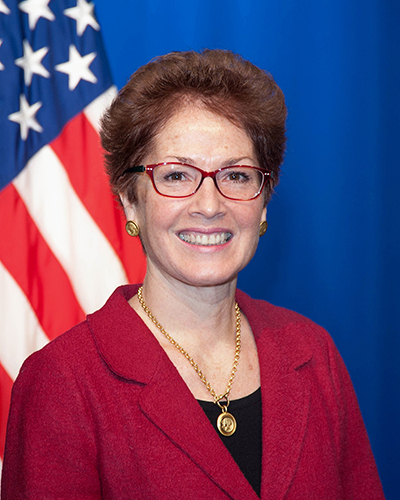
Marie Yovanovitch
Canadian-American diplomat (born 1958)
Marie Louise "Masha" Yovanovitch (born November 11, 1958) is a Canadian-American former diplomat and retired senior member of the United States Foreign Service. She served in multiple State Department posts, including Senior Advisor to the Under Secretary of State for Political Affairs (2004–2005), U.S. Ambassador to Kyrgyzstan (2005–2008), U.S. Ambassador to Armenia (2008–2011), Principal Deputy Assistant Secretary for the Bureau of European and Eurasian Affairs (2012–2013), and Ambassador to Ukraine (2016–2019). Yovanovitch is a diplomat in residence at the Institute for the Study of Diplomacy at Georgetown University. On January 31, 2020, it was reported that she had retired from the State Department.
While ambassador to Ukraine, Yovanovitch was the target of a conspiracy-driven smear campaign, amplified by President Donald Trump and his allies. In May 2019, Trump abruptly recalled Yovanovitch from her post following claims by Trump surrogates that she was undermining Trump's efforts to pressure Ukraine to investigate his political rival, former vice president and 2020 U.S. presidential candidate Joe Biden. Yovanovitch's removal preceded a July 2019 phone call by Trump in which he attempted to pressure Ukraine president Volodymyr Zelenskyy to investigate Biden. Following a whistleblower complaint about the phone call and attempts to cover it up, an impeachment inquiry against Trump was initiated by the U.S. House of Representatives. Yovanovitch testified in several House committee depositions in the inquiry.
Early life and education
Marie Yovanovitch is the daughter of Mikhail Yovanovitch and Nadia (Theokritoff) Yovanovitch, who fled the Soviet Union and later the Nazis. She was born in Canada, moved to Connecticut at age three, and became a naturalized American citizen at age eighteen. She grew up speaking Russian.
Yovanovitch graduated from Kent School in Connecticut in 1976; her parents were longtime foreign language teachers at the school. Yovanovitch earned a Bachelor of Arts degree in history and Russian studies from Princeton University in 1980. Her senior thesis was titled "The Excommunication of Tolstoy. A Personal and Political Event." She studied at the Pushkin Institute in Moscow (1980) and was awarded a Master of Science degree from the National Defense University's National War College in 2001.
Career
Early diplomatic career
Yovanovitch joined the United States Foreign Service in 1986. Her first foreign assignment, in Ottawa, was followed by overseas assignments including Moscow, London, and Mogadishu. From May 1998 to May 2000, she served as the deputy director of the Russia Desk in the U.S. Department of State.
From August 2001 to June 2004, as a career member of the Senior Foreign Service, she was the Deputy Chief of Mission of the U.S. Embassy in Kyiv, Ukraine. From August 2004 to May 2005, she was the senior advisor to the Under Secretary of State for Political Affairs. Yovanovitch also served as International Advisor and Deputy Commandant at the National Defense University's Dwight D. Eisenhower School for National Security and Resource Strategy and as dean of the School of Language Studies within the U.S. Department of State's Foreign Service Institute.
U.S. Ambassador to Kyrgyzstan and Armenia and subsequent service
Yovanovitch is "well known in diplomatic circles for her measured demeanor and diligence in representing both Republican and Democratic administrations." Yovanovitch was appointed U.S. Ambassador to Kyrgyzstan on November 20, 2004; she presented her credentials on February 4, 2005, and remained in this post until February 4, 2008. Her nomination as ambassador to Kyrgyzstan was confirmed by the Senate on a voice vote.
Yovanovitch was appointed U.S. Ambassador to Armenia on August 4, 2008; she presented her credentials on September 22, 2008, and remained in this post until June 9, 2011. Her nomination as ambassador to Armenia was again confirmed by the Senate on a voice vote. During confirmation hearings, Yovanovitch acknowledged that Turks had committed mass killings, rapes, and expulsions of Armenians between 1915 and 1923, calling this "one of the greatest tragedies of the 20th century," but, in line with U.S. policy, declined to use the phrase Armenian genocide, saying that the use of this politically sensitive phrase was a policy decision that could be made only by the highest-ranking U.S. officials, namely President George W. Bush and Secretary of State Condoleezza Rice.
While in Armenia, Yovanovitch oversaw a staff of almost 400 Americans and Armenians in one of the largest embassy compounds in the world. She pushed Armenian authorities to give fair treatment to Armenians arrested in post-election protests in 2008. Yovanovitch received the Secretary's Diplomacy in Human Rights Award, a department award honoring ambassadors who demonstrate "extraordinary commitment to defending human rights." She was also known for her work supporting democratic development and the advancement of women.
After returning to Washington in 2012 and 2013, Yovanovitch served as Principal Deputy Assistant Secretary for the Bureau of European and Eurasian Affairs. In that position, Yovanovitch was a key State Department headquarters contact for U.S. diplomats in Europe, working with, among others, U.S. Ambassador to Poland Lee Feinstein, regarding issues such as U.S. missile defense in Poland. Yovanovitch received the department's Senior Foreign Service Performance Award six times and the Superior Honor Award five times. She was promoted to the rank of Career Minister in 2016.
U.S. Ambassador to Ukraine
Yovanovitch was announced as the nominee for U.S. ambassador to Ukraine on May 18, 2016, to replace Geoff Pyatt; the nomination was sent to the Senate the next day, and confirmed by voice vote of the Senate on July 14, 2016. Having been sworn in on August 12, Yovanovitch arrived in Ukraine on August 22 and presented her credentials on August 29, 2016.
Anti-corruption work and other activities
Yovanovitch was respected within the national security community for her efforts to encourage Ukraine to tackle corruption and during her tenure sought to strengthen the Ukrainian National Anti-Corruption Bureau, which had been created to bolster efforts to fight corruption in Ukraine; these efforts earned Yovanovitch some enemies within the country. In a March 2019 speech to the Ukraine Crisis Media Center, Yovanovitch said that the Ukrainian government was not making sufficient progress to combat corruption, saying: "It is increasingly clear that Ukraine's once-in-a-generation opportunity for change has not yet resulted in the anti-corruption or rule-of-law reforms that Ukrainians expect or deserve." On April 1, 2019, Yovanovitch spoke at an anti-corruption conference where she thanked Ukrainians for their courage and commitment to end corruption.
Smear campaign against Yovanovitch and ousting
As U.S. ambassador to Ukraine, Yovanovitch was the target of a conspiracy-driven smear campaign. Allegations against her were then made by Trump's personal attorney Rudolph W. Giuliani, as well as conservative commentator John Solomon of The Hill and Ukraine's then-top prosecutor, Yuriy Lutsenko, who accused her of being part of a conspiracy involving anti-corruption probes in Ukraine and efforts by the Trump administration to investigate ties between Ukrainian officials and the Hillary Clinton 2016 presidential campaign. Lutsenko, who has been accused by Ukrainian civil society organizations of corruption, claimed that Yovanovitch, an Obama administration appointee, had interfered in Ukraine politics, had given him a "do-not-prosecute" list, and was interfering in his ability to combat corruption in Ukraine. The U.S. State Department said that Lutsenko's allegations against Yovanovitch were "an outright fabrication" and indicated that they were a "classic disinformation campaign." Lutsenko subsequently recanted his claims of a "do-not-prosecute" list. Solomon's stories were nonetheless amplified by President Trump, his son Donald Trump Jr., Giuliani, Solomon, and conservative media outlets. Ukrainians who opposed Yovanovitch were also sources for Giuliani, who "was on a months-long search for political dirt in Ukraine to help President Trump." Giuliani confirmed in a November 2019 interview that he believed he "needed Yovanovitch out of the way" because she was going to make his investigations difficult.
On April 24, 2019, after complaints from Giuliani and other Trump allies that Yovanovitch was undermining and obstructing Trump's efforts to persuade Ukraine to investigate former vice president and 2020 presidential election candidate Joe Biden, Trump ordered Yovanovitch's recall. She returned to Washington, D.C. on April 25, with her recall becoming public knowledge on May 7, and her mission as ambassador being terminated on May 20, 2019. In a July 25, 2019 phone call with Ukrainian President Volodymyr Zelensky (the contents of which became public on September 25, 2019), Trump pressured the Ukrainian government to investigate Biden and disparaged Yovanovitch to his foreign counterpart, calling her "bad news".
Content sourced from Wikipedia under CC BY-SA 4.0


