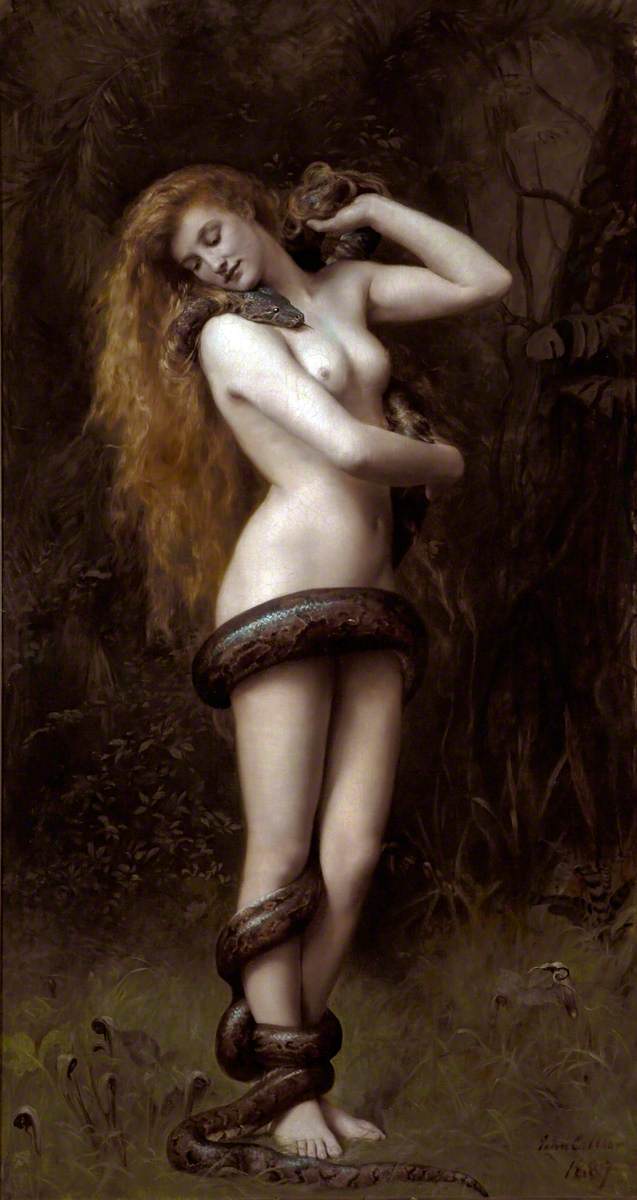
Lilith
Female entity in Near Eastern mythology
Lilith (; Hebrew: לִילִית, romanized: Līlīṯ; also spelled Lilit, Lilitu, or Lilis) is a feminine figure in Mesopotamian and Jewish mythology. According to accounts in the Talmud she is a primordial she-demon. Lilith is cited as having been "banished" from the Garden of Eden for disobeying Adam.
Lilith does not appear in the Hebrew Bible or any other biblical source, although her name is derived from a single word in the Book of Isaiah, the meaning of which is debated by scholars. She first appears in Mandaean and Jewish sources from late antiquity (500 AD onward), in historiolas – incantations that incorporate a short mythic story – that give partial descriptions of her. She is mentioned in the Babylonian Talmud (at Eruvin 100b, Niddah 24b, Shabbat 151b, Bava Batra 73a), and in the Zohar § Leviticus 19a as "a hot fiery female who first cohabited with man". Many rabbinic authorities, including Maimonides and Menachem Meiri, reject the existence of Lilith.
The name Lilith seems related to the masculine Akkadian word lilû and its female variants lilītu and ardat lilî. The lil- root is shared by the Hebrew word lilit appearing in Isaiah 34:14, which is thought to be a night bird by modern scholars such as Judit M. Blair. In Mesopotamian religion according to the cuneiform texts of Sumer, Assyria, and Babylonia, lilû are a class of demonic spirits, consisting of adolescents who died before they could bear children. Many have also connected her to the Mesopotamian demon Lamashtu, who shares similar traits and a similar position in mythology to Lilith.
History
In some Jewish folklore, such as the Alphabet of Sirach (c. 700–1000 AD), Lilith appears as Adam's first wife, who was created at the same time and from the same clay as Adam. The legend of Lilith developed extensively during the Middle Ages, in the tradition of Aggadah, the Zohar, and Jewish mysticism. For example, in the 13th-century writings of Isaac ben Jacob ha-Cohen, Lilith left Adam after she refused to become subservient to him and then would not return to the Garden of Eden after she had coupled with the archangel Samael.
Interpretations of Lilith found in later Jewish materials are plentiful, but little information has survived relating to the Sumerian, Assyrian, and Babylonian views of this class of demons. Recent scholarship has disputed the relevance of two sources previously used to connect the Jewish lilith to an Akkadian lilītu – the Gilgamesh appendix and the Arslan Tash amulets (see below for discussion of these two problematic sources).
In contrast, some scholars, such as Lowell K. Handy, hold the view that though Lilith derives from Mesopotamian demonology, evidence of the Hebrew Lilith being present in the sources frequently cited – the Sumerian Gilgamesh fragment and the Sumerian incantation from Arshlan-Tash being two – is scant, if present at all.
In Hebrew-language texts, the term lilith or lilit (translated as "night creatures", "night monster", "night hag", or "screech owl") first occurs in a list of animals in Isaiah 34. The Isaiah 34:14 Lilith reference does not appear in most common Bible translations such as KJV and NIV. Commentators and interpreters often envision the figure of Lilith as a dangerous demon of the night, who is sexually wanton, and who steals babies in the darkness. Currently there is no scholarly consensus, with some adhering to the animalistic interpretation, whereas others claim 34:14 is referencing a literal demon or a category of demons falling under the specification of "lilith". Historically, certain prominent Jewish rabbis in Talmudic texts feared the likes of liliths, some to such an extent that they recommended men not sleep in a home alone, as any who do would be "seized by Lilith." Jewish incantation bowls and amulets from Mesopotamia from the first to the eighth centuries identify Lilith as a female demon and provide the first visual depictions of her. The said amulets were often symbolic divorce papers, warding off a given lilith that was thought to be haunting one's house or family.
Etymology
In the Akkadian language of Assyria and Babylonia, the terms lili and līlītu mean spirits. Some uses of līlītu are listed in the Assyrian Dictionary of the Oriental Institute of the University of Chicago (CAD, 1956, L.190), in Wolfram von Soden's Akkadisches Handwörterbuch (AHw, p. 553), and Reallexikon der Assyriologie (RLA, p. 47).
The Sumerian female demons lili have no etymological relation to Akkadian lilu, "evening".
Archibald Sayce (1882) considered that the Hebrew and the earlier Akkadian names are derived from Proto-Semitic. Charles Fossey (1902) has this literally translating to "female night being/demon", although cuneiform inscriptions from Mesopotamia exist where Līlīt and Līlītu refers to disease-bearing wind spirits.
Mesopotamian mythology
The spirit in the tree in the Gilgamesh cycle
Samuel Noah Kramer (1932, published 1938) translated ki-sikil-lil-la-ke as "Lilith" in Tablet XII of the Epic of Gilgamesh dated c. 600 BC. Tablet XII is not part of the Epic of Gilgamesh, but is a later Assyrian Akkadian translation of the latter part of the Sumerian Epic of Gilgamesh. The ki-sikil-lil-la-ke is associated with a serpent and a zu bird. In Gilgamesh, Enkidu, and the Netherworld, a huluppu tree grows in Inanna's garden in Uruk, whose wood she plans to use to build a new throne. After ten years of growth, she comes to harvest it and finds a serpent living at its base, a Zu bird raising young in its crown, and that a ki-sikil-lil-la-ke made a house in its trunk. Gilgamesh is said to have killed the snake, and then the zu bird flew away to the mountains with its young, while the ki-sikil-lil-la-ke fearfully destroys its house and runs for the forest.
Identification of the ki-sikil-lil-la-ke as Lilith is stated in the Dictionary of Deities and Demons in the Bible (1999). Suggested translations for the Tablet XII spirit in the tree include ki-sikil as "sacred place", lil as "spirit", and lil-la-ke as "water spirit", but also simply "owl", given that the lil is building a home in the trunk of the tree. A connection between the Gilgamesh ki-sikil-lil-la-ke and the Jewish Lilith was rejected on textual grounds by Sergio Ribichini (1978).
The bird-footed woman in the Burney Relief
Kramer's translation of the Gilgamesh fragment was used by Henri Frankfort (1937) and Emil Kraeling (1937) to support identification of a woman with wings and bird-feet in the disputed Burney Relief as related to Lilith. Frankfort and Kraeling identified the figure in the relief with Lilith. Today, the identification of the Burney Relief with Lilith is questioned. Modern research has identified the figure as one of the main goddesses of the Mesopotamian pantheons, most probably Ereshkigal. But the figure is more generally identified as the goddess of love and war: Thorkild Jacobsen identified the figure as Inanna in an analysis based on the existence of symbols and attributes commonly recognized to the goddess and on textual evidence.
The Arslan Tash amulets
The Arslan Tash amulets are limestone plaques discovered in 1933 at Arslan Tash, the authenticity of which is disputed. William F. Albright, Theodor H. Gaster, and others, accepted the amulets as a pre-Jewish source which shows that the name Lilith already existed in the 7th century BC but Torczyner (1947) identified the amulets as a later Jewish source.
Content sourced from Wikipedia under CC BY-SA 4.0


