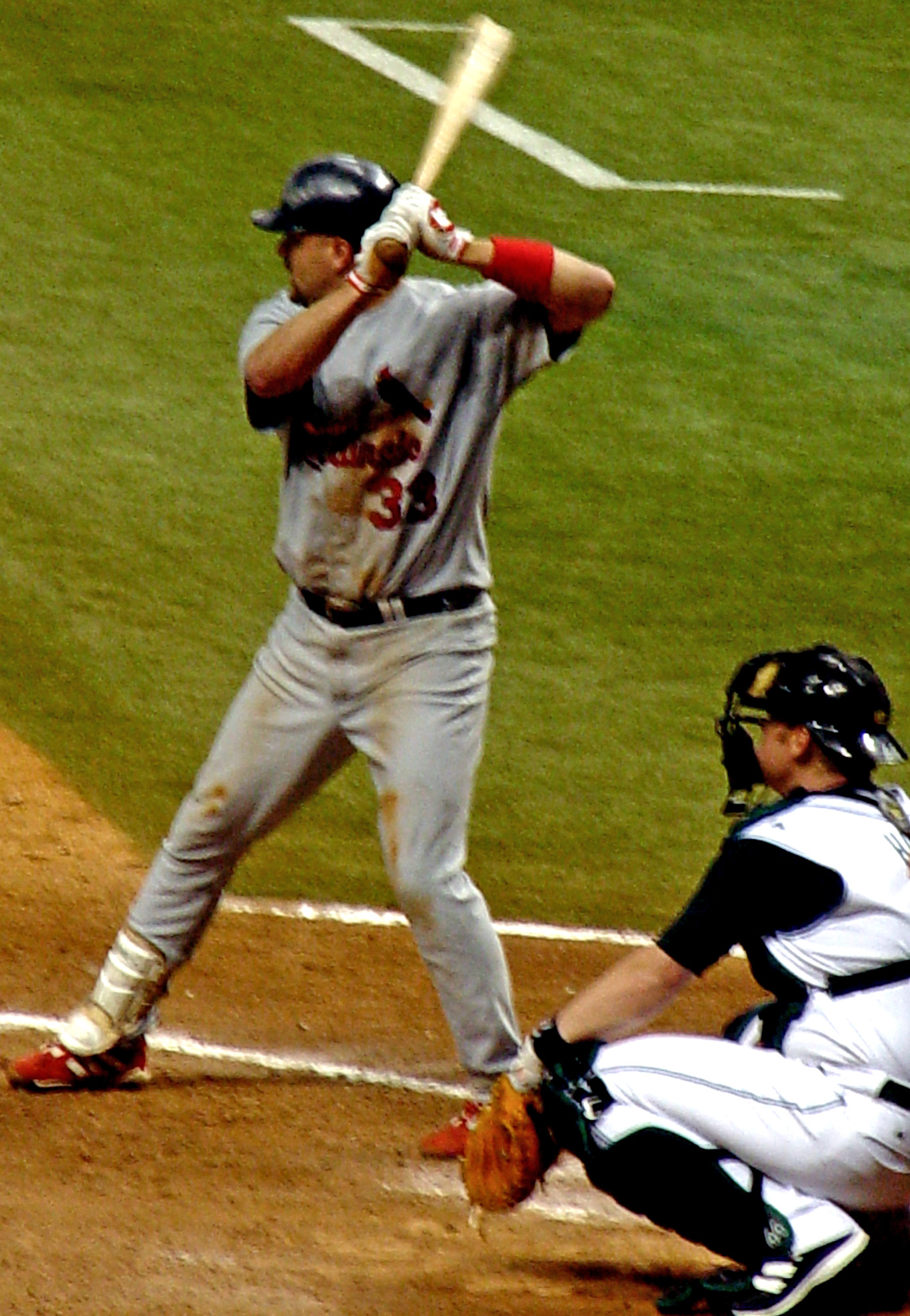
Larry Walker
Canadian baseball player (born 1966)
Larry Kenneth Robert Walker (born December 1, 1966) is a Canadian former professional baseball right fielder. During his 17-year Major League Baseball (MLB) career, he played with the Montreal Expos, Colorado Rockies, and St. Louis Cardinals. In 1997, he became the only player in major league history to register both a .700 slugging percentage (SLG) and 30 stolen bases in the same season, on his way to winning the National League (NL) Most Valuable Player Award (MVP). The first player in more than 60 years to record a batting average of .360 in three consecutive seasons from 1997 to 1999, Walker also won three NL batting championships. He was inducted into Canada's Sports Hall of Fame in 2007, and the Canadian Baseball Hall of Fame in the Class of 2009, and was named the 13th-greatest sporting figure from Canada by Sports Illustrated in 1999. In 2020, Walker was elected to the Baseball Hall of Fame.
Widely considered a five-tool player of prodigious athleticism and instincts, Walker hit for both average and power, combined with well-above-average speed, defense and throwing strength and accuracy. He was recognized as the top Canadian athlete in 1998 with the Lou Marsh Trophy. Other honors include five MLB All-Star selections, seven Gold Glove Awards, three Silver Slugger Awards, and nine Tip O'Neill Awards. His career SLG of .565 ranks 12th all time. Walker is one of only 19 hitters in history to accomplish a .300 batting average, .400 on-base percentage (OBP), and .500 SLG with at least 5,000 plate appearances, and one of six whose career began after 1960. Considering advanced metrics, he is one of only three players in history to rank within the top 100 of each of batting runs, base-running runs, and defensive runs saved; the others are Barry Bonds and Willie Mays.
Raised in Maple Ridge, British Columbia, Walker spent his youth playing street hockey with consuming NHL goaltender aspirations. That dream never materialized; however, the Expos saw his baseball potential and signed him in 1984. By 1990, Walker became their starting right fielder, propelling them to the majors' best record in 1994 when that year's strike stopped their first serious World Series run. He signed with the Rockies as a free agent following the season, and, during a six-year period starting in 1997, was the major league batting leader three times while finishing second in the NL twice. In 1997, he also led the league in home runs, OBP, and SLG, while joining the 30–30 club, registering 12 outfield assists and leading his position with four double plays turned; he won the NL MVP Award that year. Desiring a trade to a contending team, Walker was sent by the Rockies to St. Louis in the middle of their 105-win season of 2004 where he made his first World Series appearance while tying or setting three Cardinals postseason records. He announced his retirement from playing baseball after Game 6 of the 2005 NL Championship Series.
Following his playing career, Walker has served as a guest instructor for the Cardinals, and, since 2009, has coached the Canadian national team. In that time, Team Canada has competed in three World Baseball Classic (WBC) tournaments, and twice at the Pan American Games, winning consecutive gold medals in 2011 and 2015.
Early life and amateur career
Walker was born on December 1, 1966, in Maple Ridge, a suburb of Greater Vancouver in British Columbia, to Larry Sr., and Mary Walker, both of Scottish descent. Walker had three older brothers. The five men often played together in a fastpitch softball league, frequently all in the same starting lineup. Walker grew up passing much of his free time playing street hockey, especially as part of a group of boys in the backyard and driveway of another boy. In that group was future Hockey Hall of Famer Cam Neely, who became one of Walker's close friends. Walker dreamed of a career in the National Hockey League (NHL) as a goaltender, only casually playing an occasional baseball game during the summer.
Walker played hockey and volleyball at Maple Ridge Secondary School; baseball was not offered. One of his boyhood idols was NHL goalie Billy Smith, who won four consecutive Stanley Cups from 1980−83, during Walker's teenage years. Walker sharpened his skills by blocking shots against Neely. Walker's brother Carey, also a goaltender, was drafted by the Montreal Canadiens in the 12th round of the 1977 NHL draft.
Junior hockey
At the age of 16, Walker was offered tryouts with Junior A teams in Regina, Saskatchewan, and Kelowna, British Columbia, however, he was cut from both teams, while Herbert made the Regina Pats. Other offers Walker received were from Western Hockey League teams, including Swift Current, which he toured. After seeing substandard conditions there, he decided that he no longer wanted to pursue hockey once he arrived at the rink, and subsequently focused his athletic aspirations on baseball.
Baseball
The popularity of baseball in Canada during Walker's youth small compared to the following he would help spawn related to his later success with the Montreal Expos. Previously, Canadian baseball luminaries included Tip O'Neill, the first Canadian to win a Triple Crown in 1887, and Ferguson Jenkins, Canada's first selectee to the American Baseball Hall of Fame in 1991. Walker would help dramatically increase the profile of the sport in a hockey-mad nation. Part of the factor are Canada's short summers, which make it more challenging to play outdoors than in the United States. Walker later said regarding his youth career, "I'd never seen a forkball, never seen a slider. I didn't know they existed. I had never really seen a good curveball. In Canada, as a kid, we'd play 10 baseball games a year. Fifteen, tops. Some pitchers had a thing they'd call a spinner, but nothing like this. Baseball just wasn't big. The weather was against it. Nobody ever played baseball thinking about making the major leagues." He was also unaware of many of the rules, attesting to his lack of experience playing when he turned a professional.
In 1984, Walker played for the Coquitlam Reds of the British Columbia Premier Baseball League. He was selected to join the Canadian team at the 1984 World Youth Championships in Kindersley, Saskatchewan. At that tournament, he caught the eye of Expos scouting director Jim Fanning after hitting a home run with a wooden bat, in contrast to all the other players who were using metal bats. Fanning signed Walker for $1,500 (equivalent to US$4,648 in 2025) as an amateur free agent owing to his relative lack of experience playing organized baseball. At that time, Canadians were not eligible to be selected through the Major League Baseball draft. While the Expos perceived Walker to be very athletic, they decided that he was very raw, and that he did not initially warrant rating as a top prospect.
Professional career
Minor leagues
Walker attended Expos minor league spring training camp in 1985 and it was clear from the outset that pitching was a complete mystery to him. He swung indiscriminately, expecting every pitch to be a fastball, including at ones that bounced 10 feet in front of, or on, home plate. When the camp ended, there was still about one and a half months remaining until the start of the season, so he returned home, seeking additional preparation. He joined a fast-pitch softball team sponsored by a bowling alley, but this brought little relief. The Expos assigned Walker to the Utica Blue Sox of the New York–Penn League, a Class A Short Season league, for his first season of professional baseball. He played third base and first base. Although he could hit fastballs well, he continued to have difficulties with strike zone judgment and the more sophisticated pitches, finishing with a .223 batting average and two home runs. Manager Ken Brett, who was less preoccupied with fielding a winning team than giving the athletic players the opportunity to experiment, allowed Walker to stay in the lineup as a regular in part because of his willingness to learn. Walker heard that he would be released, but Brett recalled that "he was just so tough," and marveled at his "outstanding athleticism, freakish hand-eye coordination and mental approach;" he also had 12 stolen bases. Expos hitting coach Ralph Rowe successfully lobbied for him to be sent to the Florida Instructional League (FIL). With further tutelage, relentless preparation, and sheer hard work, Walker soon developed into one of the Expos' best young prospects. He continued to make annual off-season returns to FIL in West Palm Beach to calibrate and refine his approach, and eventually made his home there.
Content sourced from Wikipedia under CC BY-SA 4.0


