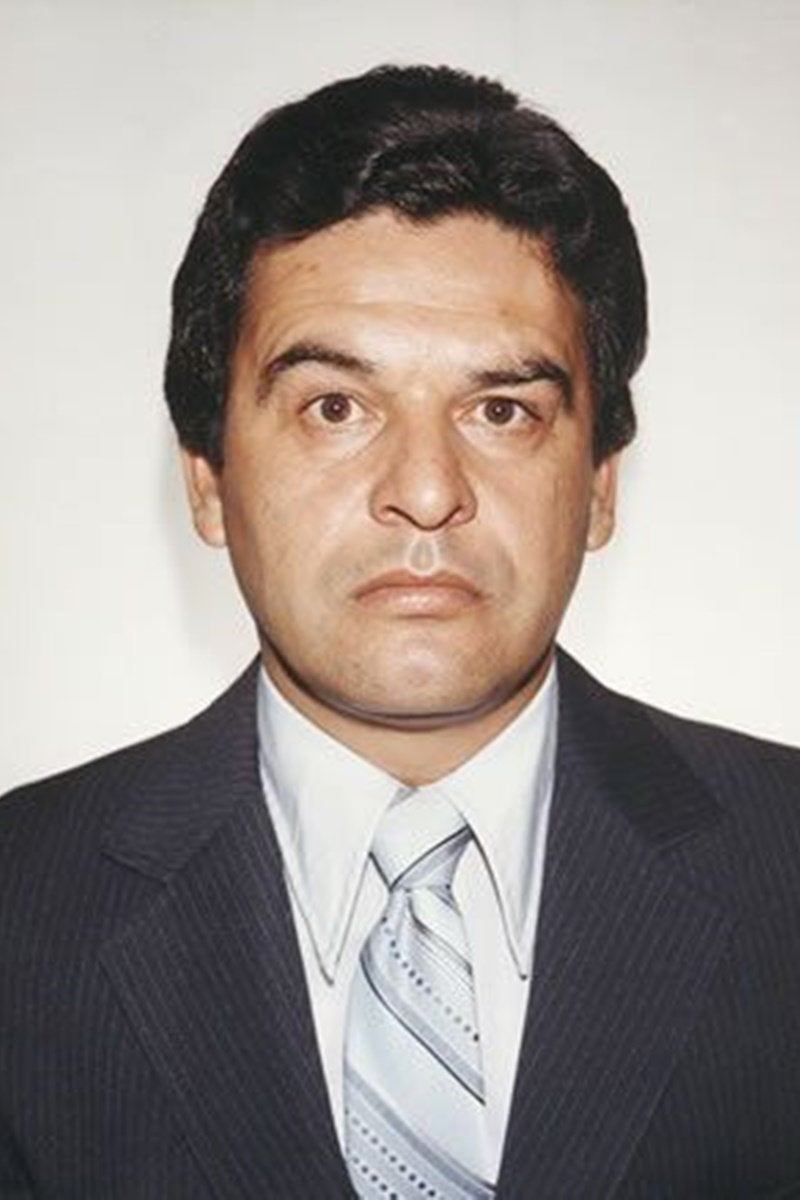
Kiki Camarena
DEA agent murdered by drug traffickers (1947–1985)
Enrique "Kiki" Camarena Salazar (July 26, 1947 – February 9, 1985) was a Mexican-American agent of the Drug Enforcement Administration (DEA). In February 1985, Camarena was kidnapped by police officers hired by the Guadalajara Cartel. After being brutally tortured for information, Camarena was eventually killed. The U.S. investigation into Camarena's murder led to ten trials in Los Angeles for Mexican nationals involved in the crime. The case continues to trouble U.S.–Mexican relations, most recently when Rafael Caro Quintero, one of the three convicted traffickers, was released from a Mexican prison in 2013. Caro Quintero was again captured by Mexican forces in July 2022, reigniting discussions surrounding Camarena’s murder and its impact on enforcing drug policies domestically and abroad.
Several journalists, historians, former DEA and CIA officers, and Mexican police officers have written that the Central Intelligence Agency (CIA) was complicit in Camarena's murder because Camarena discovered CIA involvement in drug trafficking operations in Mexico, which were used to fund the Contras in Nicaragua. The CIA has denied the allegations.
Early life and career
Enrique Camarena was born on July 26, 1947, in the border city of Mexicali, Mexico. The family—three brothers and three sisters—immigrated to Calexico, California when Camarena was a child. Camarena's parents divorced when he was young, and the family endured considerable poverty after their move. His oldest brother, PFC Eduardo Camarena-Salazar, died of malaria while serving with the U.S. Army's 173rd Airborne Brigade in Vietnam in September 1965. His other brother Ernesto had a troubled police record, including drug problems. Despite the family's difficulties, Camarena graduated from Calexico High School in 1966.
After graduating from high school, Camarena joined the Marines in 1968. Following his discharge in 1970, he returned to Calexico and joined the police department. He moved on to undercover narcotics work as a Special Agent on the Imperial County Narcotic Task Force (ICNTF). After the Drug Enforcement Administration (DEA) was established in 1973, it quickly instituted a hiring program for Spanish-speaking agents. Both Camarena and his sister Myrna joined the agency in 1973, Myrna as a secretary and Enrique as a special agent in the DEA's Calexico resident office.
In 1977, Camarena transferred to the agency's field office in Fresno, where he worked undercover on smuggling activities in the San Joaquin Valley. Author Elaine Shannon describes Camarena as "a natural in the theater of the street", able to "slip effortlessly into a Puerto Rican accent or toss off Mexican gutter slang—whatever the role demanded." Colleagues described him as driven, even by the standards of job-focused DEA agents.
In 1980, a colleague and close friend who had moved from Fresno to the DEA resident office in Guadalajara suggested that Camarena also apply for an assignment at the office, where a position was open. Foreign assignments were important for job advancement in the DEA and the Guadalajara office was seeing a surge in work, foreshadowing the explosion in drug trafficking of the 1980s. By this time, Camarena was married and had three sons. Guadalajara's spring-like weather, the city's American school, and the favorable exchange rate convinced Camarena and his family that the move would be good for the family.
Mexican background
American anti-narcotic efforts in Mexico long predate the Camarena case. Mexican heroin and marijuana production became a concern to U.S. drug enforcement by the 1960s, but the first major American joint actions with the Mexican government did not begin until the 1970s with Mexico's own "Operation Condor".
America’s involvement in Mexico’s drug trade in the 1970s and 1980s was a contributing factor to a contentious relationship with Mexico and the development of Mexican cartels. The war on drugs initiative implemented under the Reagan Presidency put considerable pressure on Mexico to cooperate with the U.S. to combat the growing power of the Guadalajara and Sinaloa cartels, which leveraged their power through the use of corruption and violence to control the drug trade. Despite joint anti-drug initiatives such as eradication programs and intelligence-sharing, the drug trade continued due to mutual mistrust, institutional corruption, and the demand for narcotics within the U.S. Ultimately, the U.S. and Mexico’s relations continue to be strained, with the drug trade still persisting.
Early anti-narcotic efforts in Mexico
When the French heroin connection was shut down in the early 1970s, Mexico took its place as an important source of American heroin. Mexican marijuana production boomed in the early 1970s as well, and was later a major component of the Guadalajara cartel's production and trafficking. At this time in the early 1970s, Mexico was not yet a major transshipment point for cocaine, primarily produced in the Andean countries of Colombia, Peru, and Bolivia.
In response to strong American pressure and domestic law enforcement concerns, Mexico began eradication programs of opium and marijuana plantations, with large infusions of U.S. assistance. The first programs were on a smaller scale and used mostly manual eradication, such as "Operation Cooperation" in 1970. As plantation sizes grew, the eradication efforts also grew. In 1975, Mexican president Luis Echeverría approved Operation Trizo, which used aerial surveillance and spraying of herbicides and defoliants from a fleet of dozens of planes and helicopters.
The spraying programs required extensive American involvement, both for funding and operations. DEA pilots performed important operational roles; in addition to training Mexican pilots, they helped spot fields for spraying and verified that spraying runs had destroyed targeted fields. As part of the program, DEA was allowed to fly in Mexican airspace freely.
These flights produced positive results, reducing acreage planted and eventually a reduction in Mexican heroin quality and quantity. Mexican law enforcement on the ground also had some positive results. Alberto Sicilia Falcon, a major trafficker who was one of the first to transship cocaine through Mexico, was arrested in 1975. Pedro Avilés Pérez, an important Sinaloa trafficker was killed in a shoot-out with Mexican Federal Police in 1978.
DEA personnel abroad
As part of these efforts, the first American narcotics law enforcement office was opened in Mexico City in the mid-1960s by the Federal Bureau of Narcotics, a branch of the Treasury Department. A Guadalajara office was opened in 1969. These and other offices opened by various agencies remained in place as American drug enforcement agencies proliferated and merged into the DEA. While the offices were opened with permission from the Mexican government, they later became controversial, particularly during the Camarena case.
DEA agents stationed in Mexico and other countries then and now are subject to several restrictions by the host country. They have no law enforcement powers; instead, they perform intelligence, liaison, and advisory functions, collect and pass along information on drug trafficking, and advise on local anti-narcotics programs. In Mexico, although there had been an informal agreement with the Mexican federal government that agents could carry personal weapons, it was illegal for foreigners to do so, and local officials were free to arrest them for this. DEA agents accredited to the U.S. Embassy in Mexico City had full diplomatic status, but agents in the resident offices did not and could be arrested and imprisoned without any official protections.
American law also restricts DEA activities abroad. Due to host country restrictions, DEA policy prohibits agents from doing undercover work abroad. A law known as the Mansfield amendment, introduced by Senator Mike Mansfield and passed by Congress in 1975, prohibited DEA personnel to be present at the scene of an arrest outside the U.S. It also banned agents from using force, except where lives were threatened. This later complicated DEA efforts in the investigation of Camarena's death.
Camarena in Guadalajara
By the time Camarena took up his post in Guadalajara in the summer of 1980, drug trafficking in Mexico was on the rise. There were several reasons for this. Under Mexican President José López Portillo, the aerial spotting and eradication endorsed by President Echeverría were curtailed, and American participation in these activities ended in 1978. This made it easier for producers to build the large plantations discovered later in the 1980s and more challenging to verify that areas identified had actually been sprayed. During the late 1970s and early 1980s, cocaine trafficking, driven mostly by Colombian smugglers, grew rapidly in the United States and became a primary target of the DEA, leaving Mexican enforcement a secondary concern. During Camarena's 4+1⁄2 years in Guadalajara, major traffickers arose to take the place of the figures arrested and killed in the 1970s. The best-known of these were Miguel Ángel Félix Gallardo, Ernesto Fonseca Carrillo and Rafael Caro Quintero. These three often coordinated their production and operations and formed the core of what came to be called the Guadalajara Cartel. All three were found guilty of having participated in Camarena's kidnap and murder.
Content sourced from Wikipedia under CC BY-SA 4.0


