Karnataka
State in southwestern India
Karnataka is a state in the southwestern region of India. It was formed as Mysore State on 1 November 1956, with the passage of the States Reorganisation Act, and renamed Karnataka in 1973. The state is bordered by the Lakshadweep Sea to the west, Goa to the northwest, Maharashtra to the north, Telangana to the northeast, Andhra Pradesh to the east, Tamil Nadu to the southeast, and Kerala to the southwest. With 61,130,704 inhabitants at the 2011 census, Karnataka is the eighth-largest state by population, comprising 31 districts. With 15,257,000 residents, the state capital Bengaluru is the largest city of Karnataka.
The economy of Karnataka is among the most productive in the country with a gross state domestic product (GSDP) of ₹25.01 trillion (US$300 billion) and a per capita GSDP of ₹332,926 (US$3,900) for the financial year 2023–24. The state experienced a GSDP growth of 10.2% for the same fiscal year. After Bengaluru Urban, Dakshina Kannada, Hubli–Dharwad, and Belagavi districts contribute the highest revenue to the state respectively. The capital of the state, Bengaluru, is known as the Silicon Valley of India, for its immense contributions to the country's information technology sector. A total of 1,973 companies in the state were found to have been involved in the IT sector as of 2007.
Karnataka is the only southern state to have land borders with all of the other four southern Indian sister states. The state covers an area of 191,791 km2 (74,051 mi2), or 5.83 per cent of the total geographical area of India. It is the sixth-largest Indian state by area. Kannada, one of the classical languages of India, is the most widely spoken and official language of the state. Other minority languages spoken include Urdu, Konkani, Marathi, Tulu, Tamil, Telugu, Malayalam, Kodava and Beary. Karnataka also contains some of the only villages in India where Sanskrit is primarily spoken.
Though several etymologies have been suggested for the name Karnataka, the generally accepted one is that Karnataka is derived from the Kannada words karu and nādu, meaning "elevated land". Karu Nadu may also be read as karu, meaning "black" and nadu, meaning "region", as a reference to the black cotton soil found in the Bayalu Seeme region of the state. The British used the word Carnatic, sometimes Karnatak, to describe both sides of peninsular India, south of the Krishna. With an antiquity that dates to the Paleolithic, Karnataka has been home to some of the most powerful empires of ancient and medieval India. The philosophers and musical bards patronised by these empires launched socio-religious and literary movements which have endured to the present day. Karnataka has contributed significantly to both forms of Indian classical music, the Carnatic and Hindustani traditions.
Etymology
History
Karnataka's pre-history goes back to a Paleolithic hand-axe culture evidenced by discoveries of, among other things, hand axes and cleavers in the region. Evidence of Neolithic and megalithic cultures have also been found in the state. Gold discovered in Harappa was found to be imported from mines in Karnataka, prompting scholars to hypothesise about contacts between ancient Karnataka and the Indus Valley Civilisation c. 3300 BCE.
Prior to the third century BCE, most of Karnataka formed part of the Mauryan Empire of Emperor Ashoka. Four centuries of Satavahana rule followed, allowing them to control large areas of Karnataka. The decline of Satavahana power led to the rise of the earliest native kingdoms, the Kadambas and the Western Gangas, marking the region's emergence as an independent political entity. The Kadamba Dynasty, founded by Mayurasharma, had its capital at Banavasi; the Western Ganga Dynasty was formed with Talakad as its capital.
These were also the first kingdoms to use Kannada in administration, as evidenced by the Halmidi inscription and a fifth-century copper coin discovered at Banavasi. These dynasties were followed by imperial Kannada empires such as the Badami Chalukyas, the Rashtrakuta Empire and the Western Chalukya Empire, which ruled over large parts of the Deccan and had their capitals in what is now Karnataka. The Western Chalukyas patronised a unique style of architecture and Kannada literature which became a precursor to the Hoysala art of the 12th century. Parts of modern-day Southern Karnataka (Gangavadi) were occupied by the Chola Empire at the turn of the 11th century. The Cholas and the Hoysalas fought over the region in the early 12th century before it eventually came under Hoysala rule.
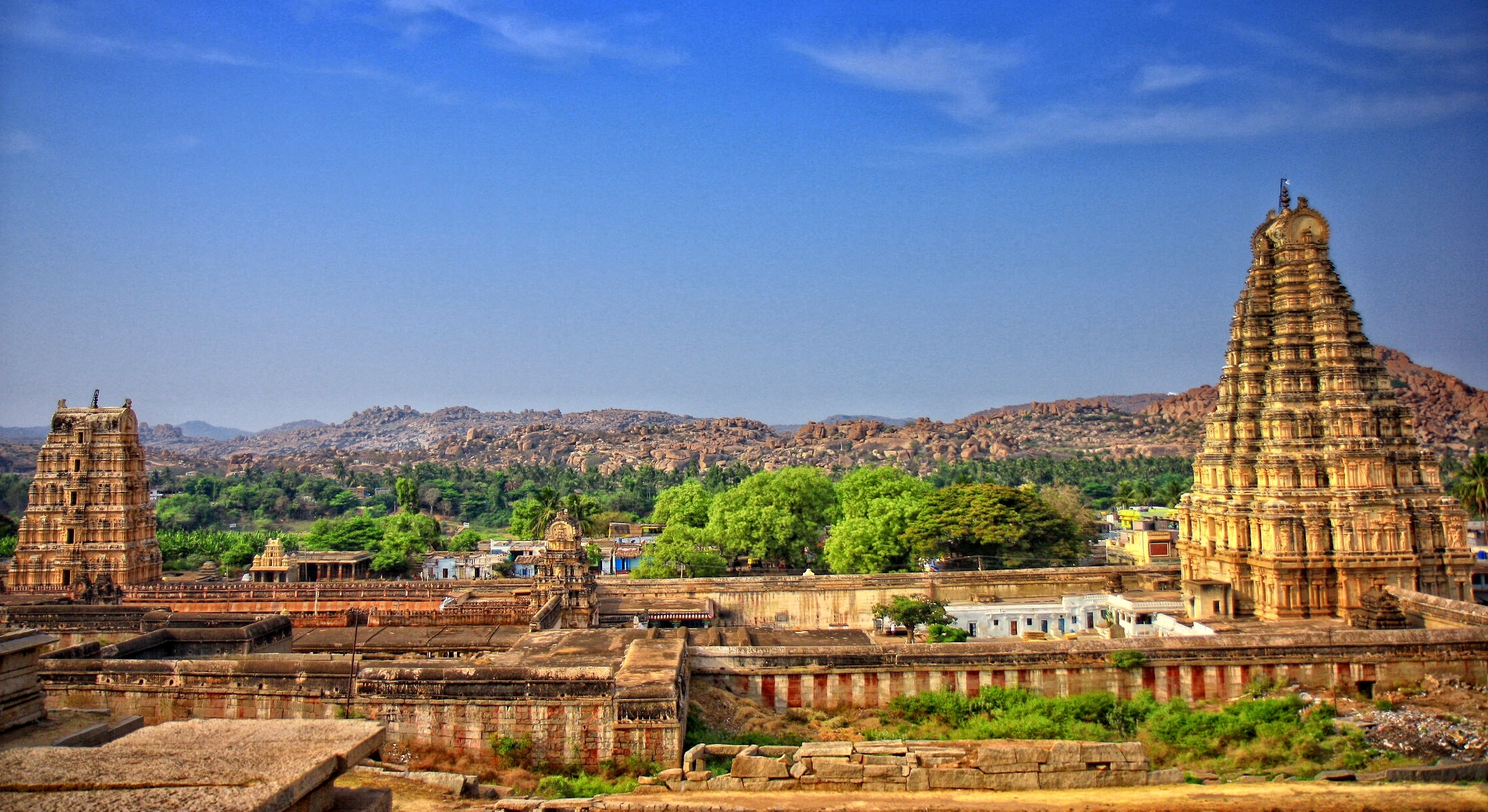
At the turn of the first millennium, the Hoysalas gained power in the region. Literature flourished during this time, which led to the emergence of distinctive Kannada literary metres, and the construction of temples and sculptures adhering to the Vesara style of architecture. The expansion of the Hoysala Empire brought minor parts of modern Andhra Pradesh and Tamil Nadu under its rule. In the early 14th century, Harihara and Bukka Raya established the Vijayanagara empire with its capital, Hosapattana (later named Vijayanagara), on the banks of the Tungabhadra River in the modern Bellary district. Under the rule of Krishnadevaraya, a distinct form of literature and architecture evolved. The empire rose as a bulwark against Muslim advances into South India, which it completely controlled for over two centuries. In 1537, Kempe Gowda I, a chieftain of the Vijayanagara Empire, widely held as the founder of modern Bengaluru, built a fort and established the area around it as Bengaluru Pete.
In 1565, Karnataka and the rest of South India experienced a major geopolitical shift when the Vijayanagara empire fell to a confederation of Islamic sultanates in the Battle of Talikota. The Bijapur Sultanate, which had risen after the demise of the Bahmani Sultanate of Bidar, soon took control of much of the Deccan; it was defeated by the Mughals in the late 17th century. The Bahmani and Bijapur rulers encouraged Urdu and Persian literature and Indo-Saracenic architecture, the Gol Gumbaz being one of the high points of this style. During the sixteenth century, Konkani Hindus migrated to Karnataka, mostly from Salcette, Goa, while during the seventeenth and eighteenth century, Goan Catholics migrated to North Canara and South Canara, especially from Bardes, Goa, as a result of food shortages, epidemics and heavy taxation imposed by the Portuguese.
In the period that followed, parts of northern Karnataka were ruled by the Nizam of Hyderabad, the Maratha Empire, the British, and other powers. In the south, the Mysore Kingdom, a former vassal of the Vijayanagara Empire, was briefly independent. With the death of Krishnaraja Wodeyar II, Haidar Ali, the commander-in-chief of the Mysore army, gained control of the region. After his death, the kingdom was inherited by his son Tipu Sultan. To contain European expansion in South India, Hyder Ali and later Tipu Sultan fought four significant Anglo-Mysore Wars, the last of which resulted in Tippu Sultan's death and the incorporation of Mysore into British India in 1799. Mysore was restored to the Wodeyars, and the Kingdom of Mysore became a princely state outside but in a subsidiary alliance with British India.
As the "doctrine of lapse" gave way to dissent and resistance from princely states across the country, Kittur Chennamma, Queen of Kittur, her military leader Sangolli Rayanna, and others, spearheaded rebellions in part of what is now Karnataka in 1830, nearly three decades before the Indian Rebellion of 1857. However, Kitturu was taken over by the British East India Company even before the doctrine was officially articulated by Lord Dalhousie in 1848. Other uprisings followed, such as the ones at Supa, Bagalkot, Shorapur, Nargund and Dandeli. These rebellions—which coincided with the Indian Rebellion of 1857—were led by Mundargi Bhimarao, Bhaskar Rao Bhave, the Halagali Bedas, Raja Venkatappa Nayaka and others. By the late 19th century, the independence movement had gained momentum; Karnad Sadashiva Rao, Aluru Venkata Raya, S. Nijalingappa, Kengal Hanumanthaiah, Nittoor Srinivasa Rau and others carried on the struggle into the early 20th century.
After the independence of British India, the Maharaja, Jayachamarajendra Wodeyar, signed an instrument of accession to accede his state to the new India. In 1950, Mysore became an Indian state of the same name; the former Maharaja served as its Rajpramukh (head of state) until 1975. Following the long-standing demand of the Ekikarana Movement, Kodagu- and Kannada-speaking regions from the adjoining states of Madras, Hyderabad and Bombay were incorporated into the Mysore state, under the States Reorganisation Act of 1956. The thus expanded state was renamed Karnataka, seventeen years later, on 1 November 1973. In the early 1900s through the post-independence era, industrial visionaries such as Sir Mokshagundam Visvesvarayya, played an important role in the development of Karnataka's strong manufacturing and industrial base.
Geography
The state has three principal geographical zones:
Content sourced from Wikipedia under CC BY-SA 4.0


