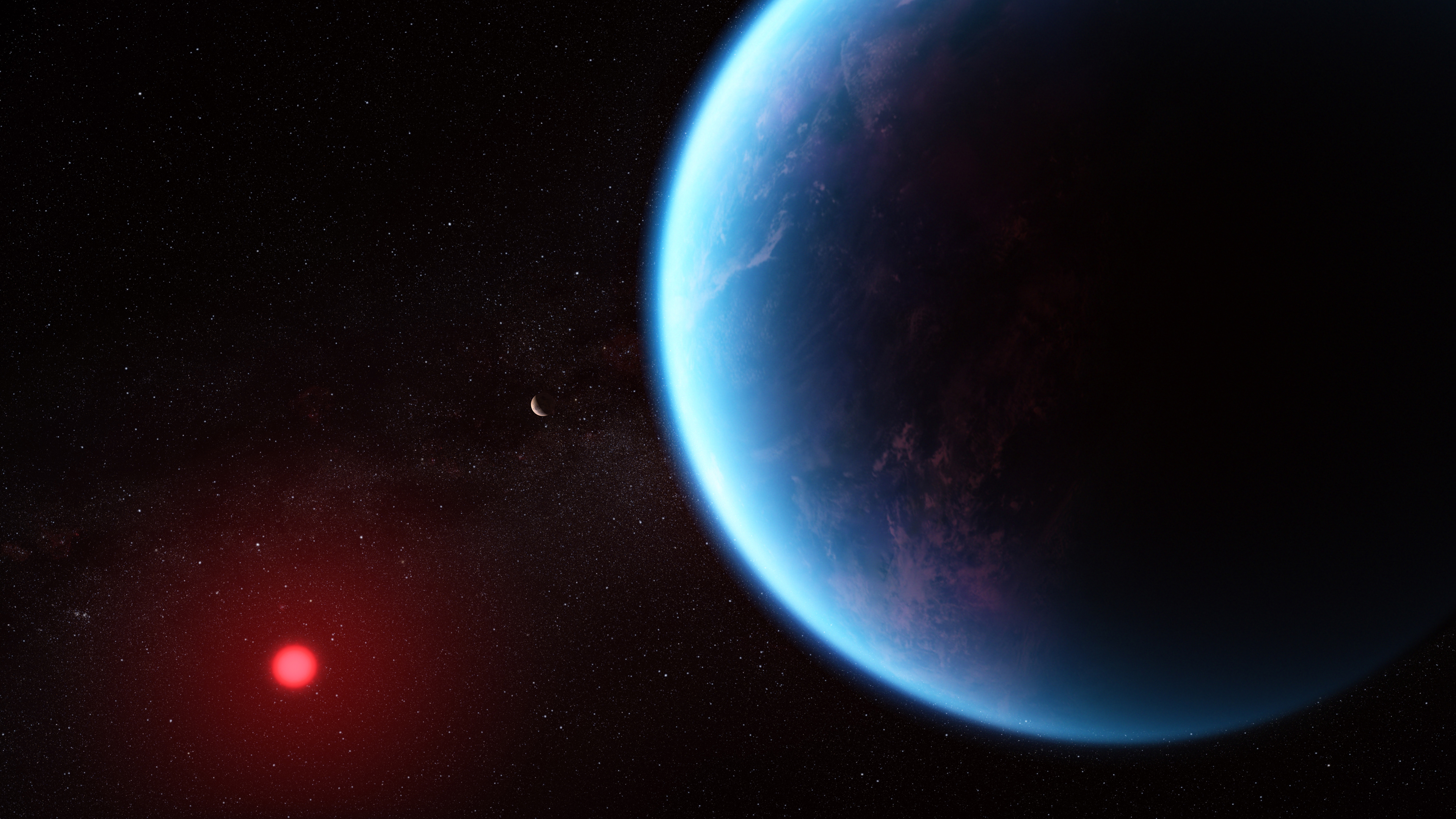
K2-18b
Sub-Neptune orbiting the red dwarf K2-18
K2-18b, also known as EPIC 201912552 b, is an exoplanet orbiting the red dwarf K2-18, located 124 light-years (38 pc) away from Earth. The planet is a sub-Neptune about 2.6 times the radius of Earth, with a 33-day orbit within the star's habitable zone; it receives approximately a similar amount of light as the Earth receives from the Sun. Initially discovered with the Kepler space telescope, it was later observed by the James Webb Space Telescope (JWST) in order to study the planet's atmosphere.
JWST discovered water vapour, carbon dioxide and methane in its atmosphere. JWST's data has been variously interpreted as indicating a water ocean planet with a hydrogen-rich atmosphere, and a gas-rich mini-Neptune. K2-18b has been studied as a potential habitable world that, temperature aside, more closely resembles an ice giant like Uranus or Neptune than Earth. It is the prototype for hycean planets, planets which have abundant water under a hydrogen envelope.
A controversial discovery of dimethyl sulfide (DMS) was reported in 2025, a chemical that could serve as a biosignature on exoplanets. It has not been widely accepted as proof of extraterrestrial life, however, as its presence could be explained by abiotic chemical processes and there are doubts that the observations actually show the presence of DMS instead of other compounds or measurement artifacts.
Host star
K2-18 is an M dwarf of the spectral class M3V in the constellation Leo, 38.025 ± 0.079 parsecs (124.02 ± 0.26 ly) distant. The star is colder and smaller than the Sun, having a temperature of 3,457 K (3,184 °C; 5,763 °F) and a radius 45% of the Sun's, and is not visible to the naked eye from the Earth. The star is 2.4 ± 0.6 billion years old and displays moderate stellar activity, but whether it has starspots, which would tend to create false signals when a planet crosses them, is unclear. K2-18 has an additional planet inside of K2-18b's orbit, K2-18c, which may interact with K2-18b through tides.
It is estimated that up to 80% of all M dwarf stars have planets in their habitable zones, including the stars LHS 1140, Proxima Centauri and TRAPPIST-1. The small mass, size and low temperatures of these stars and frequent orbits of the planets make it easier to characterize the planets. On the other hand, the low luminosity of the stars can make spectroscopic analysis of planets difficult, and the stars are frequently active with flares and inhomogeneous stellar surfaces (faculae and starspots), which can produce erroneous spectral signals when investigating a planet.
Physical properties
K2-18b has a radius of 2.610±0.087 R🜨, a mass of 8.63±1.35 M🜨, and orbits its star in 33 days. From Earth, it can be seen passing in front of the star. The planet is most likely tidally locked to the star, although considering its orbital eccentricity, a spin-orbit resonance like Mercury is also possible.
The density of K2-18b is about 2.67+0.52
−0.47 g/cm3—intermediate between that of Earth and Neptune—implying that the planet has a hydrogen-rich envelope. The planet may either be rocky with a thick envelope or have a Neptune-like composition. A pure water planet with a thin atmosphere is less likely. Planets with radii of about 1.5–2 R🜨 are unexpectedly rare relative to their expected occurrence rate, a phenomenon known as the radius valley. Presumably, planets with intermediary radii cannot hold their atmospheres against the tendency of their own energy output and the stellar radiation to drive atmospheric escape. (Planets with even smaller radii are known as super-Earths and those with larger radii as sub-Neptunes.)
The planet may have taken a few million years to form. Significant tidal heating is unlikely. Internal heating may increase temperatures at large depths, but is unlikely to significantly affect the surface temperature. If an ocean exists, it is probably underlain by a high-pressure ice layer on top of a rocky core, which might destabilize the planet's climate by preventing material flows between the core and the ocean. The existence of exomoons, which could affect the climate and habitability of K2-18b, has been examined. It appears that the Hill sphere where a moon can be held by the planet is too small to allow a moon lifespan to exceedin 10 million years. It is not clear whether planets like K2-18b can host exomoons; it is possible that tidal effects or orbital interactions would destroy them.
Possible ocean
At temperatures exceeding the critical point, liquids and gases stop being different phases and there is no longer a separation between an ocean and the atmosphere. It is unclear whether observations imply that a separate liquid ocean exists on K2-18b, and detecting such an ocean is difficult from the outside; its existence cannot be inferred or ruled out solely from the mass and radius of a planet.
The existence of a liquid water ocean is uncertain. Before the James Webb Space Telescope observations, a supercritical state of the water was believed to be more likely. JWST observations were initially considered to be more consistent with a fluid-gas interface and thus a liquid ocean - trace gases such as hydrocarbons and ammonia can be lost from an atmosphere to an ocean if it exists; their presence may thus imply the absence of an ocean-atmosphere separation. Subsequent work finds that a magma ocean may also be capable of dissolving ammonia and explaining the observation results, but not to explain the observed carbon oxide concentrations. Whether the carbon oxide concentrations can be explained by a mini-Neptune/deep hydrogen atmosphere model is uncertain. Another paper suggests that a liquid water ocean model requires the presence of a biosphere in order to produce sufficient amount of methane.
Atmosphere and climate
Observations with the Hubble Space Telescope have found that K2-18b has an atmosphere consisting of hydrogen with high metallicity. The presence of water vapour is likely but with uncertainty, as James Webb Space Telescope observations indicating concentrations of less than 0.1%; this may be due to the JWST seeing a dry stratosphere as the atmosphere is thought to have an efficient cold trap. Ammonia concentrations appear to be unmeasurably low, or due to issues with measurements. JWST observations indicate that methane and carbon dioxide each make up about 1% of the atmosphere although later observations cast some doubt on the presence of carbon dioxide. Other carbon oxides were not reported; only an upper limit to their concentrations (a few percent) has been established. The atmosphere makes up at most 6.2% of the planet's mass, and its composition probably resembles that of Uranus and Neptune.
Whether there are hazes in K2-18b's atmosphere is unclear, while evidence for water clouds, the only kind of clouds likely to form at K2-18b, is conflicting. If they exist, the clouds are most likely icy but liquid water is possible. Apart from water, ammonium chloride, sodium sulfide, potassium chloride and zinc sulfide could form clouds in the atmosphere of K2-18b, depending on the planet's properties. Most computer models expect that a temperature inversion will form at high elevation, yielding a stratosphere.
Evolution
High-energy radiation from the star, such as hard UV radiation and X-rays, is expected to heat the upper atmosphere and fill it with hydrogen formed through the photodissociation of water, thus forming an extended hydrogen-rich exosphere that can escape from the planet. The X-ray and UV fluxes that K2-18b receives from K2-18 are considerably higher than the equivalent fluxes from the Sun; the hard UV radiation flux provides enough energy to drive this exosphere to escape at a rate of about 350+400
−290 tons per second, too slow to remove the planet's atmosphere during its lifespan. Observations of decreases of Lyman alpha radiation emissions during transits of the planet may show the presence of such an exosphere, though this discovery requires confirmation.
Alternative scenarios
Detecting atmospheres around planets is difficult, and several reported findings are controversial. Barclay et al. (2021) suggested that the water vapour signal may be due to stellar activity, rather than water in K2-18b's atmosphere. Bézard et al. (2020) proposed that methane may be a more significant component, making up about 3–10% while water may constitute about 5–11% of the atmosphere, and Bézard, Charnay and Blain (2022) proposed that the evidence of water is actually due to methane, although such a scenario is less probable.
Models
Climate models have been used to simulate the climate that K2-18b might have, and an intercomparison of their results for K2-18b is part of the CAMEMBERT project to simulate the climates of sub-Neptune planets. Among the climate modelling efforts made on K2-18b are:
Content sourced from Wikipedia under CC BY-SA 4.0


