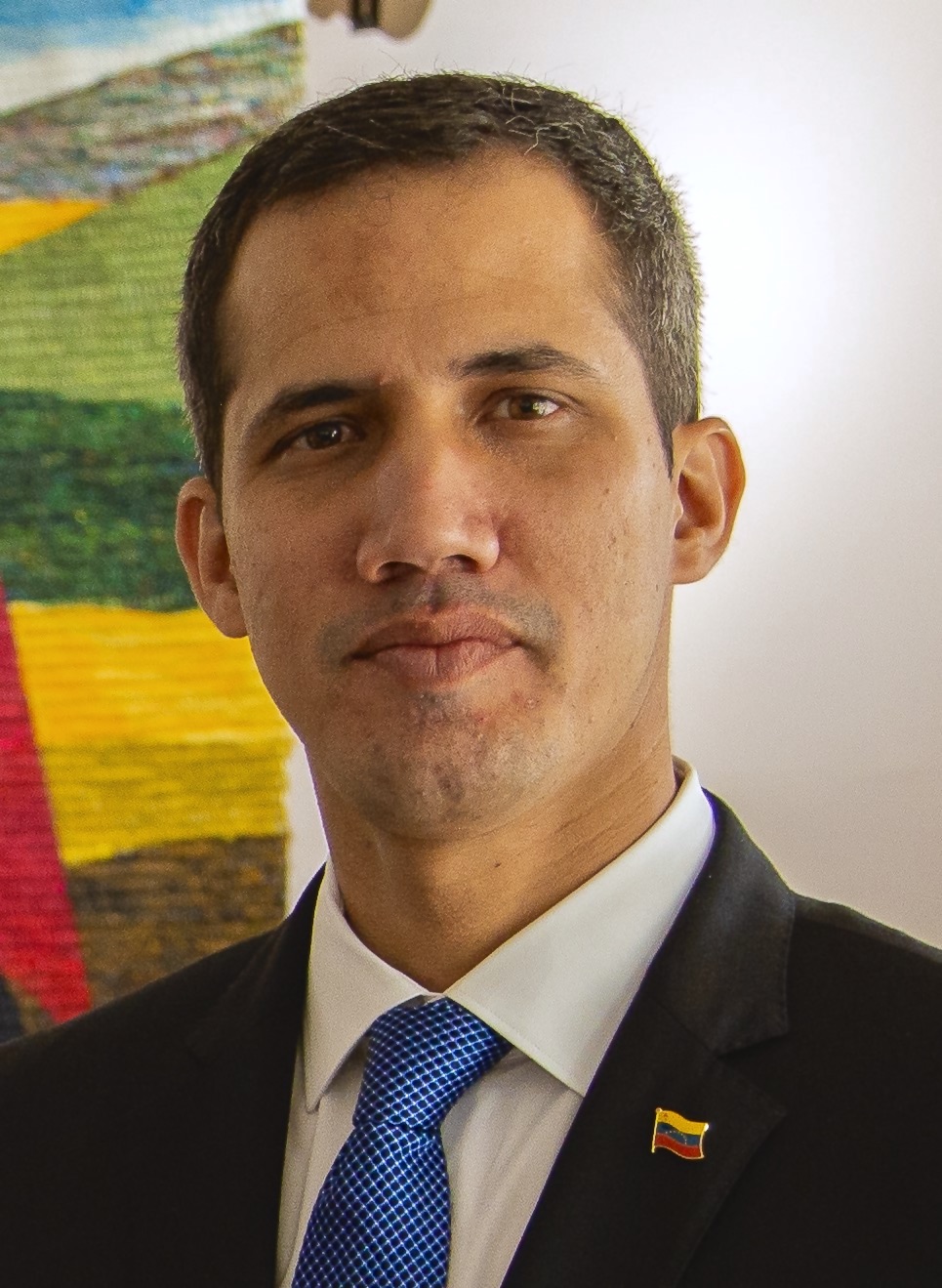
Juan Guaidó
Venezuelan politician (born 1983)
Juan Gerardo Antonio Guaidó Márquez (born 28 July 1983) is a Venezuelan politician and opposition figure. He belonged to the social-democratic party Popular Will, and was a federal deputy to the National Assembly representing the state of Vargas. He was a key figure in the Venezuelan presidential crisis between 2019 and 2023, when he was recognized by 88 countries, the European Parliament, Andean Parliament, Organization of American States etc. as the legitimate president of Venezuela vis-à-vis Nicolás Maduro by 49 countries.
Guaidó's political career began when he emerged as a student leader in the 2007 Venezuelan protests. He then helped found the Popular Will party with Leopoldo López in 2009, and was elected to be an alternate deputy in the National Assembly one year later in 2010. In 2015, Guaidó was elected as a full-seat deputy. Following a protocol to annually rotate the position of President of the National Assembly among political parties, Popular Will nominated Guaidó for the position in 2019.
On 23 January 2019, the National Assembly, which viewed the 2018 Venezuelan presidential election as illegitimate and refused to recognize the inauguration of Maduro to a second presidential term on 10 January, declared that he was acting president of Venezuela and Guaidó swore himself into office, starting the Venezuelan presidential crisis.
The Maduro administration froze Guaidó's Venezuelan assets, launched a probe accusing Guaidó of foreign interference, and threatened violence against him. Following a failed April 2019 uprising, representatives of Guaidó and Maduro began mediation. In January 2020, security forces prevented Guaidó and other congress members from entering the legislative palace during an internal election to choose the board of directors. A majority of lawmakers held an "emergency meeting" and voted to re-elect Guaidó as their leader, while the remaining lawmakers at the legislative palace elected Luis Parra. Security forces denied Guaidó and opposition lawmakers access to parliament many times since.
After the announcement of regional elections in 2021, Guaidó announced a "national salvation agreement" and proposed negotiation with Maduro with a schedule for free and fair elections, with international support and observers, in exchange for lifting international sanctions. Domestically, Guaidó's actions included a proposed Plan País (Country Plan), an amnesty law for military personnel and authorities who turn against the Maduro government, attempts to deliver humanitarian aid to the country, and social bonuses for health workers during COVID-19 pandemic.
Internationally, Guaidó gained control of some Venezuelan assets and property in the United States and United Kingdom, and appointed diplomats which had been recognized by supportive governments.
In December 2022, three of the four main opposition political parties approved to reorganize the interim government into a commission to manage foreign assets, as deputies sought a united strategy ahead of the 2024 Venezuelan presidential election. Dinorah Figuera was elected as Guaidó's successor on 5 January 2023, ending his presidential claim. In April 2023 he fled to the United States citing fears of his arrest.
On 6 October 2023, Maduro's regime alleged Guaidó to have committed money laundering, treason, and usurping public functions, issued an arrest warrant and asked the international community to cooperate with an arrest of Guaidó, requesting a red notice be issued by Interpol. Guaidó has denied the charges made by Maduro's regime.
Early life and education
Guaidó was born on 28 July 1983. Part of a large family, he was raised in a middle-class home in the outskirts of La Guaira; his parents are Wilmer and Norka. His father was an airline pilot and his mother, a teacher. One grandfather was a sergeant of the Venezuelan National Guard while another grandfather was a captain in the Venezuelan Navy. His parents divorced when he was at a young age, with his father emigrating to the Canary Islands and working as a taxi driver.
Guaidó lived through the 1999 Vargas tragedy, a series of mudslides in his home state, which killed some of his friends while also destroying his school and home, leaving him and his family homeless. The mudslide and its response, which he cites regularly in speeches, influenced his political views; colleagues say that the "feckless" response of the then-new government of Hugo Chávez is what drove him to activism.
He and his family stayed in a makeshift home in Caracas where he earned his high school diploma in 2000. Guaidó would continue to live in Caracas where he would earn his undergraduate degree in 2007 in industrial engineering from Andrés Bello Catholic University, working at Compu Mall, a Venezuelan chain of computer and electronics stores, to pay for his studies. He also participated in two postgraduate programs of public administration in Caracas: at the UCAB with the partnership of the George Washington University and at the Instituto de Estudios Superiores de Administración (IESA).
Activism
Guaidó stated, after "it became clear that under Chávez the country was drifting toward totalitarianism," he was part of the student-led political movement that protested the Venezuelan government's decision to shut down the independent television network RCTV with other prominent student leaders in 2007—the year he graduated from Andrés Bello Catholic University. They also protested broader attempted government reforms by Chávez, including the 2007 constitutional referendum, which Chávez lost.
Along with Leopoldo López and other politicians, Guaidó was a founding member of the Popular Will political party in 2009; the party is affiliated with Socialist International.
By 2014, Guaidó was the party's national coordinator. López, one of Venezuela's main opposition politicians, "mentored Guaidó for years" according to a January 2019 CNN report, and the two spoke several times daily. As Lopez's protégé, Guaidó was well known in his party and the National Assembly, but not internationally; López named Guaidó to lead the Popular Will party in 2019.
National Assembly
In the 2010 Venezuelan parliamentary election, Guaidó was elected as an alternate national deputy. He was one of several politicians who went on a hunger strike to demand parliamentary elections in 2015 and was elected to a full-seat in the National Assembly in the 2015 elections with 26% of the vote. Vargas, an impoverished area, was home to many state-run companies that employed the majority of the population; until Guaidó's 2015 election, chavista candidates had run unchallenged.
In 2017, he was named head of the Comptroller's Commission of the National Assembly and in 2018, he was named head of the legislature's opposition. He contributed to research at the University of Arizona, giving testimony to analysts on the working conditions of Latin American politicians and, specifically, institutional crisis and political change.
In the National Assembly, Guaidó investigated corruption cases involving the Maduro administration, and worked with independent organizations to recover money allegedly stolen from the Venezuelan public. He participated in the 2017 Venezuelan protests, where one time security forces fractured his arm and he was shot with rubber bullets, which he has stated left scars on his neck. In January 2018 he was sworn in as the Leader of the Majority in the National Assembly.
President of the National Assembly
A rotating presidency of the National Assembly of Venezuela agreement resulted with Popular Will attaining leadership and due to the party's head officials being imprisoned or exiled, Guaidó was chosen as president in December 2018 by the Assembly, and was sworn in on 5 January 2019. Relatives of imprisoned politicians were invited to the inauguration. At 35, Guaidó was the youngest to have led the opposition. Shortly after assuming the presidency of the legislature, Guaidó began advocating for a law to form a transitional government.
Two politicians were primarily responsible for the strategy that brought Guaidó to prominence: Julio Borges (in exile) and Leopoldo López (under house arrest). The plan was developed after the failed 2017 negotiations during the Venezuelan crisis between representatives of chavismo and the opposition, and that took more than a year to develop. Ricardo Hausmann and politicians from different political parties were also involved. Borges was involved in external efforts, such as with the Lima Group, along with Antonio Ledezma and Carlos Vecchio, who operated in the United States; María Corina Machado and López operated in Venezuela. David Smolansky and Freddy Guevara also supported Guaidó, along with Henrique Capriles, who had initially been distant. Javier Corrales, professor and author, stated that Guaidó's rise as a presidential figure began within Venezuela, not by foreign pressure. López and Guaidó contacted the United States Department of State, presenting a plan to declare Guaidó interim president and that the United States could lead other nations to support his recognition in order to remove Maduro; United States Secretary of State Mike Pompeo supported the plan. López and Guaidó promoted this initiative to the United States without the knowledge of the National Assembly, according to Neuman.
Upon taking office, Guaidó vowed to oppose Maduro, and elaborated an action plan. The plan, approved by the National Assembly, comprised three phases (end of usurpation, transitional government, and free elections), with eight key points.
Content sourced from Wikipedia under CC BY-SA 4.0


