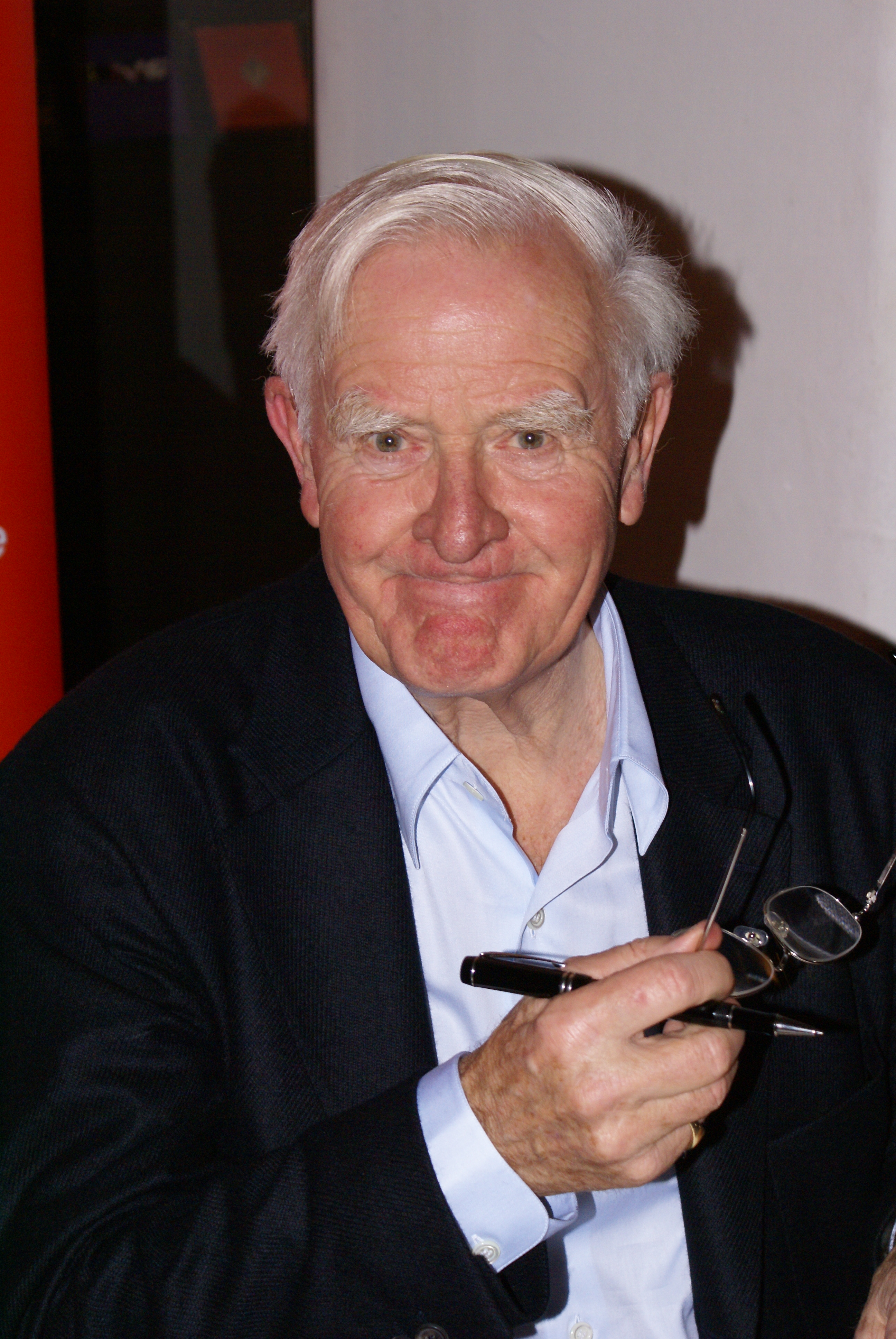
John le Carré
British novelist and former spy (1931–2020)
David John Moore Cornwell (19 October 1931 – 12 December 2020), better known by his pen name John le Carré ( lə-KARR-ay), was an Irish-British author, best known for his espionage novels, many of which were successfully adapted for film or television. A "sophisticated, morally ambiguous writer", he is considered one of the greatest novelists of the postwar era. During the 1950s and 1960s, he worked for both the Security Service (MI5) and the Secret Intelligence Service (MI6). Near the end of his life, le Carré became an Irish citizen.
Le Carré's third novel, The Spy Who Came in from the Cold (1963) became an international best-seller. It was adapted as an award-winning film. It and Tinker Tailor Soldier Spy (1974) remain his best-known works. This success allowed him to leave MI6 to become a full-time author.
His other novels that have been adapted for film or television include The Looking Glass War (1965), Smiley's People (1979), The Little Drummer Girl (1983), A Perfect Spy (1986), The Russia House (1989), The Night Manager (1993), The Tailor of Panama (1996), The Constant Gardener (2001), A Most Wanted Man (2008) and Our Kind of Traitor (2010). In 2008, The Times named le Carré one of the "50 greatest British writers since 1945". Philip Roth said that A Perfect Spy (1986) was "the best English novel since the war".
Early life and education
David John Moore Cornwell was born on 19 October 1931 in Poole, Dorset, England, son of Ronald Thomas Archibald Cornwell (Ronnie Cornwell) (1905–1975), and Olive Moore Cornwell (née Glassey, 1906–1989). His older brother, Tony (1929–2017), was an advertising executive and county cricketer (for Dorset), who later lived in the United States. His younger half-sister was the actress Charlotte Cornwell (1949–2021), and his younger half-brother, Rupert Cornwell (1946–2017), was a former Washington bureau chief for The Independent. Cornwell had little early memory of his mother, who had left their family home when he was five years old. His maternal uncle was Liberal MP Alec Glassey. When Cornwell was 21 years old, Glassey gave him the address in Ipswich where his mother was living; mother and son reunited at Ipswich railway station, at her written invitation, following Cornwell's initial letter of reconciliation.
Cornwell's father – who escaped from his "orthodox but repressive upbringing" as son of "a respectable nonconformist bricklayer who became a house builder and mayor of Poole" – had been jailed for insurance fraud and was a known associate of the Kray twins. The family was continually in debt. The father–son relationship has been described as "difficult". The Guardian reported that Le Carré recalled that he had been "beaten up by his father and grew up mostly starved of affection after his mother abandoned him at the age of five". Rick Pym, a scheming con man and the father of A Perfect Spy protagonist Magnus Pym, was based on Ronnie. When his father died in 1975, Cornwell paid for a memorial funeral service but did not attend, a plot point repeated in A Perfect Spy.
Cornwell's schooling began at St Andrew's Preparatory School, near Pangbourne, Berkshire, and continued at Sherborne School. He grew unhappy with the typically harsh English public school regime of the time and disliked his disciplinarian housemaster. He left Sherborne early to study foreign languages at the University of Bern from 1948 to 1949.
In 1950, he was called up for National Service in the British Army, and was commissioned in the Intelligence Corps as a second lieutenant on 21 October 1950. He was garrisoned in Allied-occupied Austria, serving as a German language interrogator of people who had crossed the Iron Curtain to the West. He transferred to the Supplementary Reserve of Officers on 1 July 1952, and was promoted to acting lieutenant on that date with seniority from 29 June 1952. In 1952, he returned to England to study at Lincoln College, Oxford, where he worked covertly for the Security Service, MI5, spying on far-left groups for information about possible Soviet agents. During his studies, he was a member of The Gridiron Club and a college dining society known as The Goblin Club. He was promoted to substantive lieutenant on 19 October 1954, with seniority from 29 June 1952.
When his father was declared bankrupt in 1954, Cornwell left Oxford to teach at Millfield Preparatory School; however, a year later, he returned to Oxford, and graduated in 1956 with a first-class degree in modern languages with a German literature concentration. He then taught French and German at Eton College for two years, before becoming an MI5 officer in 1958.
Work in security services
He ran agents, conducted interrogations, tapped telephone lines and effected break-ins. Encouraged by Lord Clanmorris (who wrote crime novels as "John Bingham"), and while being an active MI5 officer, Cornwell began writing his first novel, Call for the Dead (1961). Cornwell identified Lord Clanmorris as one of two models for George Smiley, the spymaster of the Circus, the other being Vivian H. H. Green. As a schoolboy, Cornwell first met the latter when Green was the Chaplain and Assistant Master at Sherborne School (1942–51). The friendship continued after Green's move to Lincoln College, where he tutored Cornwell.
In 1960, Cornwell transferred to MI6, the foreign-intelligence service, and worked under the cover of Second Secretary at the British Embassy in Bonn. He was later transferred to Hamburg as a political consul. There, he wrote the detective story A Murder of Quality (1962) and The Spy Who Came in from the Cold (1963), as "John le Carré" – a pseudonym required because Foreign Office staff were forbidden to publish under their own names. The meaning of the pseudonym is ambiguous: he sometimes said he had seen "le Carré" on a storefront, and later said he could not remember an origin. When translated, "le carré" means "the square".
In 1964, le Carré's career as an intelligence officer came to an end as the result of the betrayal of British agents' covers to the KGB by Kim Philby, the infamous British double agent, one of the Cambridge Five. Le Carré depicted and analysed Philby as the upper-class traitor, codenamed "Gerald" by the KGB, the mole hunted by George Smiley in Tinker Tailor Soldier Spy (1974).
Writing
Le Carré's first two novels, Call for the Dead (1961) and A Murder of Quality (1962), are mystery fiction. Each features a retired spy, George Smiley, investigating a death; in the first book, the apparent suicide of a suspected communist, and in the second volume, a murder at a boys' public school. Although Call for the Dead evolves into an espionage story, Smiley's motives are more personal than political. Le Carré's third novel, The Spy Who Came in from the Cold (1963), became an international best-seller and remains one of his best-known works; following its publication, he left MI6 to become a full-time writer. Although le Carré had intended The Spy Who Came in from the Cold as an indictment of espionage as morally compromised, audiences widely viewed its protagonist, Alec Leamas, as a tragic hero. In response, le Carré's next book, The Looking Glass War, was a satire about an increasingly deadly espionage mission which ultimately proves pointless.
Tinker Tailor Soldier Spy, The Honourable Schoolboy and Smiley's People (the Karla trilogy) brought Smiley back as the central figure in a sprawling espionage saga depicting his efforts first to root out a mole in the Circus and then to entrap his Soviet rival and counterpart, code-named 'Karla'. The trilogy was originally meant to be a long-running series that would find Smiley dispatching agents after Karla all around the world. Smiley's People marked the last time Smiley featured as the central character in a le Carré story, although he brought the character back in The Secret Pilgrim and A Legacy of Spies.
A Perfect Spy (1986), which chronicles the boyhood moral education of Magnus Pym and how it leads to his becoming a spy, is the author's most autobiographical espionage novel, reflecting the boy's very close relationship with his con man father. Biographer LynnDianne Beene describes the novelist's own father, Ronnie Cornwell, as "an epic con man of little education, immense charm, extravagant tastes, but no social values". Le Carré reflected that "writing A Perfect Spy is probably what a very wise shrink would have advised". He also wrote a semi-autobiographical work, The Naïve and Sentimental Lover (1971), as the story of a man's midlife existential crisis.
With the fall of the Iron Curtain in 1989, le Carré's writing shifted to the portrayal of the new multilateral world. His first completely post-Cold War novel, The Night Manager (1993), deals with drug and arms smuggling in the world of Latin American drug lords, secretive Caribbean banking entities and corrupt Western officials.
His final novel, Silverview, was published posthumously in 2021.
Content sourced from Wikipedia under CC BY-SA 4.0


