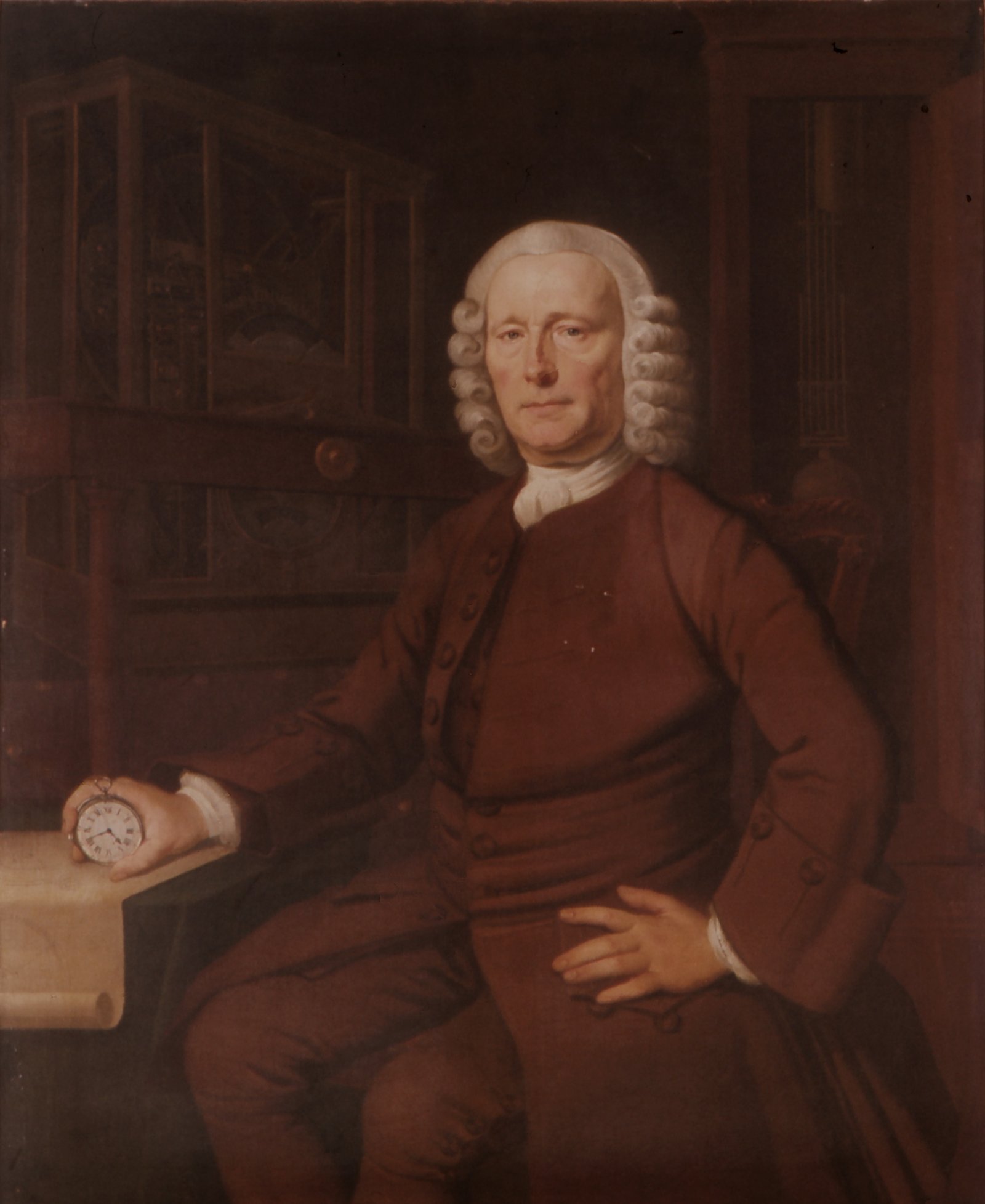
John Harrison
English clockmaker (1693–1776)
John Harrison (3 April [O.S. 24 March] 1693 – 24 March 1776) was an English carpenter and clockmaker who invented the marine chronometer, a long-sought-after device for solving the problem of how to calculate longitude while at sea.
Harrison's solution revolutionized navigation and greatly increased the safety of long-distance sea travel. The problem he solved had been considered so important following the Scilly naval disaster of 1707 that the British Parliament was offering financial rewards of up to £20,000 (equivalent to £3.97 million in 2023) under the 1714 Longitude Act, though Harrison never received the full reward due to political rivalries. He presented his first design in 1730, and worked over many years on improved designs, making several advances in time-keeping technology, finally turning to what were called sea watches. Harrison gained support from the Longitude Board in building and testing his designs. Towards the end of his life, he received recognition and a reward from Parliament.
Early life
John Harrison was born in Foulby in the West Riding of Yorkshire, the first of five children in his family. His stepfather worked as a carpenter at the nearby Nostell Priory estate. A house on the site of what may have been the family home bears a blue plaque. Around 1700, the Harrison family moved to the Lincolnshire village of Barrow upon Humber. Following his father's trade as a carpenter, Harrison built and repaired clocks in his spare time. Legend has it that at the age of six, while in bed with smallpox, he was given a watch to amuse himself and he spent hours listening to it and studying its moving parts.
He also had a fascination with music, eventually becoming choirmaster for the Church of Holy Trinity, Barrow upon Humber.
Harrison built his first longcase clock in 1713, at the age of 20. The mechanism was made entirely of wood. Three of Harrison's early wooden clocks have survived:
- the first (1713) is in the Worshipful Company of Clockmakers' collection, previously in the Guildhall in London and since 2015 on display in the Science Museum.
- The second (1715) is also in the Science Museum in London.
- the third (1717) is at Nostell Priory in Yorkshire, the face bearing the inscription "John Harrison Barrow".
The Nostell example, in the billiards room of the stately home, has a Victorian outer case with small glass windows on each side of the movement so that the wooden workings may be inspected.
On 30 August 1718 John Harrison married Elizabeth Barret at Barrow upon Humber church. After her death in 1726, he married Elizabeth Scott on 23 November 1726, at the same church.
In the early 1720s Harrison was commissioned to make a new turret clock at Brocklesby Hall, North Lincolnshire. The clock still works, and like his previous clocks has a wooden movement of oak and lignum vitae. Unlike his early clocks, it incorporates some original features to improve timekeeping, for example the grasshopper escapement. Between 1725 and 1728, John and his brother James, also a skilled joiner, made at least three precision longcase clocks, again with the movements and longcase made of oak and lignum vitae. The grid-iron pendulum was developed during this period. Of these longcase clocks:
- Number 1 is in a private collection. Until 2004, it belonged to the Time Museum (USA), which closed in 2000.
- Number 2 is in the Leeds City Museum, as the centrepiece of a permanent display dedicated to John Harrison's achievements. The exhibition, "John Harrison: The Clockmaker Who Changed the World", opened on 23 January 2014. It was the first longitude-related event marking the tercentenary of the Longitude Act.
- Number 3 is in the collection of the Worshipful Company of Clockmakers.
Harrison was a man of many skills and he used these to systematically improve the performance of the pendulum clock. He invented the gridiron pendulum, consisting of alternating brass and iron rods assembled in such a way that the thermal expansions and contractions essentially cancel each other out. Another example of his inventive genius was the grasshopper escapement, a control device for the step-by-step release of a clock's driving power. Developed from the anchor escapement, it was almost frictionless, requiring no lubrication because the pallets were made from wood. This was an important advantage at a time when lubricants and their degradation were little understood. In his earlier work on sea clocks, Harrison was continually assisted, both financially and in many other ways, by the watchmaker and instrument maker George Graham. Harrison was introduced to Graham by the Astronomer Royal Edmond Halley, who championed Harrison and his work. The support was important to Harrison, as he was supposed to have found it difficult to communicate his ideas in a coherent manner.
Longitude problem
Longitude fixes the location of a place on Earth east or west of a north–south reference line called the prime meridian. It is given as an angular measurement that ranges from 0° at the prime meridian to +180° eastward and −180° westward. Knowledge of a ship's east–west position is essential when approaching land. Over long voyages, cumulative errors in estimates of position by dead reckoning frequently led to shipwrecks and a great loss of life. Avoiding such disasters became vital in Harrison's lifetime, in an era when trade and the need for accurate navigation were increasing dramatically around the world.
Many ideas were proposed for how to determine longitude during a sea voyage. Earlier methods attempted to compare local time with the known time at a reference place, such as Greenwich or Paris, based on a simple theory that had first been proposed by Gemma Frisius. The methods relied on astronomical observations that were themselves reliant on the predictable nature of the motions of different heavenly bodies. Such methods were problematic because of the difficulty in maintaining an accurate record of the time at the reference place.
Harrison set out to solve the problem directly, by producing a reliable clock that could keep the time of the reference place accurately over long intervals without having to constantly adjust it. The difficulty was in producing a clock that was not affected by variations in temperature, pressure, or humidity, resisted corrosion in salt air, and was able to function on board a constantly moving ship. Many scientists, including Sir Isaac Newton and Christiaan Huygens, doubted that such a clock could ever be built and favoured other methods for reckoning longitude, such as the method of lunar distances. Huygens ran trials using both a pendulum and a spiral balance spring clock as methods of determining longitude; both produced inconsistent results. Newton observed that "a good watch may serve to keep a reckoning at sea for some days and to know the time of a celestial observation; and for this end a good Jewel may suffice till a better sort of watch can be found out. But when longitude at sea is lost, it cannot be found again by any watch".
First three marine timekeepers
In the 1720s the English clockmaker Henry Sully invented a marine clock that was designed to determine longitude: this was in the form of a clock with a large balance wheel that was vertically mounted on friction rollers and impulsed by a frictional rest Debaufre-type escapement. Very unconventionally, the balance oscillations were controlled by a weight at the end of a pivoted horizontal lever attached to the balance by a cord. This solution avoided temperature error due to thermal expansion, a problem which affects steel balance springs. Sully's clock kept accurate time only in calm weather, however, because the balance oscillations were affected by the pitching and rolling of the ship. Still, his clocks were among the first serious attempts to find longitude by improving the accuracy of timekeeping at sea. Harrison's machines, though much larger, are of similar layout: H3 has a vertically mounted balance wheel and is linked to another wheel of the same size, an arrangement that eliminates problems arising from the ship's motion.
In 1716 Sully presented his first Montre de la Mer to the French Académie des Sciences and in 1726 he published Une Horloge inventée et executée par M. Sulli. In 1730 Harrison designed a marine clock to compete for the Longitude prize and travelled to London, seeking financial assistance. He presented his ideas to Edmond Halley, the Astronomer Royal, who in turn referred him to George Graham, the country's foremost clockmaker. Graham must have been impressed by Harrison's ideas, for he loaned him money to build a model of his "Sea clock". As the clock was an attempt to make a seagoing version of his wooden pendulum clocks, which performed exceptionally well, he used wooden wheels, roller pinions, and a version of the grasshopper escapement. Instead of a pendulum, he used two dumbbell balances which were linked together.
Content sourced from Wikipedia under CC BY-SA 4.0


