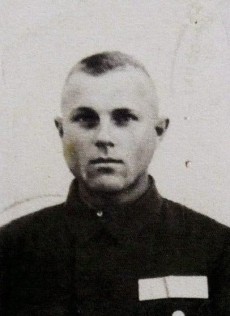
John Demjanjuk
Ukrainian guard at Nazi death camps (1920–2012)
John Demjanjuk (born Ivan Mykolaiovych Demjanjuk 3 April 1920 – 17 March 2012), was a Trawniki and Nazi camp guard at Sobibor extermination camp, Majdanek, and Flossenbürg. Demjanjuk became the center of global media attention in the 1980s, when he was tried and convicted in Israel after being identified as "Ivan the Terrible", a notoriously cruel watchman at Treblinka extermination camp. Demjanjuk was sentenced to death by hanging in 1988. In 1993, the verdict was overturned. Shortly before his death, he was tried and convicted in the Federal Republic of Germany as an accessory to the 28,060 murders that occurred during his service at Sobibor.
Born in Soviet Ukraine, Demjanjuk was conscripted into the Red Army in 1940. He fought in World War II and was taken prisoner by the Germans in spring 1942, becoming a Trawniki collaborator. After training, he served at Sobibor extermination camp and at least two concentration camps. After the war, he married a woman he met in a West German displaced persons camp, and emigrated with her and their daughter to the United States. They settled in Seven Hills, Ohio, where he worked in an auto factory and raised three children. Demjanjuk became a US citizen in 1958.
In 1977, Demjanjuk was accused of war crimes. Based on eyewitness testimony by Holocaust survivors in Israel, he was identified as the notorious Ivan the Terrible from Treblinka. Demjanjuk was extradited to Israel in 1986 for trial. In 1988, Demjanjuk was convicted and sentenced to death. He maintained his innocence, claiming that it was a case of mistaken identity. In 1993, the verdict was overturned by the Israeli Supreme Court, based on new evidence that cast reasonable doubt over his identity as Ivan the Terrible. Although the judges agreed there was sufficient evidence to show that Demjanjuk had served at Sobibor, Israel declined to prosecute. In September 1993, Demjanjuk was allowed to return to Ohio. In 1999, US prosecutors again sought to deport Demjanjuk for having been a concentration camp guard, and his citizenship was revoked in 2002. In 2009, Germany requested his extradition for over 27,900 counts of acting as an accessory to murder, one for each person killed at Sobibor during the time when he was alleged to have served there as a guard. He was deported from the US to Germany in that same year. In 2011, he was convicted and sentenced to five years in prison.
According to legal scholar Lawrence Douglas, in spite of serious missteps along the way, the German verdict brought the case "to a worthy and just conclusion". After the conviction, Demjanjuk was released pending appeal. He lived at a German nursing home in Bad Feilnbach, where he died in 2012. Having died before a final judgment on his appeal could be issued, Demjanjuk remains technically innocent under German law. In 2020, a photograph album by Sobibor guard Johann Niemann was made public; some historians have suggested that a guard who appears in two photos may have been Demjanjuk.
Background
Demjanjuk was born in Dubovi Makharyntsi (formerly Kiev Governorate, presently Koziatyn district, Vinnytsia Oblast), a farming village in the western part of Soviet Ukraine. His boyhood coincided with the Holodomor famine, and he later worked as a tractor driver in a Soviet collective farm. In 1940, he was drafted into the Red Army. After a battle in eastern Crimea, he was taken prisoner by the Germans and was held in a camp for Soviet prisoners of war in Chełm. According to German records, Demjanjuk most likely arrived at Trawniki concentration camp to be trained as a camp guard for the Nazis on 13 June 1942. He was assigned to a manorial estate called Okzów on 22 September 1942, but returned to Trawniki on 14 October. He was transferred to Majdanek concentration camp, where he was disciplined on 18 January 1943. He was sent back to Trawniki and on 26 March 1943 he was assigned to Sobibor concentration camp. On 1 October 1943, he was transferred to Flossenbürg, where he served until at least 10 December 1944.
Demjanjuk later claimed to have been drafted into the Russian Liberation Army in 1944; however, an investigation conducted in the 1990s by the US Office of Special Investigations (OSI) found this to be a cover story. OSI was unable to establish Demjanjuk's whereabouts from December 1944 to the end of the war. After the end of the war, Demjanjuk spent time in several displaced persons (DP) camps in Germany. Initially, Demjanjuk hoped to emigrate to Argentina or Canada; however, under the Displaced Persons Act of 1948, he applied to move to the United States. His application stated that he had worked as a driver in the town of Sobibór in eastern Poland; the nearby Sobibor extermination camp was named after the village. Demjanjuk later claimed this was a coincidence, and said that he picked the name Sobibor from an atlas owned by a fellow applicant because it had a large Soviet population. Historian Hans-Jürgen Bömelburg observed in regard to Demjanjuk that Nazi war criminals sometimes tried to evade prosecution after the war by presenting themselves as victims of Nazi persecution rather than as the perpetrators.
Demjanjuk found a job as a driver in a displaced persons camp in the Bavarian city of Landshut, and was subsequently transferred to camps in other southern German cities, until ending up in Feldafing near Munich in May 1951. There he met Vera Kowlowa, another DP, and they married. Demjanjuk, his wife and daughter arrived in New York City aboard the USS General W. G. Haan on 9 February 1952. They moved to Indiana, and later settled in the Cleveland suburb of Seven Hills, Ohio. There he became a United Auto Workers (UAW) diesel engine mechanic at the nearby Ford automobile factory, where a friend from Regensburg had found work. His wife found work at a General Electric facility, and the two had two more children. On 14 November 1958, Demjanjuk became a naturalized citizen of the United States and legally changed his name from Ivan to John.
Loss of US citizenship and extradition to Israel
Investigation by INS and OSI
In 1975, Michael Hanusiak, the American editor of Ukrainian News, presented US Senator Jacob Javits of New York with a list of 70 ethnic Ukrainians living in the United States who were suspected of having collaborated with Germans in World War II; Javits sent the list to US Immigration and Naturalization Service (INS). Its investigation reduced the list to nine individuals, including Demjanjuk. Hanusiak claimed that Soviet newspapers and archives had provided the names during his visit to Kyiv in 1974; however, INS suspected that Hanusiak, a member of the Communist Party USA, had received the list from the KGB. It chose to investigate the names as leads. Hanusiak claimed that Demjanjuk had been a guard at Sobibor concentration and death camp. INS quickly discovered that Demjanjuk had listed his place of domicile from 1937 to 1943 as Sobibor on his US visa application of 1951. This was considered circumstantial corroboration of Hanusiak's claims, but its agents were unable to find witnesses in the US who could identify Demjanjuk.
INS sent photographs to the Israeli government of the nine persons alleged by Hanusiak to have been involved in crimes against Jews: the government's agents asked survivors of Sobibor and Treblinka if they could identify Demjanjuk based on his visa application picture. While none recognized the name Ivan Demjanjuk, and no survivors of Sobibor identified his photograph, nine survivors of Treblinka identified Demjanjuk as "Ivan the Terrible", so named because of his cruelty as a guard operating the gas chamber at Treblinka. Lawyers at the US Office of Special Investigations (OSI) in the Department of Justice valued the identifications made by these survivors, as they had interacted with and seen "Ivan the Terrible" over a protracted period of time. They also gained an additional identification of the visa photo as Demjanjuk by Otto Horn, a former SS guard at Treblinka.
In August 1977, the Justice Department submitted a request to the US District Court for the Northern District of Ohio to revoke Demjanjuk's citizenship, based on his concealment on his 1951 immigration application of having worked at Nazi death camps. While the government was preparing for trial, Hanusiak published pictures of an ID card identifying Demjanjuk as having been a Trawniki man and guard at Sobibor in News from Ukraine. Given that eyewitnesses attested to Demjanjuk having been Ivan the Terrible at Treblinka decades before, whereas documentary evidence seemed to indicate that he had served at Sobibor with little notoriety, OSI considered dropping the proceeding against Demjanjuk to focus on higher profile cases. But OSI's new director Allan Ryan chose to go ahead with the prosecution of Demjanjuk as Ivan the Terrible. In 1979, three guards from Sobibor gave sworn depositions that they knew Demjanjuk to have been a guard there, and two identified his photograph. OSI did not submit these depositions into evidence and took them as a further indication that Demjanjuk was Ivan the Terrible, though none of the guards mentioned Demjanjuk having been at Treblinka.
Content sourced from Wikipedia under CC BY-SA 4.0


