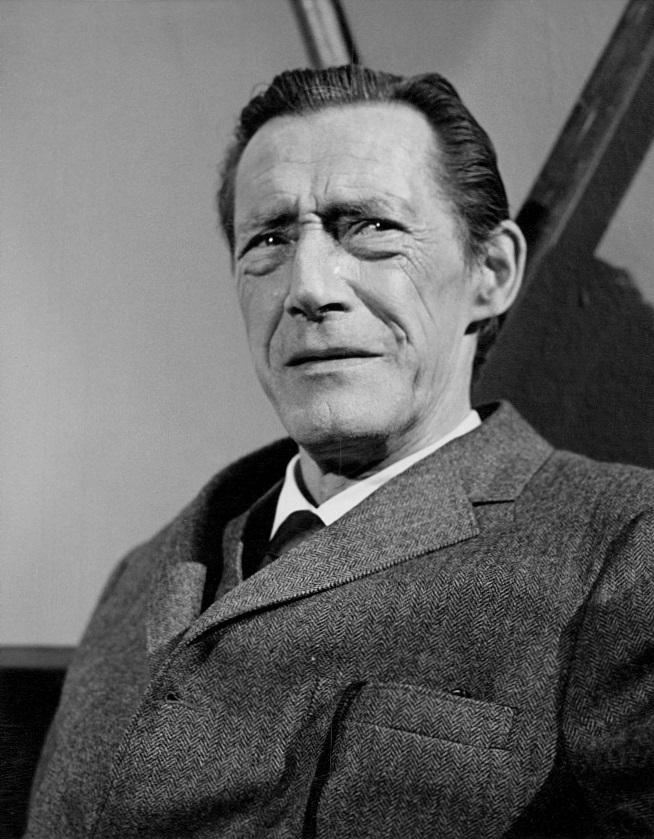
John Carradine
American actor (1906–1988)
John Carradine ( KARR-ə-deen; born Richmond Reed Carradine; February 5, 1906 – November 27, 1988) was an American actor, considered one of the greatest character actors in American cinema. He was a member of Cecil B. DeMille's stock company and later John Ford's company, known for his roles in horror films, Westerns, and Shakespearean theater, most notably portraying Count Dracula in House of Frankenstein (1944), House of Dracula (1945), Billy the Kid Versus Dracula (1966), and Nocturna: Granddaughter of Dracula (1979). Among his other notable roles was "Preacher Casy" in John Ford's The Grapes of Wrath. In later decades of his career, he starred mostly in low-budget B-movies. In total, he holds 351 film and television credits, making him one of the most prolific English-speaking film and television actors of all time.
Carradine was married four times, had five children, and was the patriarch of the Carradine family, including four sons and four grandchildren who are or were also actors.
Early life
Carradine was born in New York City the son of William Reed Carradine, a correspondent for the Associated Press, and his wife, Genevieve Winnifred Richmond, a surgeon. William Carradine was the son of evangelical author Beverly Carradine. The family lived in Peekskill, New York and Kingston, New York. William Carradine died from tuberculosis when his son John was two years old. Carradine's mother then married "a Philadelphia paper manufacturer named Peck, who thought the way to bring up someone else's boy was to beat him every day just on general principle." Carradine attended the Christ Church School in Kingston and the Episcopal Academy in Merion Station, Pennsylvania, where he developed his diction and his memory skills from portions of the Episcopal Book of Common Prayer meted out as a punishment.
Carradine's son David claimed his father ran away when he was 14 years old. He later returned and studied sculpture at Philadelphia's Graphic Arts Institute. Carradine lived with his maternal uncle, Peter Richmond, in New York City for a while, working in the film archives of the public library. David said that while still a teenager, his father went to Richmond, Virginia, to serve as an apprentice to Daniel Chester French, the sculptor who created the statue of Abraham Lincoln for the Lincoln Memorial in Washington, D.C. He traveled for a time, supporting himself painting portraits. "If the sitter was satisfied, the price was $2.50," he once said. "It cost him nothing if he thought it was a turkey. I made as high as $10 to $15 a day." During this time, he was arrested for vagrancy. While in jail, Carradine was beaten, suffering a broken nose that did not set correctly. This contributed to "the look that would become world famous."
David Carradine said, "My dad told me that he saw a production of Shakespeare's The Merchant of Venice when he was 11 years old and decided right then what he wanted to do with his life". He made his stage debut in 1925 in New Orleans in a production of Camille and worked for a time in a New Orleans Shakespeare company. Carradine joined a tent repertory theater under the management of R. D. MacLean, who became his mentor. In 1927, he took a job escorting a shipment of bananas from Dallas, Texas to Los Angeles, where he eventually picked up some theater work under the name of Peter Richmond, in homage to his uncle. He became friends with John Barrymore, and began working for Cecil B. DeMille as a set designer. Carradine, however, did not have the job long. "DeMille noticed the lack of Roman columns in my sketches," Carradine said. "I lasted two weeks." Once DeMille heard his baritone voice, however, he hired him to do voice-overs. Carradine said, "the great Cecil B. DeMille saw an apparition – me – pass him by, reciting the gravedigger's lines from 'Hamlet', and he instructed me to report to him the following day." He became a member of DeMille's stock company and his voice was heard in several DeMille pictures, including The Sign of the Cross.
Career
Carradine's first film credit was Tol'able David (1930), but he claimed to have done 70 pictures before getting billing. Carradine claimed to have tested, as an unknown – along with well-known leading men Conrad Veidt, William Courtenay, Paul Muni, and Ian Keith – for the title role in Dracula, but the historical record does not support the claim. The part eventually went to Bela Lugosi. Carradine later played the Count in the 1940s Universal Studios Dracula sequels House of Frankenstein and House of Dracula. Carradine also claimed to have tested for the monster role in Frankenstein (1931), though again, no account exists other than his own that he actually did so. By 1933, he was being credited as John Peter Richmond, perhaps in honor of his friend, John Barrymore. He adopted the stage name "John Carradine" in 1935, and legally took the name as his own two years later. In 1935's Bride of Frankenstein, Carradine had a brief uncredited walk-on role as a hunter in the forest.
On April 11, 1934, Wilfred Talbot Smith and Regina Kahl of Ordo Templi Orientis held a "Crowley Night on Winona Blvd" at Agape Lodge. Martin Starr recounts that "It included a program of recitation of (Aleister) Crowley's poetry, rituals and sacred texts...One surprising name was among the participants: the stage and motion picture actor John Carradine...who read the Crowley poem, "O Madonna of the Golden Eyes."
By 1936, Carradine had become a member of John Ford's stock company and appeared in The Prisoner of Shark Island. In total, he made 11 pictures with Ford, including his first important role, as Preacher Casy in The Grapes of Wrath (1940). Other Ford films in which Carradine appeared include The Man Who Shot Liberty Valance (1962) and Stagecoach (1939).
He also portrayed the Biblical hero Aaron in DeMille's The Ten Commandments (1956), he dominated Hitler's Madman (1943) as Reinhard Heydrich, and he portrayed Bob Ford in Henry King's 20th Century Fox production Jesse James (1939), among many many others during this time frame.
Carradine did considerable stage work, much of which provided his only opportunity to work in a classic drama context. He toured with his own Shakespearean company in the 1940s, playing Hamlet and Macbeth. His Broadway roles included Ferdinand in a 1946 production of John Webster's The Duchess of Malfi, the Ragpicker in a 13-month run of Jean Giraudoux's The Madwoman of Chaillot, Lycus in a 15-month run of A Funny Thing Happened on the Way to the Forum, and DeLacey in the expensive one-night flop Frankenstein in 1981. He also toured in road companies of such shows as Tobacco Road and Cat on a Hot Tin Roof, in which he was properly emaciated as the cancer-ridden Big Daddy, a part, he said, which Tennessee Williams wrote for him.
Carradine claimed to have appeared in more than 450 movies, but only 225 movies can be documented. His count is closer to fact if theatrical movies, made-for-TV movies, and television programs are included. He often played eccentric, insane, or diabolical characters, especially in the horror genre with which he had become identified as a "star" by the mid-1940s. He occasionally played a heroic role, as in The Grapes of Wrath, in which he played Casy, the ill-fated "preacher", and he occasionally played a sympathetic role, as in Son of Fury: The Story of Benjamin Blake, in which he played Blake's shipmate, who escapes with him to a tropical island full of riches.
He appeared in dozens of low-budget horror films from the 1940s onwards, to finance a touring classical theater company. He also played a small but important role in the very-high-budget comedy The Court Jester, which was at the time of its release the most expensive comedy film ever made. He played a mad scientist in Woody Allen's Everything You Always Wanted to Know About Sex* (*But Were Afraid to Ask). He sang the theme song to one film in which he appeared briefly, Red Zone Cuba. Carradine also made more than 100 acting appearances on television over a period of 39 years. His first performance on the "small screen" was on the DuMont Television Network in 1947, when he played Ebenezer Scrooge in a broadcast presentation of A Christmas Carol. His final role on television was in 1986 as Professor Alex Stottel on a revival of the classic series The Twilight Zone, in an episode segment titled "Still Life." Some examples of other television series on which he appeared include My Friend Flicka, Johnny Ringo (as The Rain Man), and Place the Face, NBC's Cimarron City as the foreboding Jared Tucker in the episode "Child of Fear" and on William Bendix's Overland Trail in the 1960 episode "The Reckoning," on Harrigan and Son starring Pat O'Brien in the episode "A Matter of Dignity," Maverick in "Red Dog" starring Roger Moore and Lee Van Cleef, Sugarfoot, The Rebel, and The Legend of Jesse James, on the syndicated adventure series Rescue 8 with actor Jim Davis and in two episodes of the western TV series Bonanza ("Springtime" and "Dead Wrong"). John Carradine also appeared in 1959 as the mind reader in The Rifleman episode of the same name.
Content sourced from Wikipedia under CC BY-SA 4.0


