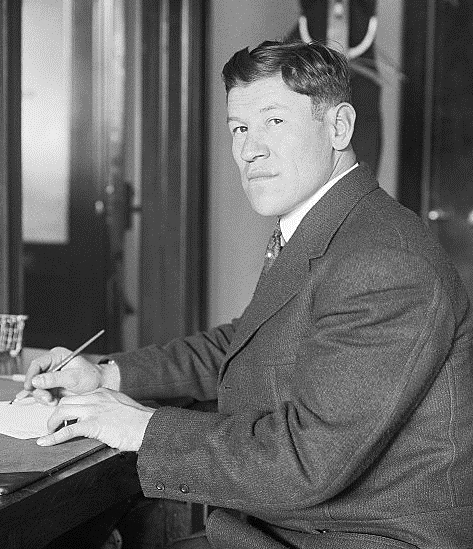
Jim Thorpe
American athlete (1887–1953)
James Francis Thorpe (Meskwaki: Wa-Tho-Huk; May 22 or 28, 1887 – March 28, 1953) was an American athlete who won Olympic gold medals and played professional football, baseball, and basketball. A citizen of the Sac and Fox Nation, he was the first Native American to win a gold medal for the United States in the Olympics. Considered one of the most versatile athletes of modern sports, Thorpe won two Olympic gold medals in the 1912 Summer Olympics (one in classic pentathlon and the other in decathlon).
Thorpe lost his Olympic titles after it was found he had been paid for playing two seasons of semi-professional baseball before competing in the Olympics, thus violating the contemporary amateurism rules. In 1983, 30 years after his death, the International Olympic Committee (IOC) restored Thorpe's Olympic medals with replicas, after ruling that the decision to strip him of his medals fell outside of the required 30 days. Official IOC records still listed Thorpe as co-champion in decathlon and pentathlon until 2022, when it was decided to restore him as the sole champion in both events.
Thorpe grew up in the Sac and Fox Nation in Indian Territory (what is now the U.S. state of Oklahoma). As a youth, he attended Carlisle Indian Industrial School in Carlisle, Pennsylvania, where he was a three-time All-American for the school's football team under coach Pop Warner. After his Olympic success in 1912, which included a record score in the decathlon, Thorpe added a victory in the All-Around Championship of the Amateur Athletic Union. In 1913, Thorpe signed with the New York Giants, and played six seasons in Major League Baseball between 1913 and 1919. Thorpe joined the Canton Bulldogs American football team in 1915, helping them win three professional championships. He later played for six teams in the National Football League (NFL). Thorpe played as part of several all-American Indian teams throughout his career, and barnstormed as a professional basketball player with a team composed entirely of American Indians.
From 1920 to 1921, Thorpe was nominally the first president of the American Professional Football Association, which became the NFL in 1922. He played professional sports until age 41, the end of his sports career coinciding with the start of the Great Depression. Thorpe struggled to earn a living after that, working several odd jobs. He suffered from alcoholism and lived his last years in failing health and poverty. Thorpe was married three times and had eight children – including Grace Thorpe, an environmentalist and Native rights activist – before suffering from heart failure and dying in 1953.
Thorpe has received numerous accolades for his athletic accomplishments. The Associated Press ranked him as the "greatest athlete" from the first 50 years of the 20th century, and the Pro Football Hall of Fame inducted Thorpe as part of its inaugural class in 1963. The town of Jim Thorpe, Pennsylvania, was named in his honor. It has a monument site that contains his remains, which were the subject of legal action. Thorpe appeared in several films and was portrayed by Burt Lancaster in the 1951 film Jim Thorpe – All-American.
Early life
Information about Thorpe's birth, name, and ethnic background varies widely. He was baptized "Jacobus Franciscus Thorpe" in the Catholic Church. Thorpe was born in Indian Territory of the United States (later Oklahoma), but no birth certificate has been found. The Jim Thorpe Museum lists his birth date as May 28, 1887, but others have listed it as May 22, 1887, near the town of Prague. Thorpe said in a note to The Shawnee News-Star in 1943 that he was born May 28, 1888, "near and south of Bellemont – Pottawatomie County – along the banks of the North Fork River ... hope this will clear up the inquiries as to my birthplace." May 22, 1887, is listed on his baptismal certificate. Thorpe referred to Shawnee as his birthplace in his 1943 note to the newspaper.
Thorpe's father, Hiram Thorpe (Sac and Fox), had an Irish father and a Sac and Fox mother. His mother, Charlotte Vieux, was the daughter of Citizen Potawatomi Nation members Elizabeth and Jacob Vieux, and was a descendant of Chief Louis Vieux.
Thorpe was raised in the Sauk, or Thâkîwaki, culture, and his Sauk name was Wa-Tho-Huk, which translates as "Bright path the lightning makes as it goes across the sky", often shortened to "Bright Path". Thorpe's parents were both Roman Catholic, a faith which Thorpe observed throughout his adult life.
Thorpe attended the Sac and Fox Indian Agency School in Stroud, with his twin brother, Charlie. Charlie helped him through school until he died of pneumonia when they were nine years old. Thorpe ran away from school several times. His father sent him to the Haskell Institute, an Indian boarding school in Lawrence, Kansas, so that Thorpe would not run away again.
When Thorpe's mother died of childbirth complications two years later, he became depressed. After several arguments with his father, Thorpe left home to work on a horse ranch.
In 1904, the 16-year-old Thorpe returned to his father and decided to attend Carlisle Indian Industrial School in Carlisle, Pennsylvania. There his athletic ability was recognized and he was coached by Glenn Scobey "Pop" Warner, one of the most influential coaches of early American football history. Later that year he was orphaned when his father Hiram Thorpe died from gangrene poisoning, after being wounded in a hunting accident. The young Thorpe again dropped out of school. He resumed farm work for a few years before returning to Carlisle School.
Amateur career
College career
Thorpe began his athletic career at Carlisle in 1907 when he walked past the track and, still in street clothes, beat all the school's high jumpers with an impromptu 5-ft 9-in jump that broke the school record.
He also competed in football, baseball, lacrosse, tennis, boxing, handball, and ballroom dancing, winning the 1912 intercollegiate ballroom dancing championship.
Thorpe made his college football debut for Carlisle on September 22, 1907, against Lebanon Valley, coming off the bench to score two touchdowns in a 40–0 victory. In his second collegiate game, on September 28, 1907, Thorpe again entered as a substitute during Carlisle’s win over Villanova. He made his first career start the next game on October 2, 1907 versus Susquehanna, where he scored four touchdowns.
Pop Warner was hesitant to allow Thorpe, his best track and field athlete, to compete in such a physical game as football. Thorpe, however, convinced Warner to let him try some rushing plays in practice against the school team's defense; Warner assumed he would be tackled easily and give up the idea. Thorpe "ran around past and through them not once, but twice". He walked over to Warner and said, "Nobody is going to tackle Jim", while flipping him the ball.
Thorpe first gained nationwide notice in 1911 for his athletic ability. As a running back, defensive back, placekicker and punter, Thorpe scored all of his team's four field goals in an 18–15 upset of Harvard, a top-ranked team in the early days of the National Collegiate Athletic Association (NCAA). He also rushed for 173 yards in the game, and afterwards Harvard did not lose again until 1915. Carlisle would go on to finish the 1911 season with an 11–1 record and were retroactively named national collegiate champions in a book titled "Champions of College Football", written by Bill Libby in 1975. In 1912, Thorpe led the nation with 29 touchdowns and 224 points scored during the season, according to the College Football Hall of Fame. Steve Boda, a researcher for the NCAA, credits Thorpe with 27 touchdowns and 224 points. Thorpe rushed 191 times for 1,869 yards, according to Boda; the figures do not include statistics from two of Carlisle's 14 games in 1912 because full records are not available.
Carlisle's 1912 record included a 27–6 victory over the West Point Army team. In that game, Thorpe's 92-yard touchdown was nullified by a teammate's penalty, but on the next play Thorpe rushed for a 97-yard touchdown. Future President Dwight D. Eisenhower, who played against him in that game, recalled of Thorpe in a 1961 speech:
Here and there, there are some people who are supremely endowed. My memory goes back to Jim Thorpe. He never practiced in his life, and he could do anything better than any other football player I ever saw.
Thorpe was a third-team All-American in 1908 and a first-team All-American in 1911 and 1912. Football was – and remained – Thorpe's favorite sport. He did not compete in track and field in 1910 or 1911, although this turned out to be the sport in which he gained his greatest fame.
In the spring of 1912, he started training for the Olympics. He had confined his efforts to jumps, hurdles and shot-puts, but now added pole vaulting, javelin, discus, hammer and 56 lb weight. In the Olympic trials held at Celtic Park in New York, his all-round ability stood out in all these events and so he earned a place on the team that went to Sweden.
The poet Marianne Moore, who taught Thorpe at Carlisle, recalled:
He had a kind of ease in his gait that is hard to describe. Equilibrium with no stricture, but couched in the lineup of football he was the epitome of concentration, wary, with an effect of plenty in reserve.
Content sourced from Wikipedia under CC BY-SA 4.0


