January 6 United States Capitol attack
2021 attack to stop election certification
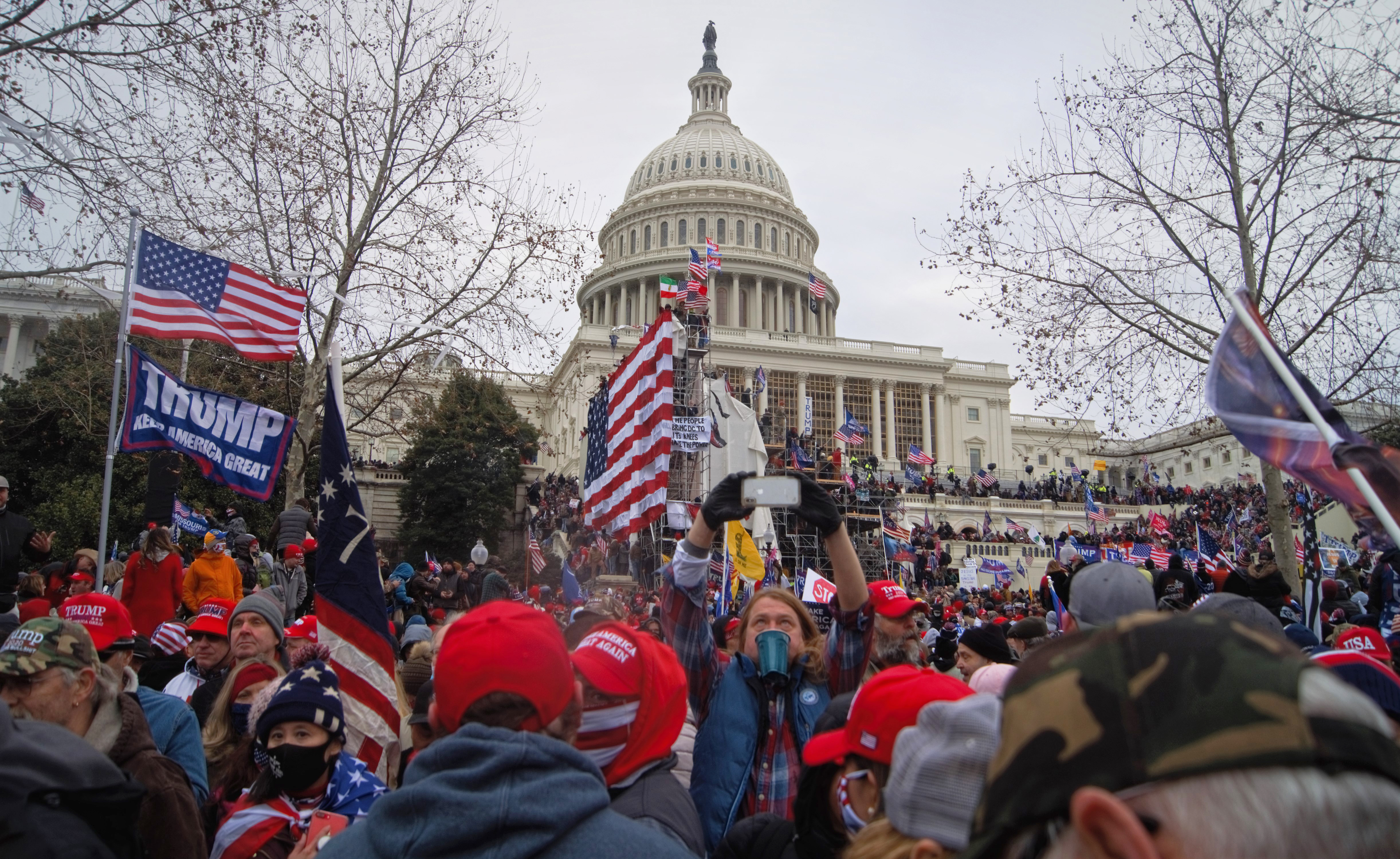
On January 6, 2021, the United States Capitol in Washington, D.C., was attacked by a mob of supporters of President Donald Trump in an attempted self-coup, two months after his defeat in the 2020 presidential election. They sought to keep him in power by preventing a joint session of Congress from counting the Electoral College votes to formalize the victory of then president-elect Joe Biden. The attack was unsuccessful in preventing the certification of the election results. According to the bipartisan House select committee that investigated the incident, the attack was the culmination of a plan by Trump to overturn the election. Within 36 hours, five people died: one was shot by the Capitol Police, another died of a drug overdose, and three died of natural causes, including a police officer who died of a stroke a day after being assaulted by rioters and collapsing at the Capitol. Many people were injured, including 174 police officers. Four officers who responded to the attack died by suicide within seven months. Damage caused by attackers exceeded $2.7 million. It is the only attempted coup d'état directed towards the Federal government in the history of the United States.
Called to action by Trump on January 5 and 6, thousands of his supporters had gathered in Washington, D.C., to support his false claims that the 2020 election had been "stolen by emboldened radical-left Democrats", and to demand that then–vice president Mike Pence and Congress reject Biden's victory. Starting at noon on January 6, at a "Save America" rally on the Ellipse, Trump gave a speech in which he repeated false claims of election irregularities and said "If you don't fight like hell, you're not going to have a country anymore". As Congress began the electoral vote count, thousands of attendees, some armed, walked to the Capitol, and hundreds breached police perimeters. Among the rioters were leaders of the Proud Boys and the Oath Keepers militia groups.
The FBI estimates 2,000–2,500 people entered the Capitol during the attack. Some vandalized and looted, including in the offices of House speaker Nancy Pelosi and other Congress members. Rioters assaulted Capitol Police officers and journalists. Capitol Police evacuated and locked down both chambers of Congress and several buildings in the Complex. Rioters occupied the empty Senate chamber, while federal law enforcement officers defended the evacuated House floor. Pipe bombs were found at the Democratic National Committee and Republican National Committee headquarters, and Molotov cocktails were discovered in a vehicle near the Capitol. Trump resisted sending the National Guard to quell the mob. That afternoon, in a Twitter video, he restated false claims about the election and told his supporters to "go home in peace". The Capitol was cleared of rioters by mid-evening, and the electoral vote count was resumed and completed by the morning of January 7, concluding with Pence declaring the final electoral vote count in favor of President-elect Biden. Pressured by his cabinet, the threat of removal, and resignations, Trump conceded to an orderly transition of power in a televised statement.
A week after the attack, the House of Representatives impeached Trump for incitement of insurrection, making him the only U.S. president to be impeached twice. After Trump had left office, the Senate voted 57–43 in favor of conviction, but fell short of the required two-thirds, resulting in his acquittal. Senate Republicans blocked a bill to create a bipartisan independent commission to investigate the attack, so the House instead approved a select investigation committee. They held public hearings, voted to subpoena Trump, and recommended that the Department of Justice (DOJ) prosecute him. Following a special counsel investigation, Trump was indicted on four charges, all dismissed following his reelection to the presidency. Trump and elected Republican officials have promoted a revisionist history of the event by downplaying the severity of the violence, spreading conspiracy theories, and portraying those charged with crimes as hostages and martyrs.
Of the 1,424 people then charged with federal crimes relating to the event, 1,010 pled guilty, and 1,060 were sentenced, 64% of them to jail time. Some participants were linked to far-right extremist groups or conspiratorial movements, including the Oath Keepers, Proud Boys, and Three Percenters, some of whom were convicted of seditious conspiracy. Enrique Tarrio, then chairman of the Proud Boys, received the longest sentence, a 22-year prison term. On January 20, 2025, upon taking office, Trump granted clemency to all January 6 rioters, including those convicted of violent offenses but excluding himself.
Background
Attempts to overturn the presidential election
Joe Biden, of the Democratic Party, defeated incumbent Republican Party president Donald Trump in the 2020 presidential election. Trump and other Republicans attempted to overturn the election, falsely claiming widespread voter fraud.
Within hours after the polls closing, while votes were still being tabulated, Trump declared victory, demanding counting be halted. He began a campaign to subvert the election, through legal challenges and extralegal effort. Trump's attorneys concluded there was neither a factual foundation nor valid legal argument for challenging the election results. Despite those analyses, Trump sought to overturn the results by filing sixty lawsuits, including two that came before the Supreme Court. Those challenges were all rejected by the courts, for lack of evidence or legal standing.
Trump then mounted a campaign to pressure Republican governors, secretaries of state, and state legislatures to nullify results by replacing slates of Biden electors with slates pledged to Trump, or by manufacturing evidence of fraud; Trump's role in the plot to use fake electors led to prosecutions in Georgia and in federal court. He demanded lawmakers investigate ostensible election "irregularities", such as by conducting signature matches of mailed-in ballots, disregarding any prior analytic efforts. Trump made inquiries regarding the possibility of invoking martial law to "re-run" or reverse the election and appointed a special counsel to find instances of fraud, despite conclusions by federal and state officials that such cases were few or non-existent. Trump ultimately undertook neither step. Trump repeatedly urged Pence to alter the results and stop Biden from taking office despite none of those actions being within Pence's constitutional powers as vice president and president of the Senate. Trump repeated this call in his rally speech on the morning of January 6.
Numerous scholars, historians, political scientists, and journalists have characterized these efforts to overturn the election as an attempted self-coup by Trump and an implementation of the "big lie".
Planning of January 6 events
On December 18, Trump called for supporters to attend a rally before the January 6 Congressional vote count, writing on Twitter, "Big protest in D.C. on January 6th. Be there, will be wild!". On December 28, far-right activist Ali Alexander described collaboration with the Proud Boys and explained the purpose of the January 6 event would be "to build momentum and pressure" to convince members of Congress to alter the election results. He named three Republican members of the House as allies who were planning "something big": Paul Gosar, Andy Biggs and Mo Brooks. "We're the four guys who came up with a January 6 event", Alexander said.
On December 23, Roger Stone's group Stop the Steal posted plans to "occupy just outside" the Capitol with promises to "escalate" if opposed by police. Stone recorded a video for his "Stop The Steal Security Project" to raise funds "for the staging, the transportation and most importantly the security" of the event. The event was largely funded by Trump donor Julie Fancelli, heiress to the Publix supermarket fortune, who budgeted $3 million for and spent at least $650,000. Fancelli's funding, via conspiracy theorist Alex Jones, was used to reserve the Ellipse. With Fancelli's funding, a robocall campaign urged people to "march to the Capitol building and call on Congress to stop the steal". Jones claimed the White House asked him to lead the march to the Capitol.
On January 2, Trump announced plans to speak at the "March to Save America" rally on January 6. On January 4, Steve Bannon said he was part of "the bloodless coup".
Seditious conspiracy by Oath Keepers and Proud Boys
On November 5, two days after the election, leaders of the Oath Keepers began communicating about a "civil war". On November 9, the leaders held a members-only online conference in which leader Stewart Rhodes outlined a plan to stop the transfer of power, including preparations for using force. The Oath Keepers planned to store "an arsenal" with a "Quick Reaction Force" (QRF) in nearby Alexandria, Virginia. The leaders planned to procure boat transportation so bridge closures could not prevent their entry into D.C.
Content sourced from Wikipedia under CC BY-SA 4.0


