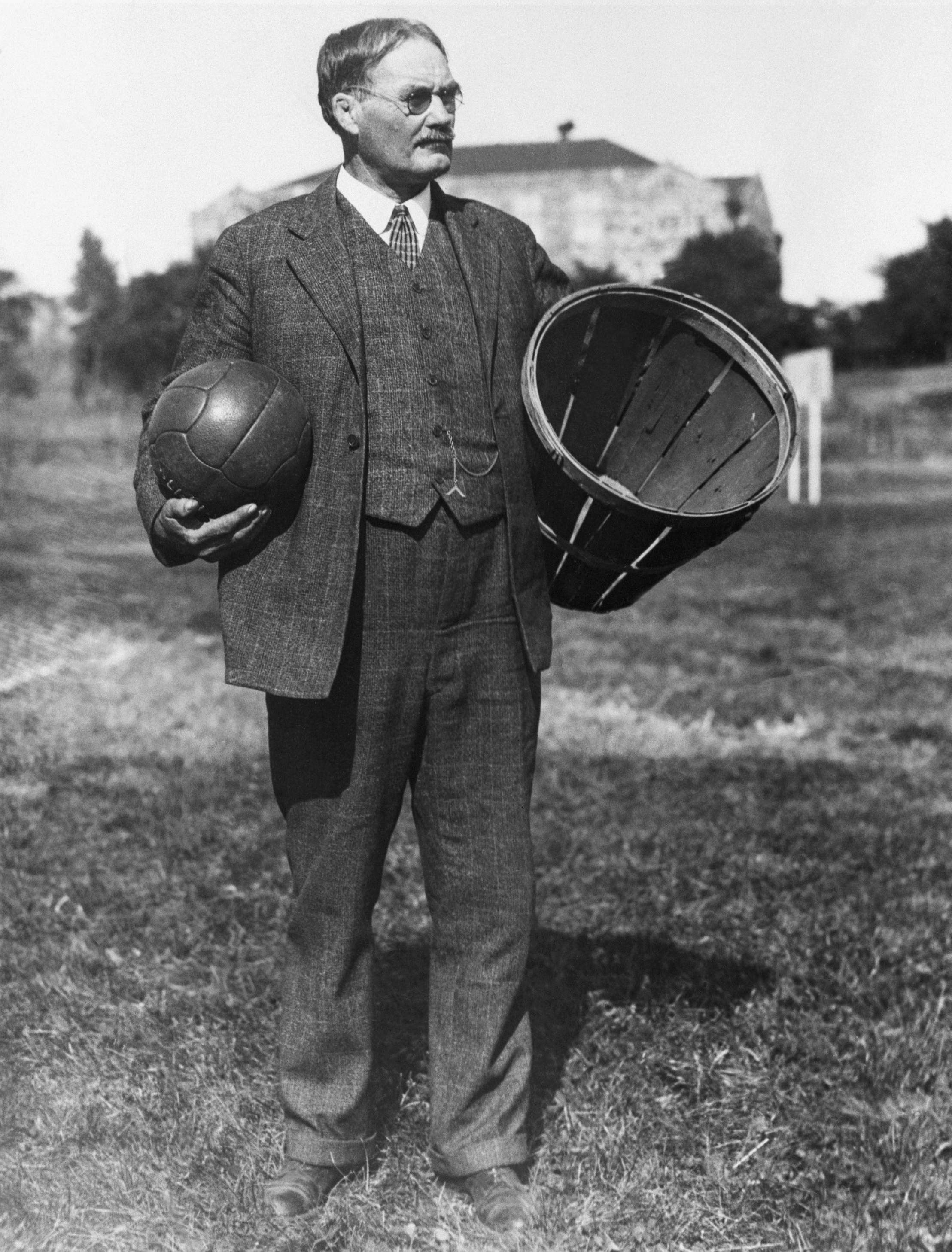
James Naismith
Inventor of basketball (1861–1939)
James Naismith ( NAY-smith; November 6, 1861 – November 28, 1939) was a Canadian-American physical educator, physician, Christian chaplain, and sports coach, best known as the inventor of the game of basketball.
First developing the game in Canada, he wrote the original basketball rule book after moving to the United States and founded the University of Kansas basketball program in 1898. Naismith lived to see basketball adopted as an Olympic demonstration sport in 1904 and as an official event at the 1936 Summer Olympics in Berlin, and to see the birth of the National Invitation Tournament (1938) and the NCAA Tournament (1939). He also lived to see the creation of half of the leagues that eventually became the present-day National Basketball Association, with the 1935 creation of the Midwest Basketball Conference before it became the National Basketball League in 1937.
Naismith studied and taught physical education at McGill University in Montreal until 1890, before moving later that year to Springfield, Massachusetts, where in 1891 he designed basketball while teaching at the International YMCA Training School. Seven years after inventing basketball, Naismith received his medical degree in Denver in 1898. He then arrived at the University of Kansas, later becoming the Kansas Jayhawks' athletic director and coach.
While a coach at Kansas, Naismith coached Phog Allen, who later became the coach at Kansas for 39 seasons, beginning a lengthy and prestigious coaching tree. Allen went on to coach players including Adolph Rupp and Dean Smith, who themselves coached many notable players and future coaches.
Early years
Naismith was born on November 6, 1861, in Almonte, Canada West, Province of Canada (now part of Mississippi Mills, Ontario, Canada) to Scottish parents. Despite some sources to the contrary, Naismith never had a middle name and never signed his name with an "A" initial. The "A" was added by someone in administration at the University of Kansas. Naismith spent his days outside playing catch, hide-and-seek, or duck on a rock, a medieval game in which a person guards a large skipping stone from opposing players, who try to knock it down by throwing smaller stones at it. Orphaned early in his life, Naismith lived with his aunt and uncle for many years and attended grade school at Bennies Corners near Almonte. Then, he enrolled in Almonte High School, in Almonte, Ontario, from which he graduated in 1883.
In the same year, Naismith entered McGill University in Montreal. Although described as a slight figure, standing 5 feet 10+1⁄2 inches (1.791 m) and listed at 178 pounds (81 kg) he was a talented and versatile athlete, representing McGill in football, lacrosse, rugby, soccer, and gymnastics. He played centre on the football team, and made himself some padding to protect his ears. He won multiple Wicksteed medals for outstanding gymnastics performances. Naismith earned a BA in physical education (1888) and a diploma at the Presbyterian College in Montreal (1890). At the end of his career, in 1938 and 1939, he would receive honorary doctorates from both institutions. From 1888 to 1890, Naismith taught physical education and became the first McGill director of athletics, but then left Montreal to study at the YMCA International Training School in Springfield, Massachusetts. Naismith played football during his one year as a student at Springfield, where he was coached by Amos Alonzo Stagg and scored a touchdown in the first exhibition of indoor college football at Madison Square Garden.
Springfield College: Invention of basketball
Naismith is credited with inventing basketball. Having been an outstanding football player at McGill University in Montreal, he later decided to become a physical education teacher at McGill University for his three postgraduate years and then went to Springfield, Massachusetts, to study at the YMCA International Training School in the 1890s. Whilst teaching there, Naismith realized he needed to invent an indoor game for the winter due to the weather conditions.
After completing the YMCA physical director training program that had brought him to Springfield, Naismith was hired as a full-time faculty member in 1891. At the Springfield YMCA, Naismith struggled with a rowdy class that was confined to indoor games throughout the harsh New England winter, and thus was perpetually short-tempered. Under orders from then head of physical education Luther Gulick, Naismith was given 14 days to create an indoor game that would provide an "athletic distraction"; Gulick demanded that it would not take up much room, could help its track athletes to keep in shape and explicitly emphasized to "make it fair for all players and not too rough". Naismith was later employed to teach physical education using two boxes. He told the superintendent he needed the two boxes to be put onto a pole so a large ball could be thrown into them.
In his attempt to think up a new game, Naismith was guided by three main thoughts. Firstly, he analyzed the most popular games of the times (rugby, lacrosse, soccer, football, hockey, and baseball); Naismith noticed the hazards of a ball and concluded that the big, soft soccer ball was safest. He noticed that most physical injuries would occur with players being in direct contact. Due to this discovery players were not permitted to run with the ball. Instead, they had to throw it from the spot where they caught it. In addition the ball was to be held only with the hands, the arms and body could not be used to cradle and carry the ball. Finally, to further reduce physical contact Naismith decided to make the goal open to all players by placing it high above the player's heads with the plane of the goal's opening parallel to the floor. This made the goal unguardable, giving players an equal opportunity to score. In order to score goals, players would throw a soft, lobbing shot like that which had proven effective in his old favorite game, duck on a rock. For this purpose, Naismith asked a janitor to find a pair of boxes, but the janitor brought him peach baskets instead. Naismith christened this new game Basket Ball and put his thoughts together in 13 basic rules.
The first game of "Basket Ball" was played in December 1891. In a handwritten report, Naismith described the circumstances of the inaugural match; in contrast to modern basketball, the players played nine versus nine, handled a soccer ball, and instead of shooting at two hoops, the goals were a pair of peach baskets: "When Mr. Stubbins brot [sic] up the peach baskets to the gym I secured them on the inside of the railing of the gallery. This was about 10 feet [3.0 meters] from the floor, one at each end of the gymnasium. I then put the 13 rules on the bulletin board just behind the instructor's platform, secured a soccer ball, and awaited the arrival of the class ... The class did not show much enthusiasm, but followed my lead ... I then explained what they had to do to make goals, tossed the ball up between the two center men and tried to keep them somewhat near the rules. Most of the fouls were called for running with the ball, though tackling the man with the ball was not uncommon." In contrast to modern basketball, the original rules did not include what is known today as the dribble. Since the ball could only be moved up the court by a pass early players tossed the ball over their heads as they ran up court. Also following each "goal", a jump ball was taken in the middle of the court. Both practices are obsolete in the rules of modern basketball.
In a radio interview in January 1939, Naismith gave more details of the first game and the initial rules that were used:
I showed them two peach baskets I'd nailed up at each end of the gym, and I told them the idea was to throw the ball into the opposing team's peach basket. I blew a whistle, and the first game of basketball began ... The boys began tackling, kicking, and punching in the clinches. They ended up in a free-for-all in the middle of the gym floor. [The injury toll: several black eyes, one separated shoulder, and one player knocked unconscious.] It certainly was murder. [Naismith changed some of the rules as part of his quest to develop a clean sport.] The most important one was that there should be no running with the ball. That stopped tackling and slugging. We tried out the game with those [new] rules (fouls), and we didn't have one casualty.
Naismith was a classmate of Amos Alonzo Stagg at the YMCA School, where Stagg coached the football team. They became close friends and Naismith played on the football team and Stagg played on the basketball team. Naismith invited Stagg to play in the first public basketball game on March 12, 1892. The students defeated the faculty 5–1 and Stagg scored the only basket for the faculty. The Springfield Republican reported on the same: "Over 200 spectators crammed their necks over the gallery railing of the Christian Workers gymnasium while they watched the game of 'basket ball' between the teachers and the students. The most conspicuous figure on the floor was Stagg in the blue Yale uniform who managed to have a hand in every scrimmage."
Content sourced from Wikipedia under CC BY-SA 4.0


