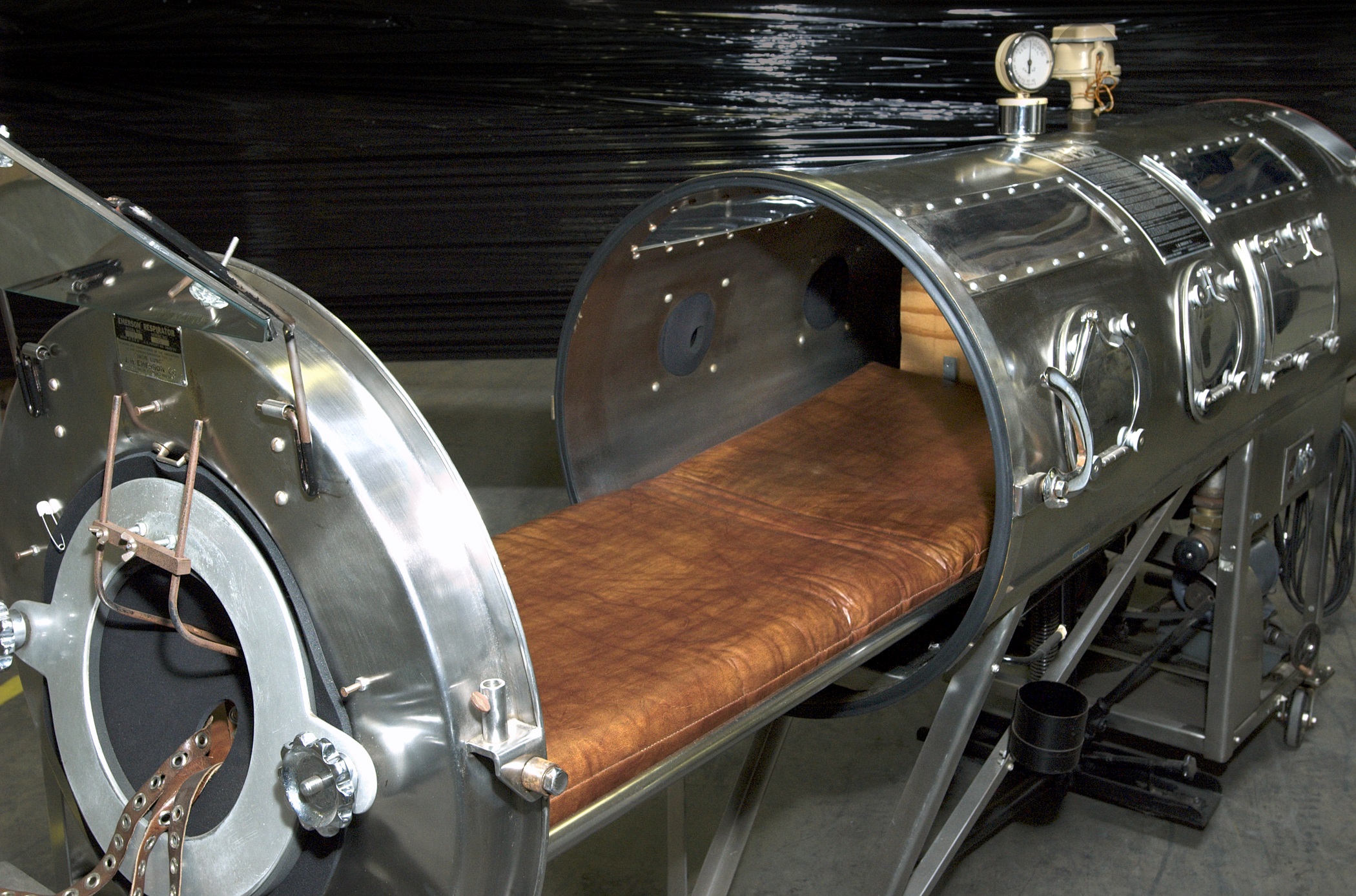
Iron lung
Negative-pressure mechanically functioning respirator
An iron lung is a type of negative pressure ventilator, a mechanical respirator which encloses most of a person's body and varies the air pressure in the enclosed space to stimulate breathing. It assists breathing when muscle control is lost, or the work of breathing exceeds the person's ability. Need for this treatment may result from diseases including polio and botulism and certain poisons (for example, barbiturates and tubocurarine).
The use of iron lungs is largely obsolete in modern medicine as more modern breathing therapies have been developed and due to the eradication of polio in most of the world. In 2020, however, the COVID-19 pandemic revived some interest in them as a cheap, readily-producible substitute for positive-pressure ventilators, which were feared to be outnumbered by patients potentially needing temporary artificially assisted respiration.
The iron lung is a large horizontal cylinder designed to stimulate breathing in patients who have lost control of their respiratory muscles. The patient's head is exposed outside the cylinder, while the body is sealed inside. Air pressure inside the cylinder is cycled to facilitate inhalation and exhalation. Devices like the Drinker, Emerson, and Both respirators are examples of iron lungs, which can be manually or mechanically powered. Smaller versions, like the cuirass ventilator and jacket ventilator, enclose only the patient's torso. Breathing in humans occurs through negative pressure, where the rib cage expands and the diaphragm contracts, causing air to flow in and out of the lungs.
The concept of external negative pressure ventilation was introduced by John Mayow in 1670. The first widely used device was the iron lung, developed by Philip Drinker and Louis Shaw in 1927, with the first clinical use being in 1928. Initially used for coal gas poisoning treatment, the iron lung gained fame for treating respiratory failure caused by polio in the mid-20th century. John Haven Emerson introduced an improved and more affordable version in 1931. The Both respirator, a cheaper and lighter alternative to the Drinker model, was invented in Australia in 1938. British philanthropist William Morris financed the production of the Both–Nuffield respirators, donating them to hospitals throughout Britain and the British Empire. During the polio outbreaks of the 1940s and 1950s, iron lungs filled hospital wards, assisting patients with paralyzed diaphragms in their recovery.
Polio vaccination programs and the development of modern ventilators have nearly eradicated the use of iron lungs in the developed world. Positive pressure ventilation systems, which blow air into the patient's lungs via intubation, have become more common than negative pressure systems like iron lungs. However, negative pressure ventilation is more similar to normal physiological breathing and may be preferable in rare conditions such as central hypoventilation syndrome. As of 2024, after the death of Paul Alexander, only one patient in the US, Martha Lillard, was still using an iron lung. In response to the COVID-19 pandemic and the shortage of modern ventilators, some enterprises developed prototypes of new, easily producible versions of the iron lung.
Design and function
The iron lung is typically a large horizontal cylinder in which a person is laid, with their head protruding from a hole in the end of the cylinder, so that their full head (down to their voice box) is outside the cylinder, exposed to ambient air, and the rest of their body sealed inside the cylinder, where air pressure is continuously cycled up and down to stimulate breathing.
To cause the patient to inhale, air is pumped out of the cylinder, causing a slight vacuum, which causes the patient's chest and abdomen to expand (drawing air from outside the cylinder, through the patient's exposed nose or mouth, into their lungs). Then, for the patient to exhale, the air inside the cylinder is compressed slightly (or allowed to equalize to ambient room pressure), causing the patient's chest and abdomen to partially collapse, forcing air out of the lungs, as the patient exhales the breath through their exposed mouth and nose, outside the cylinder.
Examples of the device include the Drinker respirator, the Emerson respirator, and the Both respirator. Iron lungs can be either manually or mechanically powered, but are normally powered by an electric motor linked to a flexible pumping diaphragm (commonly opposite the end of the cylinder from the patient's head). Larger "room-sized" iron lungs were also developed, allowing for simultaneous ventilation of several patients (each with their heads protruding from sealed openings in the outer wall), with sufficient space inside for a nurse or a respiratory therapist to be inside the sealed room, attending the patients.
Smaller, single-patient versions of the iron lung include the so-called cuirass ventilator (named for the cuirass, a torso-covering body armor). The cuirass ventilator encloses only the patient's torso, or chest and abdomen, but otherwise operates essentially the same as the original, full-sized iron lung. A lightweight variation on the cuirass ventilator is the jacket ventilator or poncho or raincoat ventilator, which uses a flexible, impermeable material (such as plastic or rubber) stretched over a metal or plastic frame over the patient's torso.
Method and use
Humans, like most mammals, breathe by negative pressure breathing: the rib cage expands and the diaphragm contracts, expanding the chest cavity. This causes the pressure in the chest cavity to decrease, and the lungs expand to fill the space. This, in turn, causes the pressure of the air inside the lungs to decrease (it becomes negative, relative to the atmosphere), and air flows into the lungs from the atmosphere: inhalation. When the diaphragm relaxes, the reverse happens and the person exhales. If a person loses part or all of the ability to control the muscles involved, breathing becomes difficult or impossible.
Invention and early use
Initial development
In 1670, English scientist John Mayow came up with the idea of external negative pressure ventilation. Mayow built a model consisting of bellows and a bladder to pull in and expel air. The first negative pressure ventilator was described by British physician John Dalziel in 1832. Successful use of similar devices was described a few years later. Early prototypes included a hand-operated bellows-driven "Spirophore" designed by Dr Woillez of Paris (1876), and an airtight wooden box designed specifically for the treatment of polio by Dr Stueart of South Africa (1918). Stueart's box was sealed at the waist and shoulders with clay and powered by motor-driven bellows.
Drinker and Shaw tank
The first of these devices to be widely used however was developed in 1928 by Phillip Drinker and Louis Shaw of the United States. The iron lung, often referred to in the early days as the "Drinker respirator", was invented by Philip Drinker (1894–1972) and Louis Agassiz Shaw Jr., professors of industrial hygiene at the Harvard School of Public Health. The machine was powered by an electric motor with air pumps from two vacuum cleaners. The air pumps changed the pressure inside a rectangular, airtight metal box, pulling air in and out of the lungs. The first clinical use of the Drinker respirator on a human was on October 12, 1928, at the Boston Children's Hospital in the US. The subject was an eight-year-old girl who was nearly dead as a result of respiratory failure due to polio. Her dramatic recovery within less than a minute of being placed in the chamber helped popularize the new device.
Variations
Boston manufacturer Warren E. Collins began production of the iron lung that year. Although it was initially developed for the treatment of victims of coal gas poisoning, it was most famously used in the mid-20th century for the treatment of respiratory failure caused by polio.
Danish physiologist August Krogh, upon returning to Copenhagen in 1931 from a visit to New York where he saw the Drinker machine in use, constructed the first Danish respirator designed for clinical purposes. Krogh's device differed from Drinker's in that its motor was powered by water from the city pipelines. Krogh also made an infant respirator version.
In 1931, John Haven Emerson (1906–1997) introduced an improved and less expensive iron lung. The Emerson iron lung had a bed that could slide in and out of the cylinder as needed, and the tank had portal windows which allowed attendants to reach in and adjust limbs, sheets, or hot packs. Drinker and Harvard University sued Emerson, claiming he had infringed on patent rights. Emerson defended himself by making the case that such lifesaving devices should be freely available to all. Emerson also demonstrated that every aspect of Drinker's patents had been published or used by others at earlier times. Since an invention must be novel to be patentable, prior publication/use of the invention meant it was not novel and therefore unpatentable. Emerson won the case, and Drinker's patents were declared invalid.
Content sourced from Wikipedia under CC BY-SA 4.0


