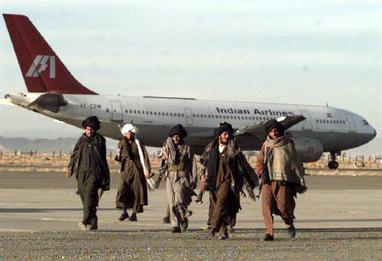
Indian Airlines Flight 814
1999 Indian aircraft hijacking
Indian Airlines Flight 814, commonly known as IC 814, was an Indian Airlines Airbus A300 that was hijacked on 24 December 1999 by five members of Harkat-ul-Mujahideen. The passenger flight, en route from Kathmandu to Delhi, was taken over shortly after it entered Indian airspace at about 16:53 IST. The aircraft had 190 occupants: 179 passengers and 11 crew members including Captain Devi Sharan, First Officer Rajinder Kumar, and Flight Engineer Anil Kumar Jaggia.
The aircraft was flown to Amritsar, Lahore, and Dubai. While in Dubai, the hijackers released 27 passengers plus the body of a male hostage who had been stabbed by the hijackers multiple times. Later, on 25 December, the hijackers forced the aircraft to land in Kandahar in Afghanistan. At the time, most of Afghanistan, including the Kandahar airport, was under the control of the Taliban. External intervention was hindered by Taliban men encircling the aircraft, and by the presence of two officers from the Inter-Services Intelligence of Pakistan. On 27 December after two days of internal discussions, the Indian Government sent a team of negotiators headed by Vivek Katju from the Ministry of Home Affairs, which included officials Ajit Doval and C.D. Sahay. After days of negotiations, India agreed to release three men it had imprisoned for terrorism – Ahmed Omar Saeed Sheikh, Masood Azhar and Mushtaq Ahmed Zargar – in exchange for the hostages.
The hostage crisis ended on 31 December when the passengers and crew were released after the Indian government handed the three prisoners over to the Taliban. Despite Indian expectations that the three former prisoners and the hijackers would be arrested, the men were driven to the Pakistan border and released, and they have since been suspected of involvement in other terrorism-related incidents such as the 2001 Indian Parliament attack, 2002 kidnapping and murder of Daniel Pearl, 2016 Pathankot attack and the 2019 Pulwama attack. India's Central Bureau of Investigation (CBI) charged ten people in relation to the case (with whereabouts unknown for seven including the five hijackers), of whom only two were convicted and sentenced to life imprisonment. The hijacking is a part of the millennium attack plots in late 1999 and early 2000 by Al-Qaeda linked terrorists.
Background
Aircraft
The aircraft involved was an Airbus A300B2-101, registered as VT-EDW with serial number 036 and was powered by two General Electric CF6-50C engines. The aircraft carried 190 occupants which included 179 passengers and 11 crew members. The crew consisted of Captain Devi Sharan, First officer Rajinder Kumar, and Flight engineer Anil Kumar Jaggia. The passengers also included foreign nationals, amongst whom was Roberto Giori, the then-owner of De La Rue Giori, a company that controlled the majority of the world's currency-printing business at the time.
Hijackers
The flight carried five members of Harkat-ul-Mujahideen (HuM) amongst the passengers. As per the Indian ministry of external affairs, the five perpetrators were later identified as Pakistani nationals Ibrahim Athar (from Bahawalpur), Shahid Akhtar Sayeed, Sunny Ahmed Qazi, Zahoor Mistry (all three from Karachi) and Shakir (from Sukkur). The hijackers used the code names Chief, Doctor, Burger, Bhola and Shankar respectively to refer to themselves. Athar is the brother of Masood Azhar and another one of his brother's brothers, Abdul Rauf Azhar, and his brother-in-law, Yusuf Azhar, planned the hijacking.
HuM is an Islamist organisation based out of Pakistan. It had split from Harkat-ul-Jihad-al-Islami (HuI) in 1985 before reuniting in 1993 to form Harkat-ul-Ansar (HuA). However, after HuA was declared a designated terrorist organisation by the United States in 1997, it changed its name back to Harkat-ul-Mujahideen. After its leaders were arrested by the Indian Armed Forces in 1993, the organisation perpetrated various attacks and kidnappings in India to secure the release of their leaders imprisoned in India. These included the killing of two Indian army personnel in 1994 and multiple incidents of kidnapping of Western tourists in 1994 and 1995.
Kathmandu had been a major operational base for Pakistan's Inter-Services Intelligence (ISI) and a hub for other illegal activities. Based on later investigation and statements from others arrested in connection with the incident, the incident was reportedly planned for over two months. The hijackers and their associates made several trips to Kathmandu during this period. The hijack was originally planned for 27 December 1999 but was moved forward later. The tickets for the hijackers were booked through three different tour agencies under false names, and the booking was altered on 13 December. Access to the airport was facilitated through underworld operative Dawood Ibrahim.
Hijacking
On 24 December 1999, the flight took off from Kathmandu en route to Delhi after 16:00 IST. It entered Indian airspace around 16:39, and the passengers and crew were being served refreshments. As chief steward Anil Sharma completed serving the pilots their refreshments, a man wearing a mask and brandishing a revolver and a grenade accosted him and demanded access to the cockpit. At 16:53, the pilot was told that the flight had been hijacked. The Delhi Air Traffic Control was informed of the situation at 16:56.
The hijackers instructed the flight captain to fly west towards the Pakistani air space. The Crisis Management Group (CMG) of the Indian Government led by union secretary Prabhat Kumar was not convened immediately, and the information concerning the hijacking was not communicated at that time to the Intelligence Bureau and the Research and Analysis Wing (RAW). Indian prime minister Atal Bihari Vajpayee was traveling during the incident and was briefed regarding the incident only after he landed in Delhi. He later called an emergency meeting to discuss the situation. Meanwhile, as per later accounts, the hijackers ordered the crew to take away the food that had been served, separated the male passengers from women and children, blindfolded them and threatened them with explosives if they did not cooperate.
Landing at Amritsar and passenger stabbings
At 18:04, captain Sharan radioed the Indian ATC that they had only one hour of fuel left and that the Pakistani ATC had refused permission to land the aircraft at Lahore. He implored the ATC to reach out to Pakistan, as the hijackers did not want to land in India and had threatened to execute ten hostages if their demands were not met. At 18:30, the Indian High Commission in Pakistan requested permission for the plane to land there, which was denied by the Pakistani government. At 18:25, the CMG informed the National Security Guard (NSG) to prepare for a possible rescue mission.
When informed of the fuel shortage, the hijackers allowed the captain to land at the Amritsar airport in India. At 18:44, the flight began its descent towards Amritsar, following a message from the captain to the Indian ATC and the CMG was informed of the same. The Indian home minister L. K. Advani and Director General of Police for the state of Punjab Sarabjeet Singh both later stated that they came to know of the hijacking from the television news rather than being informed by the CMG. As per the official guidelines, Singh asked the Inspector General of Police of the Amritsar area to take charge of the situation. As the officer was on leave, J.P. Birdi, who occupied the position previously, was sent to handle the situation.
At 19:10, as the NSG team was ready to take off to Amritsar, it had to wait as the government negotiators did not arrive in time. On landing at Amritsar, the captain requested immediate refueling of the aircraft. The hijackers refused to communicate with local police officials while the plane was at the airport. Later eyewitness accounts indicated that the hijackers, upset by the delay in refueling, stabbed passengers Satnam Singh and Rupin Katyal with a knife, causing several wounds. The captain made contact with the ATC four times, informing them that the hijackers were armed with Kalashnikov rifles and had begun killing hostages, and requested them to refuel the plane as fast as possible to prevent any additional deaths. Captain Sharan later stated that he had hoped that the ordeal would end with the assistance of Indian government and that the plane would not have to take off again from Amritsar.
Take-off to Lahore
The CMG directed the authorities to ensure that the plane was immobilised at any cost and armed personnel of the Punjab Police were put in position to ensure the same. Meanwhile, the aircraft engines were kept running and the plane stayed on the runway. A refueling bowser was finally dispatched and was parked to the side of the aircraft. As the aircraft started moving, it was ordered to block the aircraft from taking off and it narrowly missed hitting the plane. Then National Security Advisor Brajesh Mishra later revealed that the government had advised for a sniper to be hidden in the bowser, who could shoot if required to disable the plane. Later, it was revealed that this approach caused the hijackers to suspect that the refueling process would prevent their departure, and they ordered captain Sharan to take off immediately, resulting in the plane narrowly avoiding hitting the fuel tanker on the runway.
Content sourced from Wikipedia under CC BY-SA 4.0


