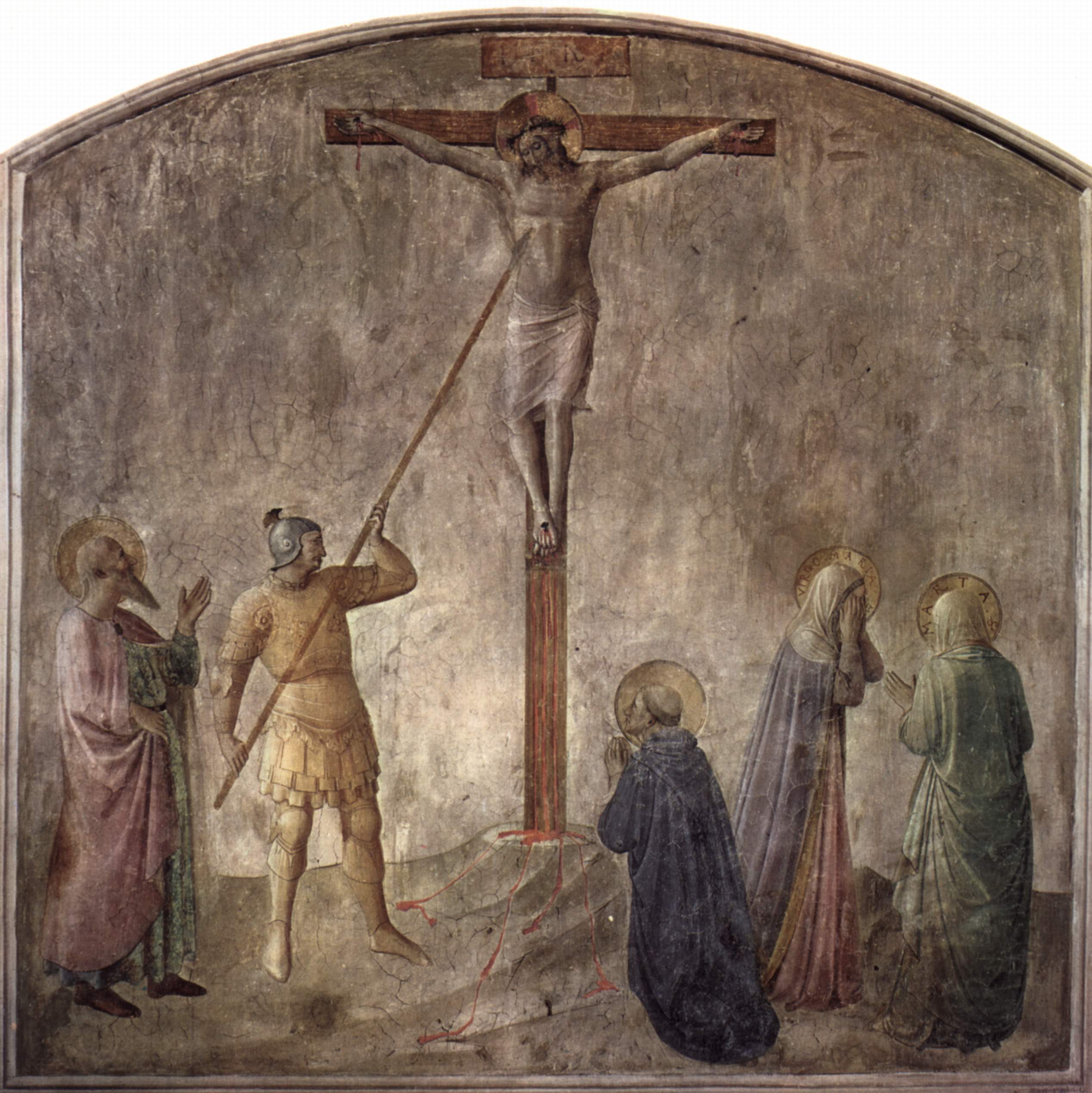
Holy Lance
Lance that pierced Jesus' side as he hung on the cross
The Holy Lance, also known as the Spear of Longinus (named after Saint Longinus), the Spear of Destiny, or the Holy Spear, is alleged to be the lance that pierced the side of Jesus as he hung on the cross during his crucifixion. As with other instruments of the Passion, the lance is only briefly mentioned in the Christian Bible, but later became the subject of extrabiblical traditions in the medieval church. Relics purported to be the lance began to appear as early as the 6th century, originally in Jerusalem. By the Late Middle Ages, relics identified as the spearhead of the Holy Lance (or fragments thereof) had been described throughout Europe. Several of these artifacts are still preserved to this day.
Holy Lance relics have typically been used for religious ceremonies, but at times some of them have been considered to be guarantees of victory in battle. For example, Henry the Fowler's lance was credited for winning the Battle of Riade, and the Crusaders believed their discovery of a Holy Lance brought them a favorable end to the Siege of Antioch.
In the modern era, at least four major relics are claimed to be the Holy Lance or parts of it. They are located in Rome, Vienna, Vagharshapat and Antioch. The most prominent Holy Lance relic has been the one in Vienna, adorned with a distinctive gold cuff. This version of the lance is on public display with the rest of the Imperial Regalia at the Hofburg.
Biblical references
The lance (Greek: λόγχη, lonkhē) is mentioned in the Gospel of John, but not in the Synoptic Gospels. The gospel states that the Romans planned to break Jesus' legs, a method of hastening death during a crucifixion known as crurifragium. Jesus's followers wanted to ensure that he died before the start of the Sabbath at sundown on Friday, so that he could be promptly laid to rest; burials are not traditionally permitted on the Sabbath. Just before they did so, they noticed that Jesus was already dead and that there was no reason to break his legs ("and no bone will be broken"). To make sure that he was dead, a Roman soldier stabbed him in the side.
One of the soldiers pierced his side with a lance (λόγχη), and immediately there came out blood and water.
The Gospel of John does not give the name of the soldier who pierced Christ's side with a lonchē. The oldest known references to the legend, the apocryphal Gospel of Nicodemus, appended to late manuscripts of the 4th century Acts of Pilate, identify the soldier as a centurion and called Longinus (making the spear's Latin name Lancea Longini).
A form of the name Longinus occurs in the Rabula Gospels in the late 6th century. In a miniature, the name ΛΟΓΙΝΟΣ (LOGINOS) is written above the head of the soldier who is thrusting his lance into Christ's side. This is one of the earliest records of the name, if the inscription is not a later addition.
Relics
Rome
A Holy Lance relic is preserved at Saint Peter's Basilica in Vatican City, in a loggia carved into the pillar above the statue of Saint Longinus.
The earliest known references to Holy Lance relics date to the 6th century. The Breviary of Jerusalem (circa 530) describes the lance on display at the Church of the Holy Sepulchre. In his Expositio Psalmorum (c. 540–548), Cassiodorus asserts the continued presence of the lance in Jerusalem. A report by the Piacenza pilgrim (c. 570) places the lance in the Church of Zion. Gregory of Tours described the lance and other relics of the Passion in his Libri Miraculorum (c. 574–594). The holy lance is also supposed to have been stolen from Rome by Alaric and his Visigoths during their plundering in August 410. Therefore it could have been buried together with Alaric among tons of gold, silver and the golden menorah in Cosenza, southern Italy in the fall of 410. Nobody has found Alaric’s tomb and treasure that was probably emptied by the Byzantines, and therefore the holy lance could possibly appear some hundred years later in Jerusalem.
In 614, Jerusalem was captured by the Sasanian general Shahrbaraz. The Chronicon Paschale says that the Holy Lance was among the relics captured, but one of Shahrbaraz's associates gave it to Nicetas who brought it to the Hagia Sophia in Constantinople later that year. However, De locis sanctis, describing the pilgrimage of Arculf in 670, places the lance in Jerusalem, at the Church of the Holy Sepulchre. Arculf is the last of the medieval pilgrims to report the lance in Jerusalem, as Willibald and Bernard made no mention of it.
By the middle of the 10th century, a lance relic was venerated in Constantinople at the Church of the Virgin of the Pharos. The relic was likely viewed by some of the soldiers and clergy participating in the First Crusade, adding to the confusion surrounding the emergence of another Holy Lance at Antioch in 1098. During the Siege of Tripoli, Raymond of Toulose reportedly brought the Antioch lance to Constantinople, and presented it to Emperor Alexios I Komnenos. Scholars disagree on how this presumably awkward situation was resolved. Steven Runciman argued that the Byzantine court regarded the Antioch relic as a nail (ἧλος), relying on Raymond's ignorance of the Greek language to avoid offending him. Alternatively, Edgar Robert Ashton Sewter believed that Alexios intended to denounce the crusaders' lance as a fraud, and that this was accomplished when Prince Bohemond I of Antioch was compelled in 1108 to swear an oath to him on the other lance. Whether Alexios kept the Antioch lance or returned it to Raymond is uncertain. Several 12th century documents state that a single Holy Lance was among the relics at Constantinople, without any details that could identify it as either the crusaders' discovery or the Byzantine spear.
According to Alberic of Trois-Fontaines, a fragment of the Holy Lance was set into the icon that Alexios V Doukas lost in battle with Henry of Flanders in 1204. The capture of this icon by Henry's forces was considered important to many contemporary sources on the Fourth Crusade. In addition to the crusaders' report to Pope Innocent III, the incident was documented by Geoffrey of Villehardouin, the Devastatio Constantinopolitana, Niketas Choniates, Robert de Clari, Ralph of Coggeshall, and Robert of Auxerre. However, none of these sources mention the icon bearing any relics, whereas Alberic claimed it was adorned with the lance fragment, a portion of the Holy Shroud, one of Jesus's deciduous teeth, and other relics from thirty martyrs. Modern historians have regarded Alberic's account with some skepticism, characterizing it as "fanciful" and "pure invention." In any case, after the battle the crusaders sent the icon to Cîteaux Abbey, but there is no record of whether it reached that destination.
Following the sack of Constantinople, Robert de Clari described the spoils won by the newly-established Latin Empire, including "the iron of the lance with which Our Lord had His side pierced," in the Church of the Virgin of the Pharos. However by the 1230s, the Latin Empire's financial state had grown desperate. In 1239, Baldwin II arranged to sell Constantinople's Crown of Thorns relic to King Louis IX of France. Over the next several years, Baldwin sold a total of twenty-two relics to Louis. The Holy Lance was included in the final lot, which probably arrived at Paris in 1242. All of these relics were later enshrined in the Sainte Chapelle. During the French Revolution they were removed to the Bibliothèque Nationale, but the lance subsequently disappeared.
Despite the transfer of the Holy Lance to Paris, various travelers continued to report its presence in Constantinople throughout the late Byzantine period. Of particular interest, John Mandeville described the lance relics in both Paris and Constantinople, stating that the latter was much larger than the former. Although the authenticity of Mandeville's travelogue is questionable, the widespread popularity of the work demonstrates that the existence of multiple Holy Lance relics was public knowledge.
The relics remaining in Constantinople, including the lance, were presumably seized by Sultan Mehmed II in 1453 when he conquered the city. In 1492, his son Bayezid II sent the lance to Pope Innocent VIII, to encourage the pope to continue to keep his brother and rival Cem prisoner. At this time great doubts as to its authenticity were felt at Rome, as Johann Burchard records, because of the presence of other rival lances in Paris, Nuremberg (see Holy Lance in Vienna below), and Armenia (see Holy Lance in Echmiadzin below). This relic has never since left Rome, and its resting place is at Saint Peter's. Innocent's tomb, created by Antonio del Pollaiuolo, features a bronze effigy of the pope holding the spear blade he received from Bayezid.
In the mid-18th century Pope Benedict XIV states that he obtained an exact drawing of the Saint Chapelle lance, to compare it with the spearhead in St. Peter's. He concluded that former relic was the broken point missing from the latter, and that the two fragments had originally formed one blade.
Content sourced from Wikipedia under CC BY-SA 4.0


